

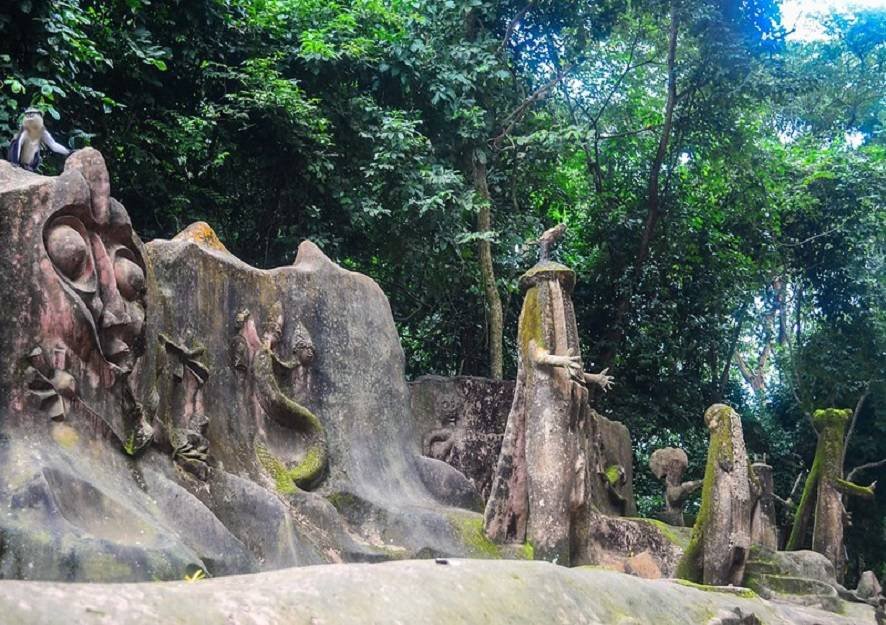
Osogbo, alternatively pronounced Oshogbo is a Yoruba town that is in most instance regarded as the hub of Nigerian art culture. Its art history cannot stand without the Mbari Mbayo, a club that was established for African writers, artists, and musicians in Ibadan before its concept was transferred to Oshogbo.
This began with Jewish German scholar and entrepreneur Ulli Beier. After moving to Nigeria with his Austrian artist wife Susanne Wenger, the couple itched at bridging the existing lacuna between the Western world and Nigerians.
Beier made a conscious effort to know the Nigerian cultural environment and founded the ‘Black Orpheus’ magazine in Ibadan in 1957. Sporadically gaining an international market, there was then patronages by writers and poets both local and international, with the availability of Yoruba text translations.
Following Wenger’s separation from her husband Beier, she formed a circle of artists known as the “New Sacred Art.” She took on the project of rebuilding the Osun Holy Grove in 1960 and became a custodian, nurturing and preserving the place. Today, the grove is a UNESCO World Cultural Heritage site.
Beier, having founded the first Mbari Club in Ibadan in 1961, held art exhibitions to showcase the works of locals. It was during one of such exhibitions that he met dramatist and composer Duro Ladipo who converted his father’s house to open Oshogbo’s own Mbari Mbayo club. (Mbari was an Igbo word for creation).
At that time, Oshogbo was a city of 250,000 people, about 50 miles (80 km) northeast of Ibadan. Ladipo transformed his father’s house into an art gallery and theatre where he produced his plays. In order for the club to become appealing to the locals in Oshogbo, Ladipo constantly made references to Yoruba mythology, drumming, dance, and poetry and soon developed a kind of Yoruba opera.
The Oshogbo club evolved so much so that it did not only cater for artists and intellectuals, but also the lifestyle of the people in the community. Beier and Ladipo, with their ‘Oshogbo school’ in the 1960s, nurtured unemployed primary-school dropouts into fine artists whose works were a true blend of the foreign influences and their Oshogbo traditions. They created fresh and sophisticated art.
The Mbari Mbayo club in Oshogbo became a home where their works would be on display, an initiative that availed the local art scene the rare opportunity to thrive and appeal to international markets.
This movement birthed some of Oshogbo’s greatest artists, including Rufus Ogundele, Adebisi Fabunmi, and Prince Taiwo Olaniyi Oyewale-Toyeje Oyelale Osuntoki, popularly known as Twins Seven-Seven, whose work is influenced by traditional Yoruba mythology and culture, and gods.
Ogundele’s works are a fine blend of the European artist’s influence and traditional Yoruba culture. The power of Ogun, the Yoruba’s god of war, fire, and iron, is a theme that flows through his works.
Fabunmi was a member of the Duro Ladipo ensemble. Be it his yarn paintings or city prints, Fabunmi’s works almost always had the city of Oshogbo as his theme and the Yoruba sculpture effects were also evident in his work.
Today, Oshogbo’s art history is intertwined with the Osogbo Holy Grove, scholar and entrepreneur Beier, Wenger also known as the ‘living goddess’ and dramatist Ladipo.