

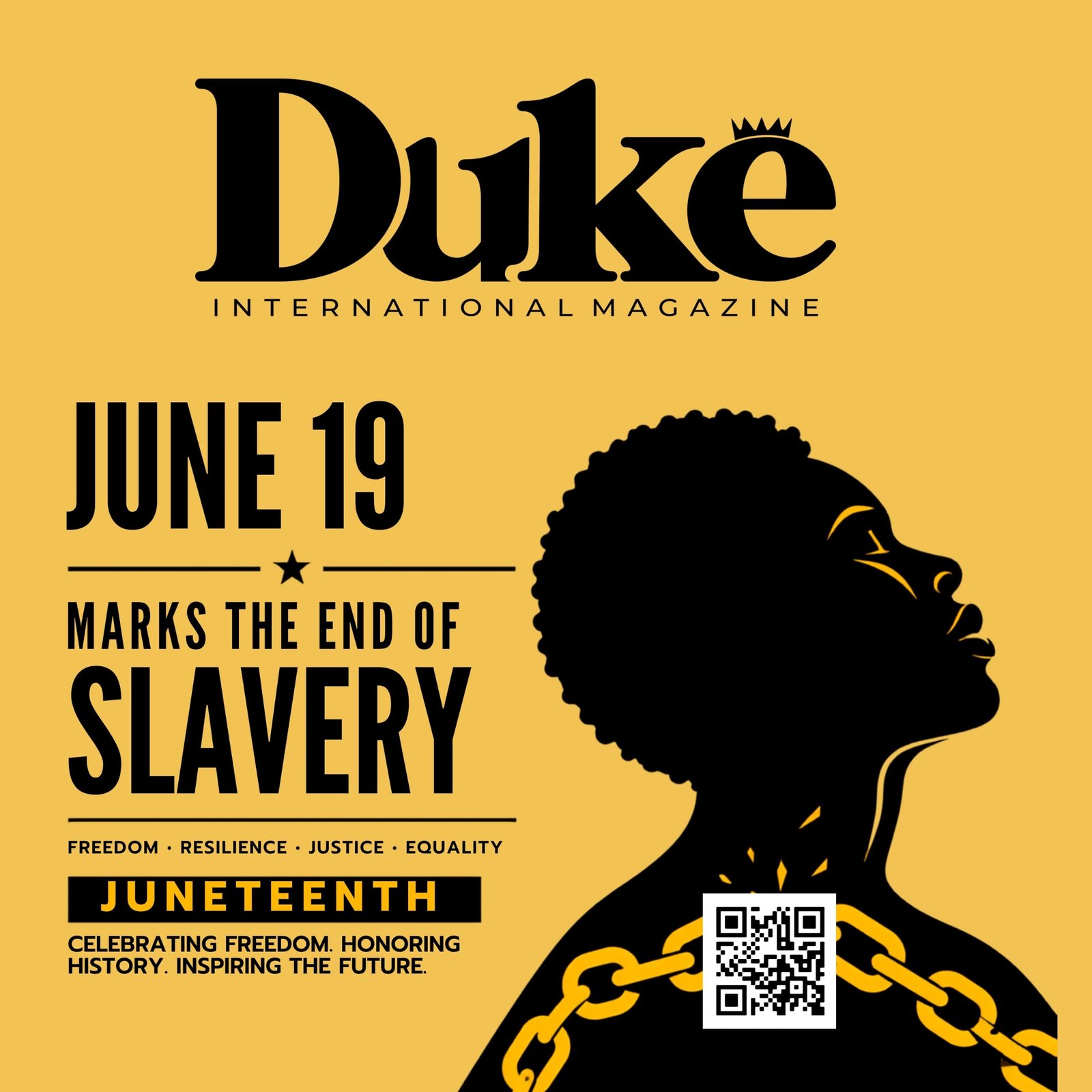
On 19 June 1865, Major General Gordon Granger stepped onto the docks of Galveston, Texas, with 2,000 Union soldiers and a single sheet of paper that rewrote the lives of a quarter of a million people.
General Order No. 3 was blunt: “all slaves are free.” The words landed like a thunderclap, yet they arrived two and a half years after Lincoln’s Emancipation Proclamation. For the enslaved people of Texas, freedom had been delayed by indifference and the absence of federal authority. The news was not granted; it had to be enforced.
This is the story of Juneteenth. But for the Black men who read this magazine, it is also a story about something more specific: the weight of waiting, the burden of proving your manhood in a society that denies it, and the triumph of claiming your dignity when the world tells you it does not belong to you.
The Burden of Black Masculinity
In 1957, a group of former Johnson Publishing Company employees launched Duke magazine, the first men’s magazine marketed to African American men. The cover of that premiere issue featured not a real man, but a mannequin: well-dressed, faceless, with button eyes. That mannequin represented “everyman”, allowing Black readers to see themselves as modern, urbane and sophisticated. He was seen and yet unseen, a phenomenon peculiar to Black masculinity.
That mannequin captures something essential about the Black male experience. For centuries, Black men have been rendered faceless by stereotype: hypervisible as threats, invisible as human beings. He was never allowed to simply be a man; he was always a symbol of something else.
Juneteenth forces us to confront this history head-on. The delay in freedom was not an accident; it was a choice. And that choice was rooted in the same logic that has always underpinned the oppression of Black men: the belief that Black male bodies are property, that Black male lives are expendable, and that Black male freedom is negotiable.
The Dignity of Defiance
Yet Juneteenth is not merely a story of oppression. It is a story of defiance. When the news finally reached Galveston, the celebrations were not just about the end of bondage; they were about the beginning of self-determination. Freed Black men gathered to pray, to sing, to organise, and to build institutions that would sustain their communities for generations.
This is the spirit that Duke International Magazine exists to celebrate. It is the spirit of Black men who break barriers and reach for the stars. It is the spirit of Dan Burley, the editor of the original Duke magazine, who dared to imagine a publication that validated Black men’s pursuit of the good life. That magazine lasted only six issues, but its legacy endures. It proved that Black men wanted to see themselves not as stereotypes, but as the heroes of their own stories.
What Juneteenth Means for Black Men Today
Juneteenth is not a day for passive remembrance. It is a call to action. It asks every Black man to consider what freedom truly means in his own life. Is it financial independence? Is it the freedom to walk down the street without fear? Is it the freedom to love whom you choose, to raise your children with pride, to pursue your passions without apology?
Opal Lee, the activist whose campaign helped make Juneteenth a federal holiday, walked 2.5 miles each day to symbolise the two and a half years it took for freedom to reach Galveston. In September 2016, at the age of 89, she embarked on a cross-country walk to raise awareness. Her journey was a physical manifestation of the work that remains: the work of memory, the work of justice, and the work of building a world where Black men are seen, heard and valued.
As Al Edwards, the Texas state representative who championed Juneteenth’s recognition, once said: “Every year we must remind successive generations that this event triggered a series of events that one by one defines the challenges and responsibilities of successive generations.”
For the Black men reading this magazine, those words carry a particular weight. You are the inheritors of a legacy of resilience. You are the descendants of men who waited two and a half years for news of their own freedom and, when it came, refused to let it be taken away. You are the embodiment of a dignity that no system of oppression could extinguish.
The Work That Remains
Juneteenth reminds us that freedom is not a destination; it is a practice. It is something we must claim, defend and renew every single day. It is the work of building businesses, raising families, writing stories, making art and showing up as full, unapologetic Black men in a world that still too often tries to diminish you.
Duke International Magazine is part of that work. Every story in these pages is a testament to the truth that Black men are not a monolith. You are doctors and dreamers, fathers and fighters, artists and activists. You are the men who defy all odds and redefine success in every way.
On 19 June, we remember that the wait for freedom was long, but it was not in vain. We remember that joy, when it comes, is always worth the fight. And we recommit ourselves to the unfinished work of making that freedom real, for ourselves, for our sons, and for the generations yet to come.
Because when a Black man is free, truly free, the whole world feels a little lighter.