

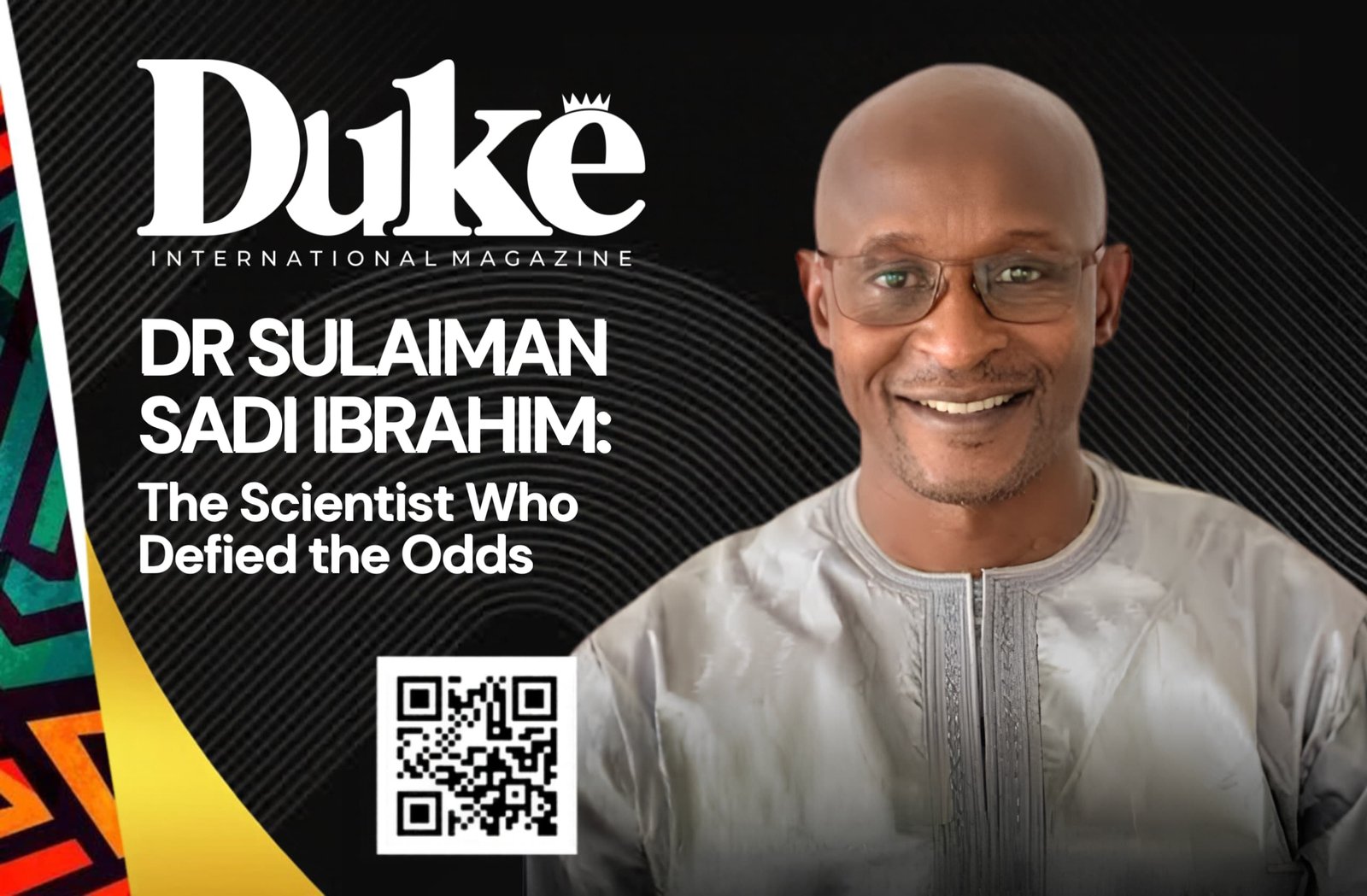
Dr Sulaiman Sadi Ibrahim is a Nigerian biochemist whose recent achievement has placed him at the forefront of global efforts to control malaria.
In 2022, the senior lecturer at Bayero University, Kano (BUK), became the first Nigerian to win the Wellcome Trust Career Development Award, a prestigious United Kingdom research grant worth £969,680, or more than half a billion Naira.
The award is not merely a personal honour; it is a significant moment for Nigerian science and a potential turning point in the fight against one of the country’s deadliest diseases.
Born in 1979 in Getso town, Gwarzo Local Government Area of Kano State, Dr Ibrahim’s path to international recognition was neither linear nor privileged. He studied Biochemistry at BUK and completed his National Youth Service Corps in Ebonyi State between 2003 and 2004.
After returning, he taught biology and chemistry to visually impaired students at the Special Education School in Tudun Maliki, Kano City, between 2004 and 2007, while simultaneously enrolling for a master’s degree. He later worked for a pharmaceutical company before joining the university as an assistant lecturer in 2008.
A Tertiary Education Trust Fund scholarship in 2011 allowed him to study molecular entomology in the United Kingdom, and he obtained a PhD from the Liverpool School of Tropical Medicine in 2015, focusing on the genetic basis of insecticide resistance in malaria vectors.
His breakthrough with the Wellcome Trust came in stages. Between 2016 and 2019, he held a Wellcome Trust International Training Fellowship, which enabled him to establish a molecular biology laboratory and an equipped insectary in the Department of Biochemistry at BUK, complete with an independent solar power supply.
That earlier fellowship also allowed him to conduct research across the Sahel region, including Nigeria, Cameroon, Niger and Chad, investigating the dominant malaria mosquitoes and the molecular mechanisms they use to resist insecticides.
The findings were published in peer-reviewed journals and influenced policy and decision-making, while the laboratory became a resource for students and researchers across Nigeria.
The Career Development Award, awarded in September 2022, builds directly on that foundation. The project spans eight years and addresses a question of growing urgency: as global temperatures rise, which malaria-transmitting mosquitoes will become dominant, and what genetic mechanisms will they use to survive the harsher environment of a warmer world?.
The research specifically targets the cytochrome P450s from the major malaria vector Anopheles funestus, a key factor in insecticide resistance across Africa. By understanding how mosquitoes adapt to rising temperatures and develop resistance to the insecticides used in treated nets and indoor spraying, Dr Ibrahim’s work aims to improve the way these disease-carrying insects are controlled.
The grant is also designed to strengthen research capacity within Nigeria itself. It will improve infrastructural capacity, support both undergraduate and postgraduate students, and fund collaboration with the Centre for Research in Infectious Diseases in Cameroon and the Liverpool School of Tropical Medicine in the UK.
For a country that bears the highest burden of malaria in the world, accounting for 27 per cent of all global cases and 31 per cent of all deaths from the disease, this investment in locally led research is of considerable significance.
Dr Ibrahim’s response to the award has been characteristically grounded. He described it as timely, particularly against the backdrop of protracted industrial action by public universities across Nigeria, and said it proved that lecturers in public universities are internationally competitive.
Reflecting on his journey, he offered a simple but pointed philosophy: “A dream doesn’t become reality through magic; it takes sweat, determination, and hard work”.
Today, Dr Ibrahim continues to work on malaria, disease vectors, insecticide resistance and climate-driven infectious disease dynamics, while leading research capacity-building efforts in Northern Nigeria.
His current research centre in Kano is developing facilities for tropical and infectious disease research, linking local science with global efforts to reduce the malaria burden.
From teaching visually impaired students in Kano to winning one of the world’s most competitive research awards, Dr Sulaiman Sadi Ibrahim has defied the odds not through magic, but through the sweat and determination he speaks of. In doing so, he has shown that world-class science can be done in Nigeria, by Nigerians, for the benefit of the communities that need it most.

