

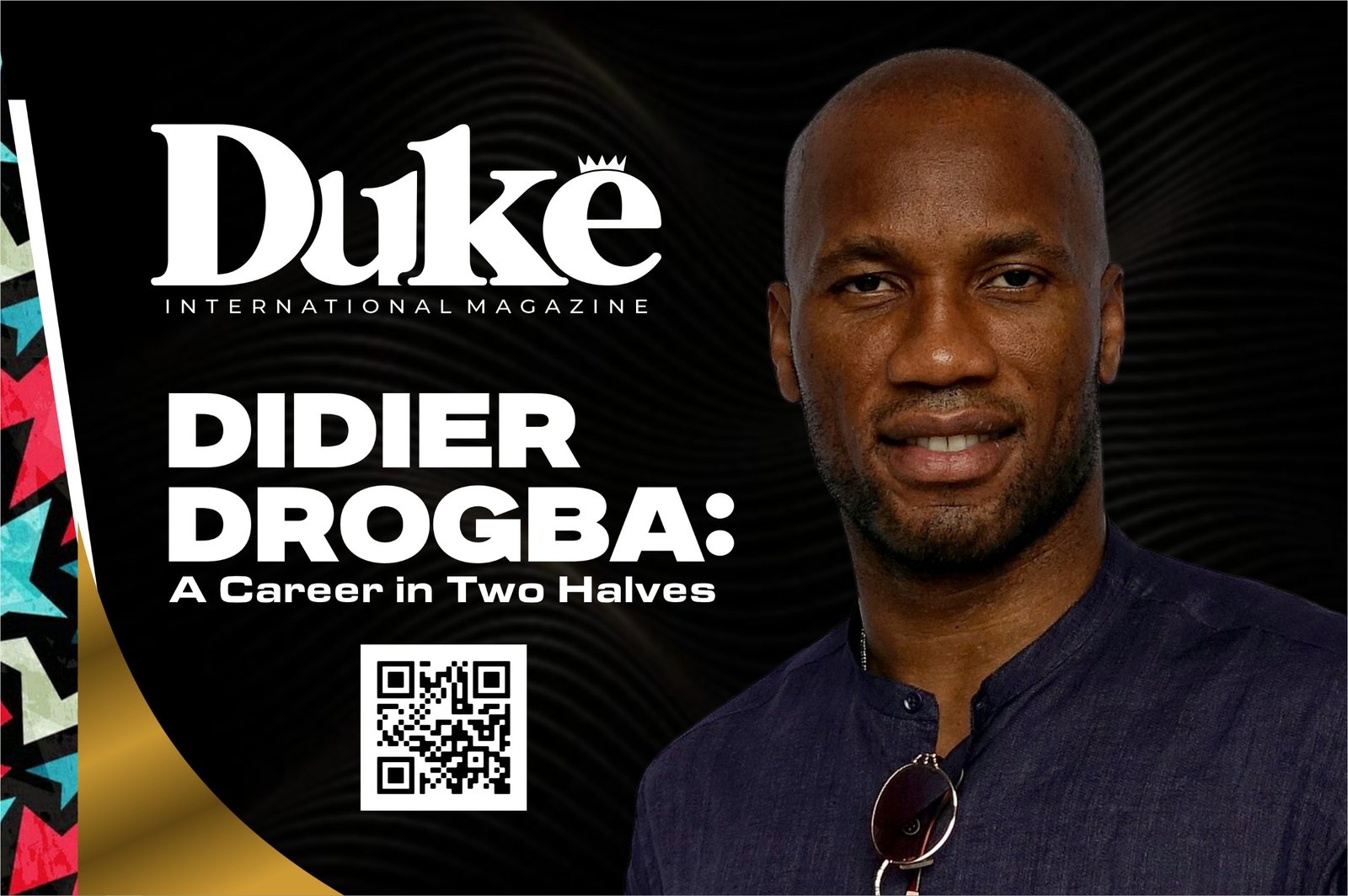
There is no single image that captures Didier Drogba. There are two. The first is athletic and theatrical: the Ivorian striker rising above Bayern Munich’s defence in the 88th minute of the 2012 Champions League final, heading Chelsea level and dragging a tense night towards extra time and a penalty shoot-out.
The second is quieter and far more consequential: Drogba on his knees in a changing room in 2005, speaking directly to camera after Ivory Coast had qualified for their first World Cup, asking the country’s warring factions to lay down their arms.
The footballing case is straightforward. Drogba arrived at Chelsea from Marseille in 2004 and left, at the end of his first spell, as one of the most complete centre-forwards of his generation.
He scored 157 goals in 341 appearances, won four Premier League titles, four FA Cups and three League Cups, and delivered the trophy Roman Abramovich craved above all others. His record of nine goals in nine cup finals for the club underlined a rare appetite for the biggest occasions.
In Munich, with Chelsea trailing to Thomas Müller’s 83rd-minute header, Drogba met a corner with a powerful header of his own to level the score with two minutes remaining. When the final went to extra time and then to penalties, Petr Čech saved from Arjen Robben and later from Ivica Olić, leaving Drogba to convert the decisive kick and seal Chelsea’s first Champions League title.
The broader legacy is more unusual. Drogba’s intervention in 2005 was not a polished piece of statesmanship. It was raw and urgent, delivered by a footballer who realised his sport had given him a platform his country could not ignore.
After Ivory Coast beat Sudan 3-1 away to qualify for their first World Cup, the national team captain, Cyril Domoraud, invited the media into the changing room and handed the microphone to Drogba.
“Men and women of the Ivory Coast,” he said, “we proved today that all Ivorians can coexist and play together with a shared objective.” He then dropped to his knees, his teammates following, and pleaded with the nation to forgive. He asked them to lay down all weapons and to hold elections, warning that the one country in Africa with so many riches must not descend into war.
The moment mattered, though it was one factor among many. By the time Drogba addressed the nation from the Al-Merrikh Stadium in Omdurman on 8 October 2005, the civil war had been raging for three years.
Years of mediation and political negotiation were already under way, and Drogba’s speech formed part of the pressure that pushed the government and the New Forces towards a ceasefire and a restart of peace talks. In early 2007, the two sides signed an official peace agreement.
Drogba has consistently insisted that the peace was not his to claim, crediting the mediators and the political leaders who did the hard work. His role, as he saw it, was to say out loud what ordinary Ivorians already wanted. As he later put it, seeing both leaders side by side for the national anthems made him feel “the Ivory Coast was born again”.
That is why he remains more than a great striker. He was a player of powerful runs, strong headers and big-game goals, but also a public figure who understood that a career can be measured in more than medals. Chelsea supporters will always have Munich. Ivory Coast will always have the kneeling moment. Drogba’s achievement is that he gave both the same seriousness.

