

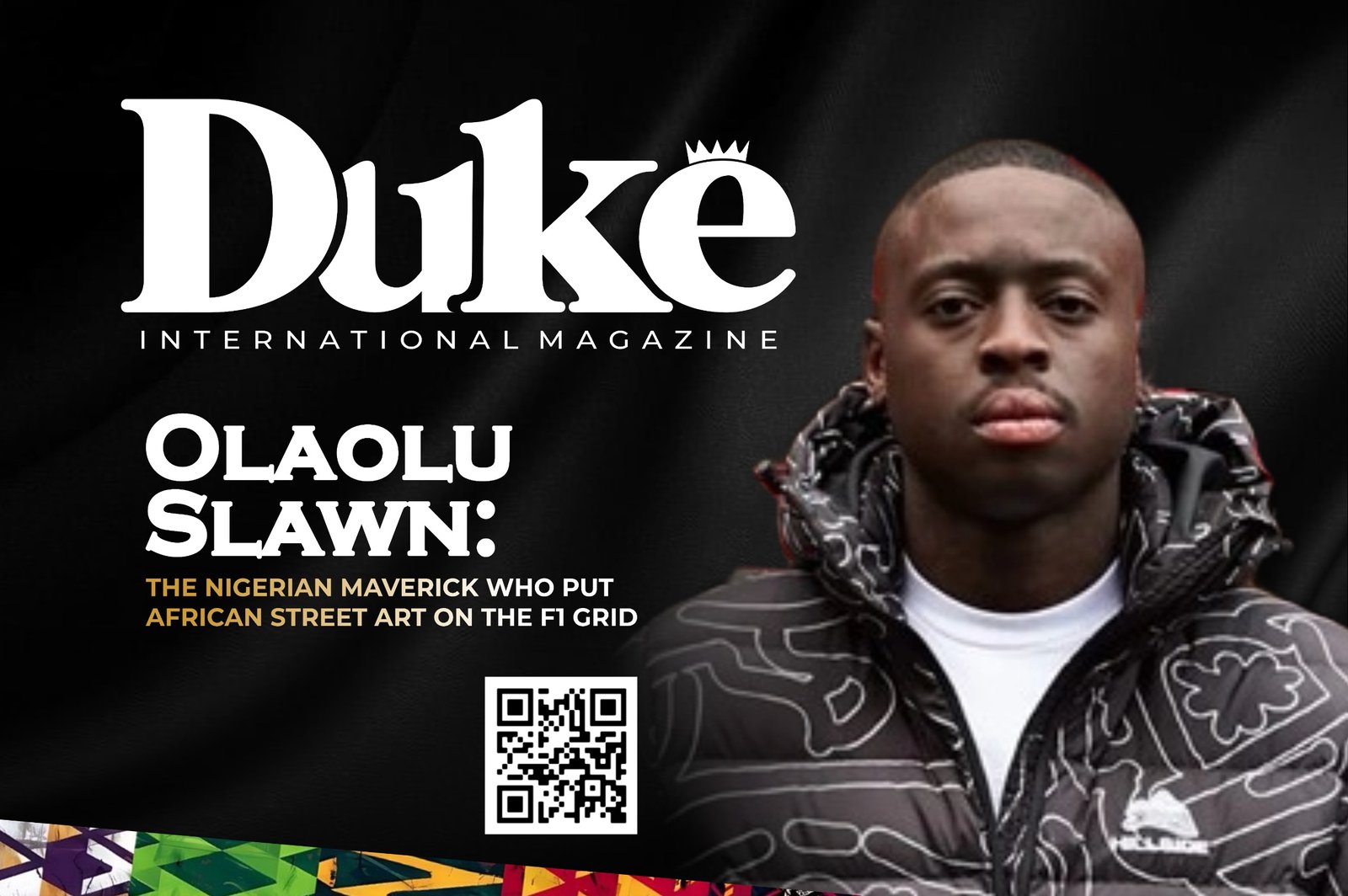
The champagne spray had barely settled at Silverstone when the art world’s tectonic plates shifted permanently. There, emblazoned across the aerodynamic curves of a Formula 1 machine roaring at 200 miles per hour, danced the vibrant brushstrokes of 27-year-old Nigerian artist Olaolu Akeredolu-Ale – better known to the world as Slawn. In that historic moment, the London-based Lagosian didn’t just become the first artist to design an F1 race car livery; he shattered the invisible barriers between street art and high-speed engineering, between African creativity and European motorsport tradition.
Slawn’s journey to this unprecedented collaboration began in the concrete playgrounds of Lagos, where as a teenager he transformed the walls of Wafflesncream – Nigeria’s first skate shop – into kaleidoscopic canvases. Even then, his distinctive style – what he would later describe as “Abstract Expressionism baptised in the rebellious waters of graffiti” – announced itself as something extraordinary. The skate park became his unofficial gallery, the starting grid for an artistic revolution that would eventually conquer global fashion, contemporary art auctions, and now, the sacred tarmac of Formula 1.
The path from Lagos’ street culture to motorsport’s most elite stage was anything but linear. During the 2020 lockdown in London, Slawn made his pivotal transition from co-founder of cult fashion label Motherlan to full-time painter, creating works that pulsed with the same energy as his hometown’s bustling markets and vibrant nightlife. His 2021 debut exhibition at Truman Brewery caught the attention of the art establishment, leading to a landmark Sotheby’s auction where his pieces commanded prices that belied his youth. By 2023, he had become the youngest and first Nigerian-born artist to redesign the iconic Brit Awards statuette, wrapping the music industry’s highest honour in his unmistakable visual language.
When Racing Bulls F1 team and Hugo Boss went searching for a collaborator to redefine their visual identity, they didn’t just find an artist – they discovered a cultural alchemist. Slawn approached the commission with characteristic irreverence and profound respect. “I may not understand the physics making these cars stick to the track,” he admitted with a grin during the design process, “but I understand the physics of making people stop scrolling.” His final design – a dynamic interplay of Yoruba-inspired motifs and bold, streetwise typography – transformed the racing machine into a moving mural, a declaration that African aesthetics belong in spaces traditionally guarded by European exclusivity.
The impact extended far beyond the car’s striking appearance. Slawn’s vision permeated every element of the team’s identity – from the drivers’ race suits featuring his signature “kollective” typography to the pit crew uniforms adorned with his vibrant patterns. Even his East London café, Beau Beau’s, became an extension of the collaboration, temporarily reborn as the Hugo Race Car Café where patrons could sip Nigerian coffee from custom-designed cups while experiencing F1 through state-of-the-art simulators.
What makes this partnership truly revolutionary isn’t merely its visual audacity, but its symbolic weight. Formula 1, long considered the preserve of traditional sponsors and conservative design, has embraced a new paradigm. In Slawn’s hands, the racing livery – typically treated as corporate real estate – becomes a canvas for cultural storytelling. His designs whisper of Lagos’ bustling markets in the pits of Monaco and shout Yoruba proverbs along the straights of Monza.
As the art world continues to debate boundaries and belonging, Slawn’s work offers a resounding answer: true creativity knows no limits. Whether through his ongoing collaborations with luxury houses like Louis Vuitton, his ambitious plans to establish a contemporary art space in Lagos, or his groundbreaking F1 intervention, he proves that the most powerful art doesn’t wait for invitation – it creates its own platforms.
On that Sunday at Silverstone, as Slawn’s design streaked past the chequered flag, it carried more than just Racing Bulls’ hopes for points. It carried the aspirations of every young artist told their vision doesn’t belong in hallowed spaces. The message was clear: the future of art isn’t confined to galleries – it’s wherever daring creators like Slawn decide to make their mark. And if the past is any indication, his next canvas could be anywhere – perhaps even reimagining the Queen’s Guard uniforms, as he once joked, or maybe something far more unexpected. In Slawn’s world, the only predictable thing is the relentless pursuit of beautiful disruption.