

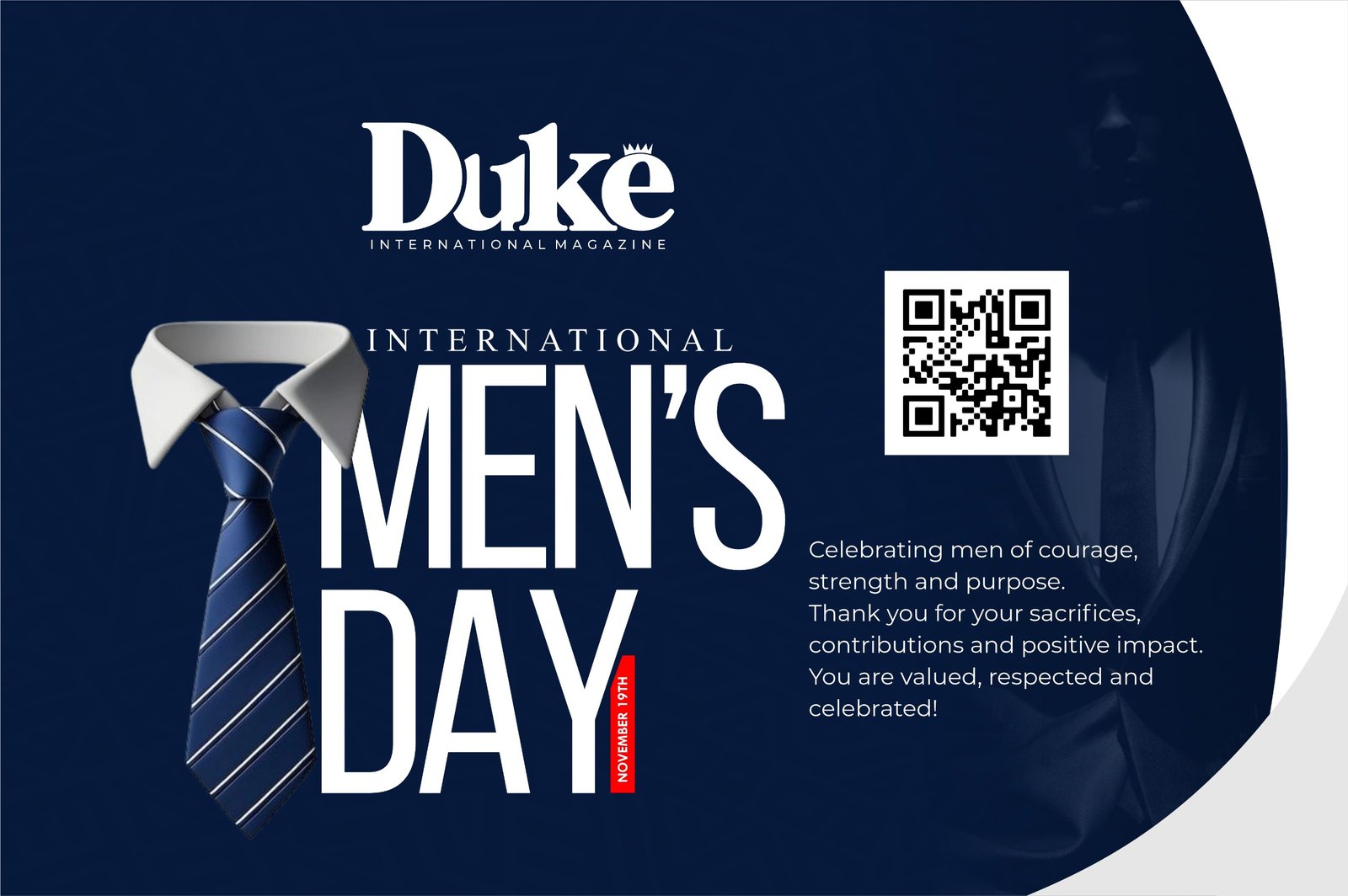
Every November, a quiet revolution takes place. It does not always make headlines, but it is reshaping how we talk about manhood, wellbeing and the everyday heroism of men and boys. International Men’s Day, observed on 19 November, is no longer just a date on the calendar. It has become a global checkpoint for a conversation that is long overdue.
For Duke International Magazine, a publication dedicated to enriching Black male culture and dignity, International Men’s Day is not a token gesture. It is a call to action. This year, our campaign rightly celebrates men of courage, strength and purpose.
We honor their sacrifices, contributions and positive impact. But to truly value and respect the men in our lives, we must do more than applaud the polished exterior. We must look beyond the armor they wear every single day.
The modern iteration of International Men’s Day was formally inaugurated in 1999 by Dr Jerome Teelucksingh, a history lecturer from Trinidad and Tobago. His motivation was deeply personal.
He wanted to promote positive male role models and honour his father’s birthday. What began as a small observance has grown into a movement celebrated in more than 80 countries, with the Indian celebration now recognised as the single biggest in the world.
Crucially, International Men’s Day was never designed to compete with International Women’s Day. Its six foundational pillars make that clear.
They call for promoting positive male role models, celebrating men’s contributions, focusing on men’s health and wellbeing, highlighting discrimination against men, improving gender relations and creating a safer world for everyone. As Dr Teelucksingh himself noted, the day should not be in opposition to International Women’s Day.
Celebration must go hand in hand with honesty. The data on men’s wellbeing paints a stark picture that demands our attention. Globally, men account for an estimated 72 percent of all suicides, with an age standardised rate of 13.9 per 100,000 compared with 5.0 per 100,000 for women. Some analyses place the male share of suicide deaths even higher, at between 75 and 80 percent.
Men are also 60 percent more likely than women to die prematurely from noncommunicable diseases such as heart disease and diabetes, yet they are significantly less likely to seek mental health support, often due to stigma, gender norms and barriers within healthcare systems.
These are not abstract numbers. They represent fathers, brothers, friends and colleagues who are suffering in silence. An epidemic of loneliness among men is increasingly being discussed, alongside pressures created by patriarchal expectations that harm men too.
The conversation around toxic masculinity and the prevalence of male suicide is no longer fringe. It is central to the wellbeing of our communities. This is the heavy armor that the suit and tie so often represent. It is the expectation to remain stoic, to provide without complaint and to never let the world see the cracks beneath the tailored fabric.
If the crisis is real, so is the solution. The first pillar of International Men’s Day calls for the promotion of positive male role models, not just movie stars and athletes, but everyday working class men who are living decent, honest lives. This is where the Duke ethos truly shines.
Duke International Magazine was built on the belief that Black men thriving in their careers, families and communities deserve to be seen and celebrated.
The magazine has profiled figures like Soso Soberekon, whose journey from Delta State to becoming a key architect of Nigerian talent is a masterclass in strategy and vision for the long term. These are the stories that counter the noise. They are narratives of men who build, mentor and lead with integrity.
This year’s 2026 theme, “The Future Is Everyone,” expands the vision by promoting inclusion and genuine equality for all genders. It builds on the spirit of previous years, including the 2025 focus on celebrating men and boys. The message is clear. A better future cannot be built by one gender alone.
Celebration without action rings hollow. International Men’s Day offers a practical framework for change, and there are simple yet powerful ways to engage. In the workplace, consider organising a Walk and Talk or a morning tea with a guest speaker on men’s wellbeing. Recognise the great male colleagues who mentor, support and lead by example.
In schools and universities, create space to celebrate positive male role models and support boys who are navigating their own paths to manhood. In our families and friendships, the most radical act may simply be checking in genuinely and without judgment on the men we love.
For Duke International Magazine, the commitment is editorial and cultural. By continuing to profile Black men who embody courage, resilience and responsibility, we contribute to a narrative that is too often missing from mainstream media. We amplify the everyday dukes, the entrepreneurs, the fathers, the mentors and the men who show up.
International Men’s Day is not about putting men on a pedestal. It is about seeing them clearly, their contributions and their struggles, their strength and their silence. It is about creating a world where a man does not have to choose between being strong and being well.
As our campaign reminds us, these men are valued, respected and celebrated. They are men of courage, strength and purpose. We are celebrating men and boys, not a caricature of masculinity, but the real, complex and vital presence of men in our lives. As the 2026 theme declares, the future is everyone. And that future begins with the conversations we are brave enough to have today.

