

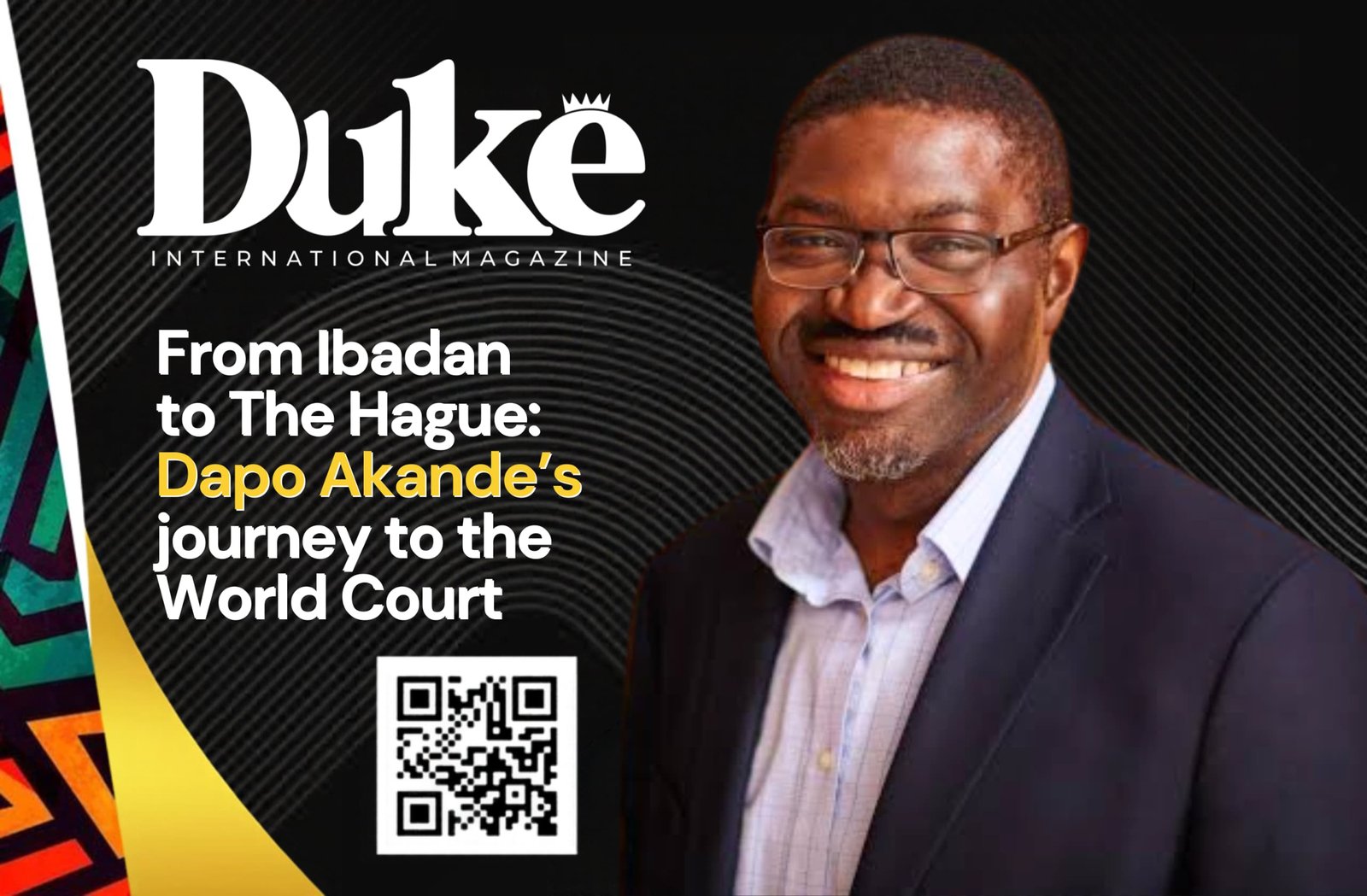
Dr Dapo Akande’s path to the International Court of Justice began not in the grand chambers of The Hague, but in Ibadan, where he was raised and first trained as a lawyer.
He qualified as a barrister and solicitor at the Nigerian Law School in 1993, after taking his LLB at the University of Ife, now Obafemi Awolowo University. From there he went to the London School of Economics for an LLM, and later to Oxford for an MA.
Today he is the Chichele Professor of Public International Law at Oxford, a Fellow of All Souls College and co-director of the Oxford Institute for Ethics, Law and Armed Conflict. He is also a practising barrister at Essex Court Chambers, and since 2021 has served on the United Nations International Law Commission for the 2023 to 2027 term.
His nomination to the Commission was itself a landmark: he was the first candidate ever to be put forward jointly by the United Kingdom and Nigeria, and the first to be nominated by states from four different UN regional groups.
Akande’s reputation rests on a career spent moving between scholarship and practice. He has acted as counsel, adviser or expert before the International Court of Justice, the International Criminal Court, the International Tribunal for the Law of the Sea and the European Court of Human Rights, among other tribunals.
His casework has ranged from the Chagos Advisory Opinion, where he acted for Zambia, to the Genocide Convention case brought by The Gambia against Myanmar, where he represented the United Kingdom as intervenor. He has also advised governments across the UN’s regional groups and organisations including the African Union and the Commonwealth Secretariat.
In November 2026, that breadth of experience carried him to the bench of the International Court of Justice. He was elected by an absolute majority in the first round of voting in both the UN General Assembly and the Security Council, and will take his seat in The Hague on 6 February 2027 for a nine-year term.
His election restores British representation on the court after nearly a decade, following Sir Christopher Greenwood’s defeat in 2017.
Akande greeted the result with characteristic restraint. “I am deeply honoured to be elected to the International Court of Justice,” he said. “I pledge to serve with independence and to decide cases on the basis of a faithful and impartial application of the law.” Lord Chancellor Alex Norris, who backed his candidacy, described him as bringing “the independence, legal rigour, judgment and breadth of perspective that the court needs” at a moment when international law is under pressure.
For a lawyer who began his career as a research assistant to Judge Bola Ajibola, the move to the World Court is the culmination of a career built on quiet, cross-border scholarship rather than loud proclamation.
In a field often shaped by national interest, Akande has built a reputation for independence and rigour that travels well beyond any single state. His arrival at the ICJ will be watched closely not only because of what it means for Britain, but because of what it says about the kind of international lawyer the court now needs.

