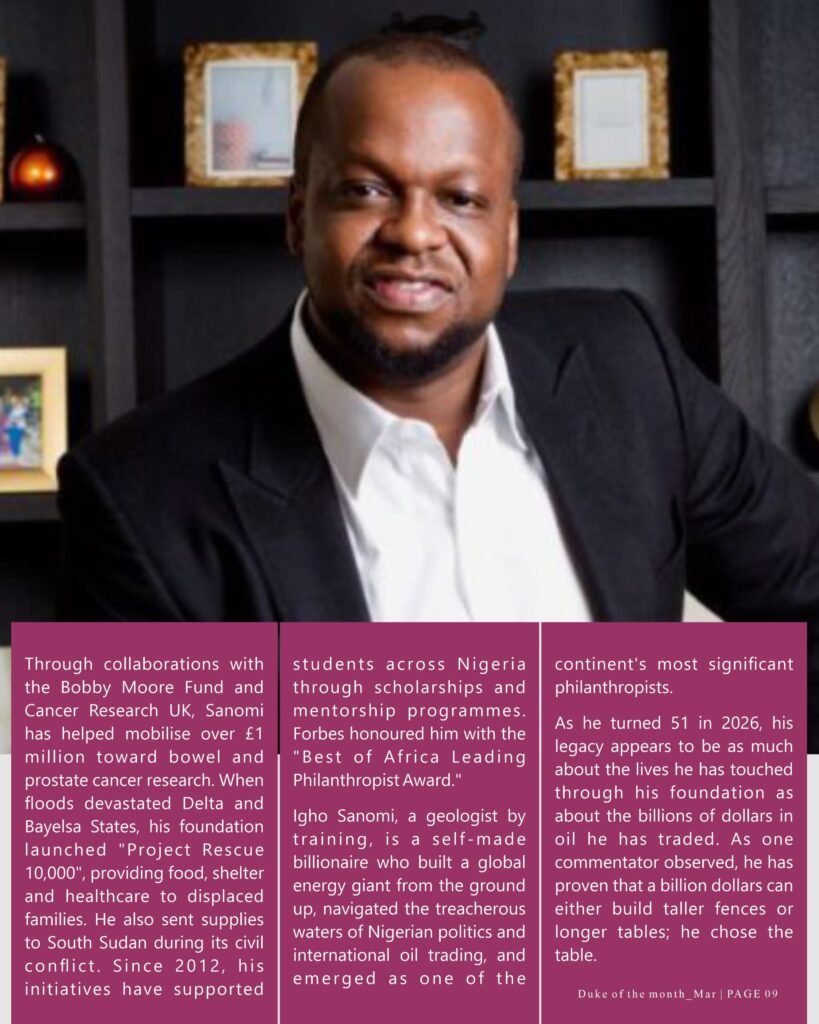


This month, Duke International Magazine celebrates two men who built empires not with noise, but with nerve. Igho Sanomi turned a geology degree into a global commodities powerhouse, then gave millions back through his foundation.
Michael B. Jordan transformed years of steady work into an Oscar-winning performance and used his platform to open doors for others. One trades oil. The other trades stories. Both trade in excellence. Both prove that the most impressive legacy is not what you accumulate, but what you give away.

The Crown of Horror: How Micheal B. Jordan Ascended to Oscar Glory
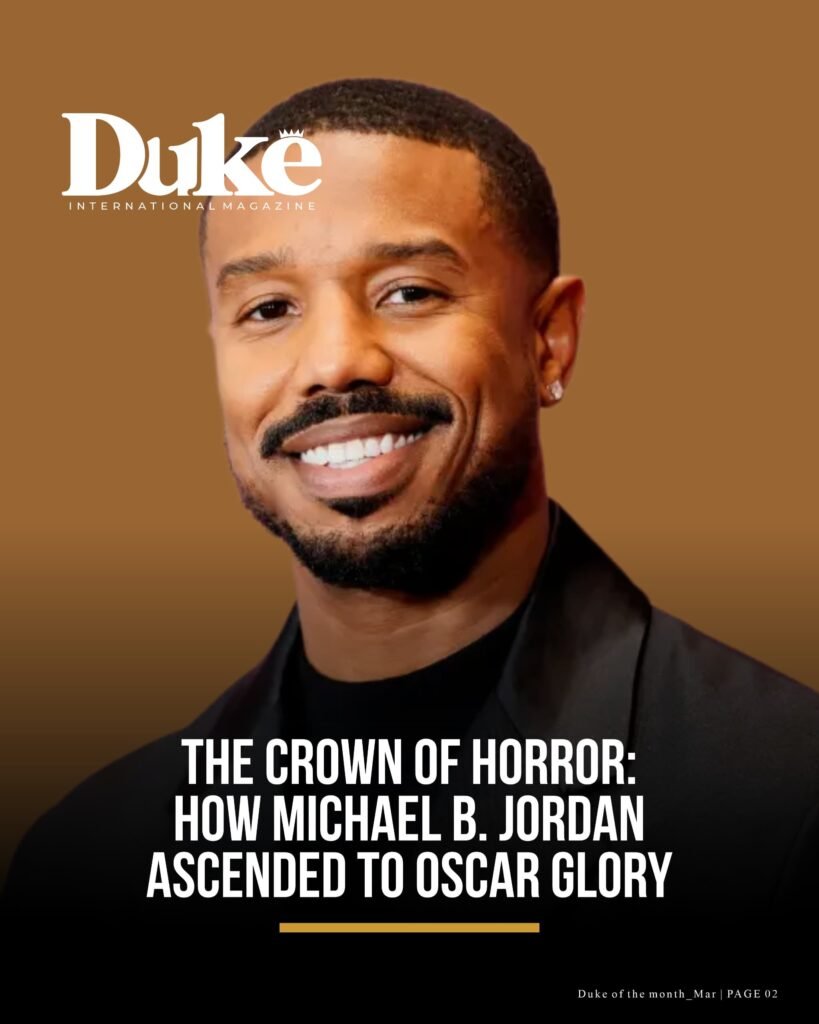
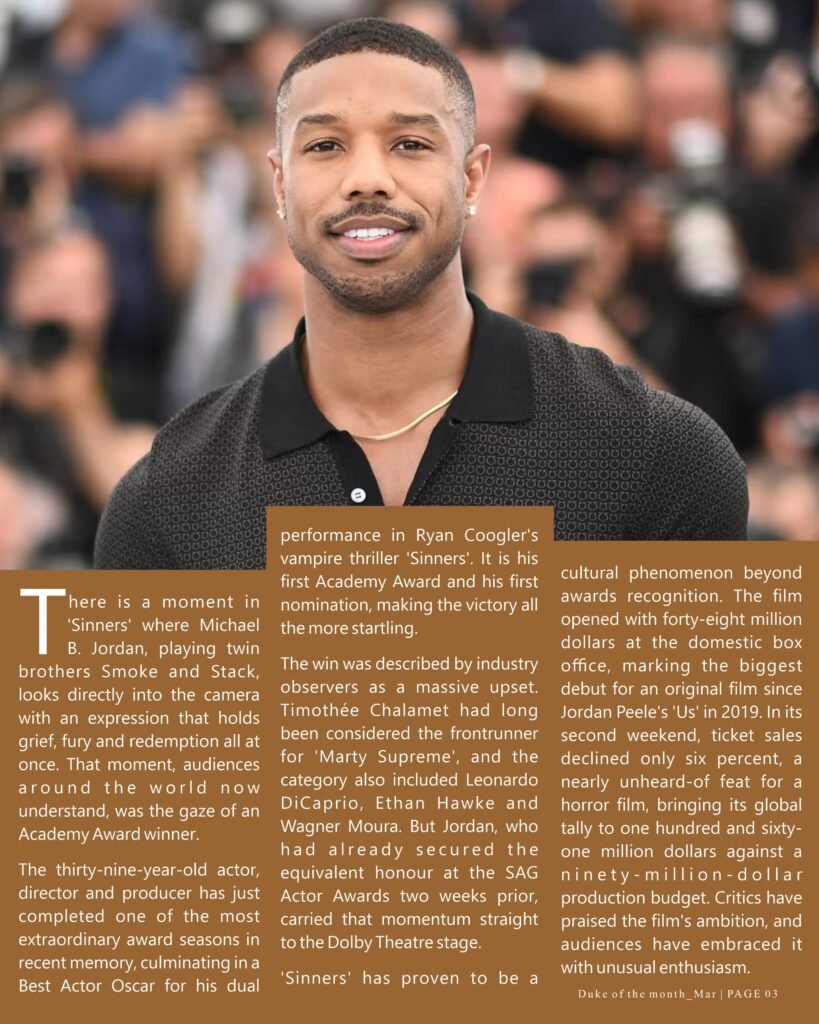
There is a moment in ‘Sinners’ where Michael B. Jordan, playing twin brothers Smoke and Stack, looks directly into the camera with an expression that holds grief, fury and redemption all at once. That moment, audiences around the world now understand, was the gaze of an Academy Award winner.
The thirty-nine-year-old actor, director and producer has just completed one of the most extraordinary award seasons in recent memory, culminating in a Best Actor Oscar for his dual performance in Ryan Coogler’s vampire thriller ‘Sinners’. It is his first Academy Award and his first nomination, making the victory all the more startling.
The win was described by industry observers as a massive upset. Timothée Chalamet had long been considered the frontrunner for ‘Marty Supreme’, and the category also included Leonardo DiCaprio, Ethan Hawke and Wagner Moura. But Jordan, who had already secured the equivalent honour at the SAG Actor Awards two weeks prior, carried that momentum straight to the Dolby Theatre stage.
‘Sinners’ has proven to be a cultural phenomenon beyond awards recognition. The film opened with forty-eight million dollars at the domestic box office, marking the biggest debut for an original film since Jordan Peele’s ‘Us’ in 2019.
In its second weekend, ticket sales declined only six percent, a nearly unheard-of feat for a horror film, bringing its global tally to one hundred and sixty-one million dollars against a ninety-million-dollar production budget. Critics have praised the film’s ambition, and audiences have embraced it with unusual enthusiasm.
The NAACP Image Awards, held in February, saw Jordan take home two statues: Outstanding Actor in a Motion Picture and the evening’s top honour, Entertainer of the Year, beating out Cynthia Erivo, Doechii, Kendrick Lamar and Teyana Taylor. ‘Sinners’ as a film won thirteen Image Awards from a leading eighteen nominations, including Best Motion Picture.
Jordan’s ascent has been decades in the making. His first major role came opposite Keanu Reeves in ‘Hardball’ twenty-five years ago. He then appeared as Wallace on the seminal television drama ‘The Wire’ in 2002 and as Vince Howard on ‘Friday Night Lights’. But his career took a decisive turn in 2013 when he earned critical acclaim for portraying Oscar Grant in Ryan Coogler’s debut feature, ‘Fruitvale Station’.
That collaboration has become one of the most fruitful partnerships in modern cinema. Jordan has now starred in every single feature film Coogler has directed, including both ‘Black Panther’ films and the first ‘Creed’ film. Their collective work has earned twenty-nine Academy Award nominations. Jordan made his directorial debut with ‘Creed III’, which crossed the one hundred million dollar mark at the global box office and broke records for the franchise.
The Santa Ana, California native is currently in post-production on ‘The Thomas Crown Affair’, in which he will also star. Warner Bros has also landed a deal for an untitled new film based on an original script by Coogler, reuniting the pair once again.
What makes Jordan’s Oscar victory particularly significant is the company it places him in. Before Sunday night, only five African American men had won the Best Actor Oscar over ninety-seven ceremonies. Jordan became the sixth. In a career defined by playing men who fight against impossible odds, he has now secured a victory that no amount of boxing training could have prepared him for.
The actor has spoken little about the win in the days following the ceremony, preferring instead to let the work speak for itself. But those who know him say the moment has not yet fully landed. After fifteen years of steady ascent, from the streets of ‘The Wire’ to the vampire-haunted juke joints of ‘Sinners’, Michael B. Jordan has finally claimed his place among the greats. And at thirty-nine, he is only just getting started.
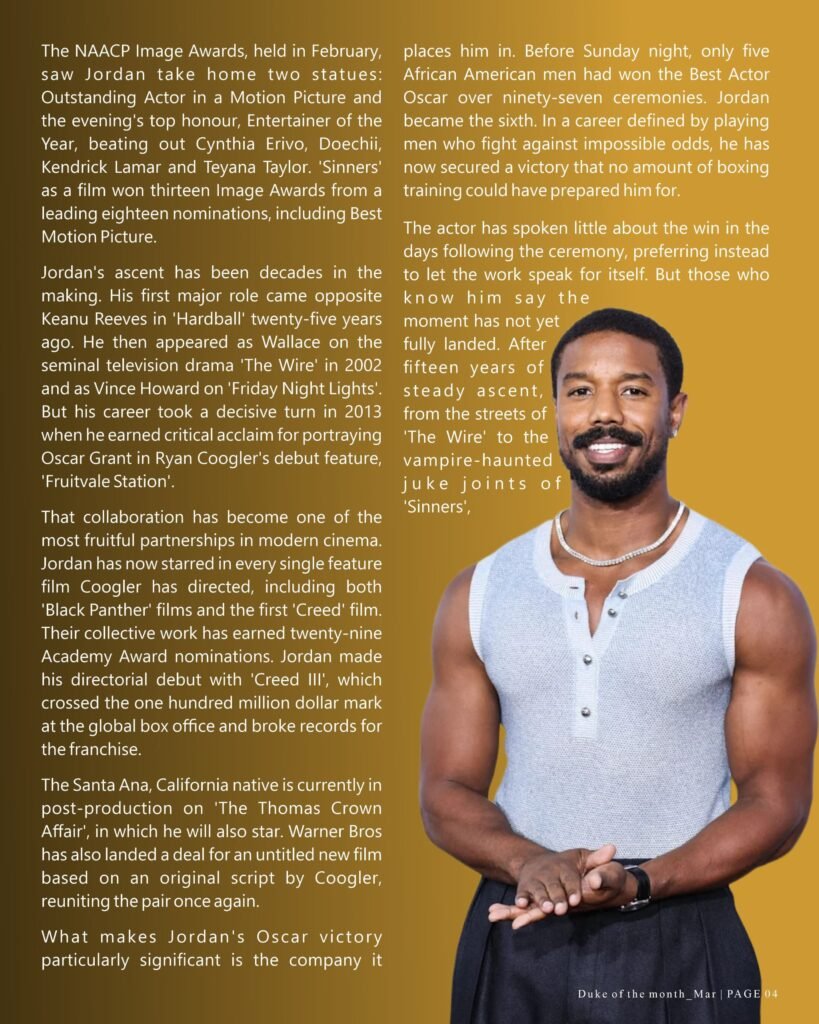
For young actors of colour watching from home, the message of Jordan’s victory is unmistakable. He has proven that a Black man can win the highest acting honour not for a civil rights biopic or a story of suffering, but for a horror film about twin brothers fighting vampires in the American South.
That genre films, often dismissed by award voters, can carry the same emotional weight as any period drama. That a former child actor from Santa Ana can grow into a mogul, a director and now an Oscar winner without losing the humility that first endeared him to audiences.
His production company, Outlier Society, continues to champion inclusive storytelling behind the camera as well. The company has a first-look deal with Amazon and has shepherded projects that prioritise diverse directors and writers. Jordan has spoken openly about using his leverage to ensure that the crews working on his films reflect the world they depict on screen. That commitment, long a talking point, now has the validation of an Oscar to bolster its reach.
Looking ahead, the question is no longer whether Michael B. Jordan can succeed. The question is what ceiling remains unbroken, he has already acted, directed and produced. He has won the Oscar, the SAG Award and the NAACP Image Award for Entertainer of the Year. He has a franchise in ‘Creed’, a universe in ‘Black Panther’ and a growing slate of original projects.
For Duke Magazine and its ‘Duke of the Month’ series, Michael B. Jordan represents a figure whose excellence transcends the screen. He is a builder, a barrier-breaker and a reminder that exceptionalism is not about luck. It is about showing up, year after year, and daring to do the work that no one else will.
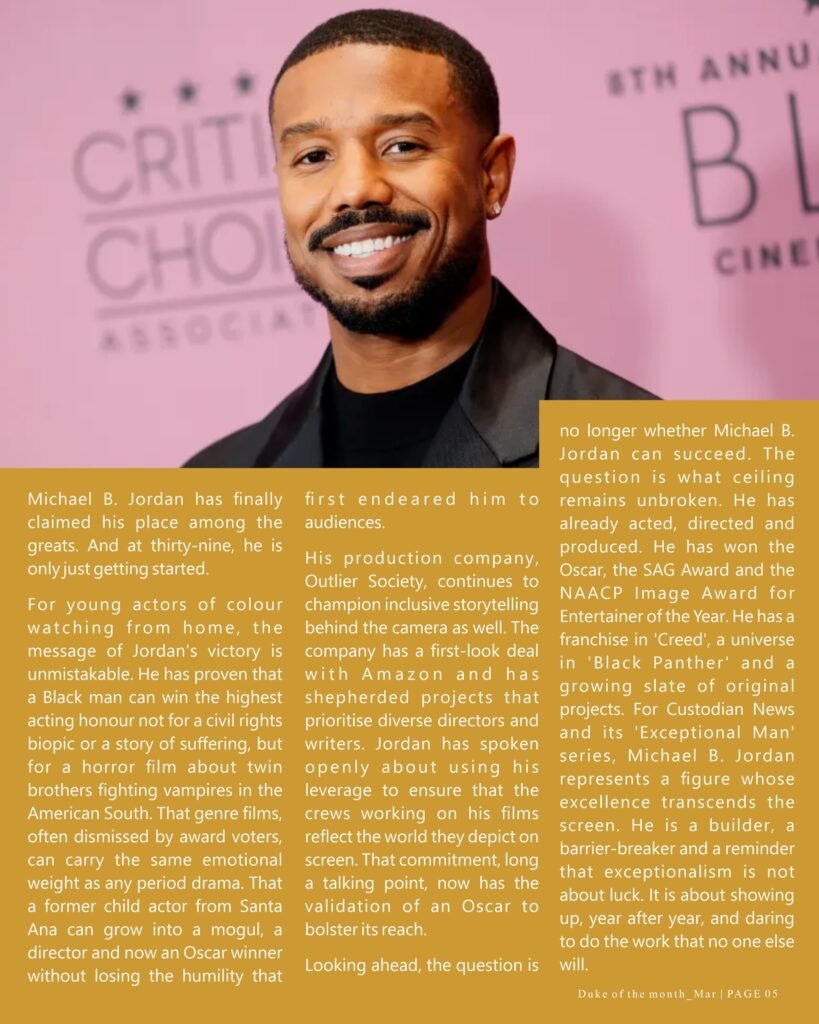
The Quiet Tycoon: Igho Sanomi’s Journey from Geologist to Global Trader
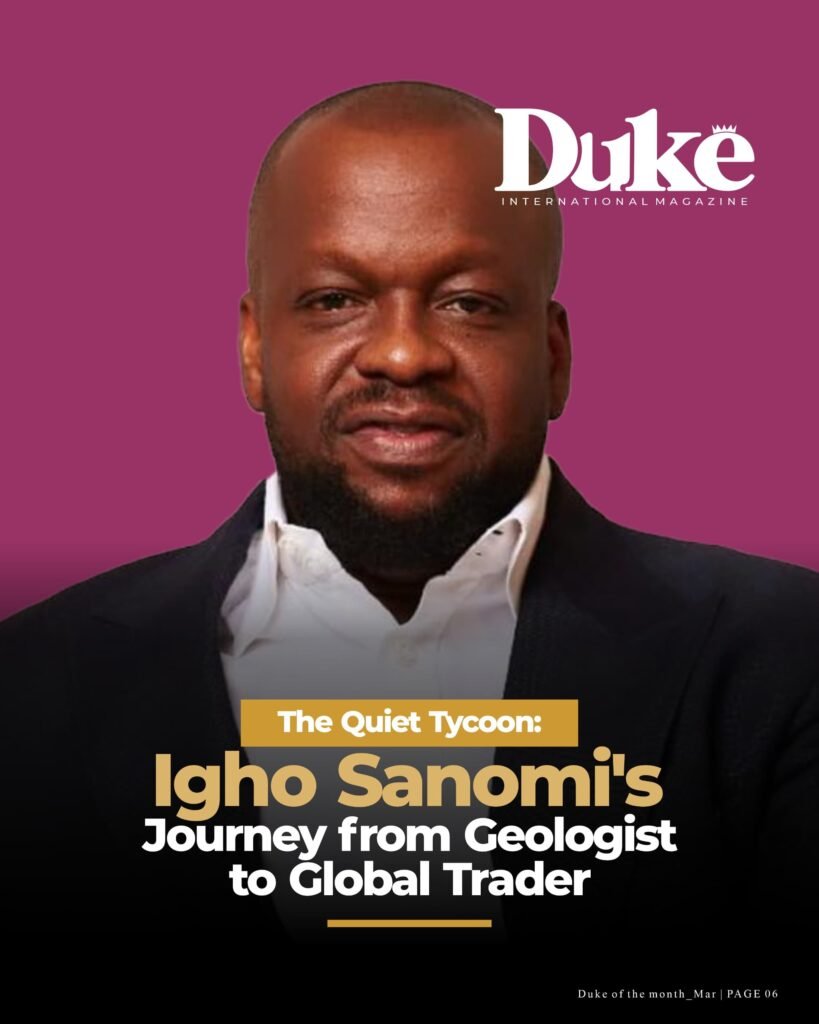
Igho Sanomi is famously media-shy. The Nigerian energy magnate has spent most of his career building a multi-billion dollar commodities trading firm from the ground up, while quietly giving away millions to healthcare and education.
Born in Agbor, Delta State, as the fifth child and first son of a Catholic family, Sanomi grew up in a disciplined household. His father was a retired Assistant Inspector General of Police; his mother is a tribal chief and former nurse.
After earning a geology degree from the University of Jos, Sanomi did not seek conventional employment. Instead, he spotted a gap in Nigeria’s downstream oil and gas industry. During the early 2000s, local companies that won fuel import contracts lacked technical capacity and would simply resell their bids. Sanomi offered to execute their contracts for them, promising higher profits than reselling.
He partnered with a Swiss oil player, learned physical trading, saved start-up capital, and built connections with international financial institutions. He founded Sarian Oil around 2000, which later rebranded to Taleveras in 2004.
Taleveras has since grown into an international commodities trading firm active across crude oil, refined products, natural gas and power. According to Forbes, the company trades over 100 million barrels of crude oil annually, plus millions of tonnes of gasoline, LPG and jet fuel, with an annual turnover of several billion dollars. Sanomi is the controlling shareholder.
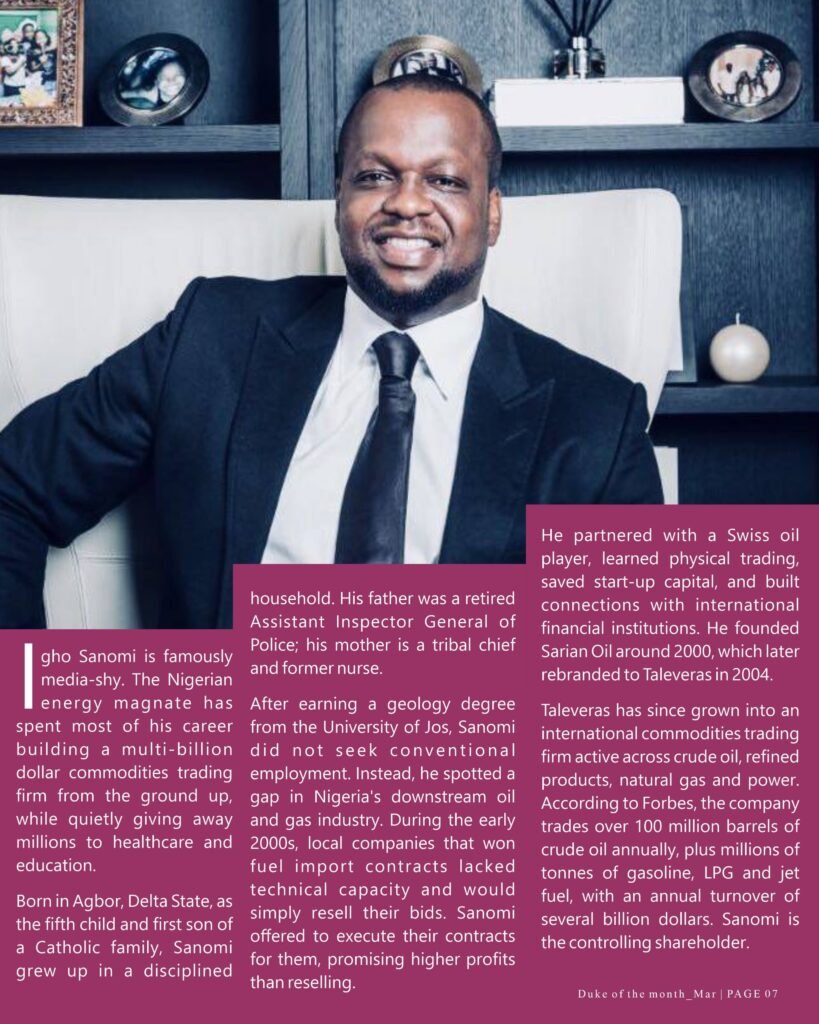
The group’s reach extends beyond trading. Taleveras holds stakes in two Nigerian oil blocks and has production sharing contracts for three offshore blocks in Ivory Coast. In 2013, it sold a 65% stake in one upstream project to Lukoil of Russia. Taleveras also entered Nigeria’s power sector, acquiring Afam Power and signing a technical agreement with Alstom to rehabilitate the 776-megawatt Afam plant. At its peak, the company moved more than 170 million barrels of crude and products annually.
Despite this success, Sanomi’s journey has not been without controversy. In December 2014, his company failed to renew a crude-for-product exchange contract it had operated for over three years, a decision that dealt a significant financial blow.
Sanomi has long faced allegations of sweetheart deals, which he consistently refutes. In a rare 2017 interview, he explained that both the Jonathan and Buhari administrations focused on local content development, and Taleveras won its contracts fairly by meeting the criteria.
More recently, Sanomi appeared in headlines due to a UK bribery trial. In April 2026, statements he made to UK investigators were read in Southwark Crown Court in the case against former Nigerian oil minister Diezani Alison-Madueke. Sanomi explained that foreign currency exchange was difficult in Nigeria, and he obtained items on the minister’s behalf in London for reimbursement. He maintained that his companies always won contracts fairly, without improper involvement from the minister.
In a rare public statement on his business philosophy, Sanomi said: “All I ever wanted to do was to quietly build a successful company, keeping to the old traditional way of doing business with a handshake, and performing the contracts we got very well.”
Philanthropy is perhaps the most defining feature of Sanomi’s life. In 2011, he and his siblings founded the Dickens Sanomi Foundation to commemorate their father, funded by Taleveras.
In 2023, the foundation helped raise over N100 million for children battling life-threatening conditions. In 2025, it raised a further N300 million for life-saving medical interventions.
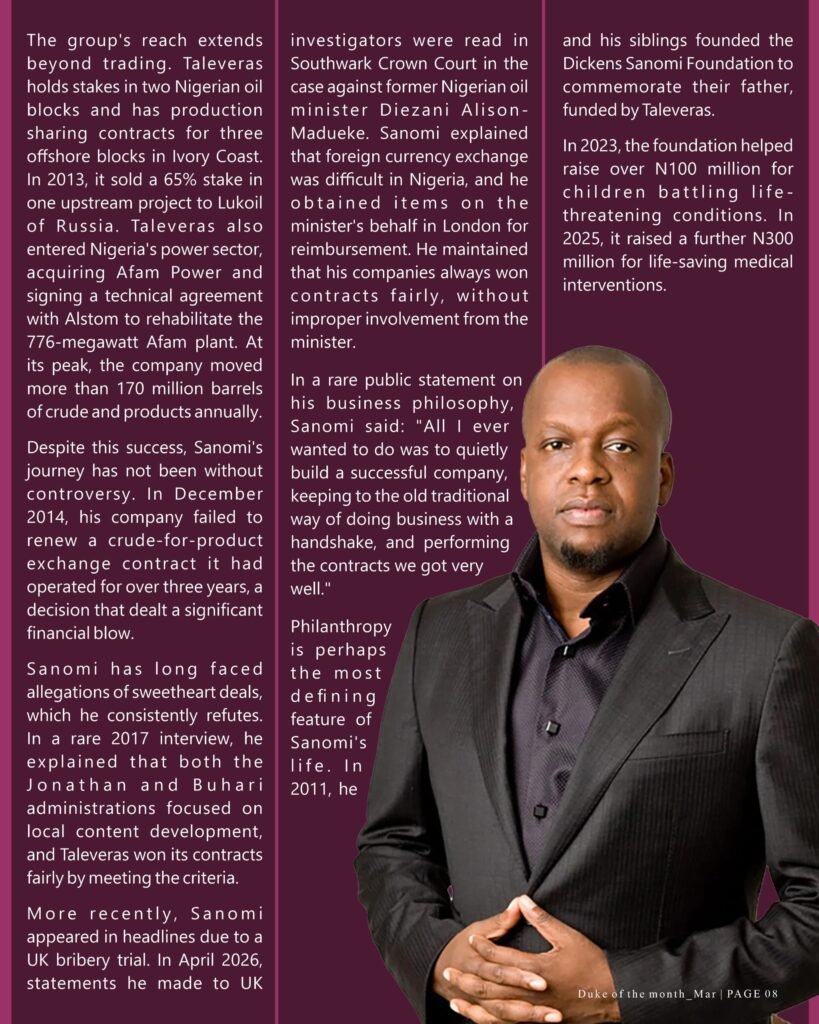
Through collaborations with the Bobby Moore Fund and Cancer Research UK, Sanomi has helped mobilise over £1 million toward bowel and prostate cancer research. When floods devastated Delta and Bayelsa States, his foundation launched “Project Rescue 10,000”, providing food, shelter and healthcare to displaced families.
He also sent supplies to South Sudan during its civil conflict. Since 2012, his initiatives have supported students across Nigeria through scholarships and mentorship programmes. Forbes honoured him with the “Best of Africa Leading Philanthropist Award.”
Igho Sanomi, a geologist by training, is a self-made billionaire who built a global energy giant from the ground up, navigated the treacherous waters of Nigerian politics and international oil trading, and emerged as one of the continent’s most significant philanthropists.
As he turned 51 in 2026, his legacy appears to be as much about the lives he has touched through his foundation as about the billions of dollars in oil he has traded. As one commentator observed, he has proven that a billion dollars can either build taller fences or longer tables; he chose the table.