

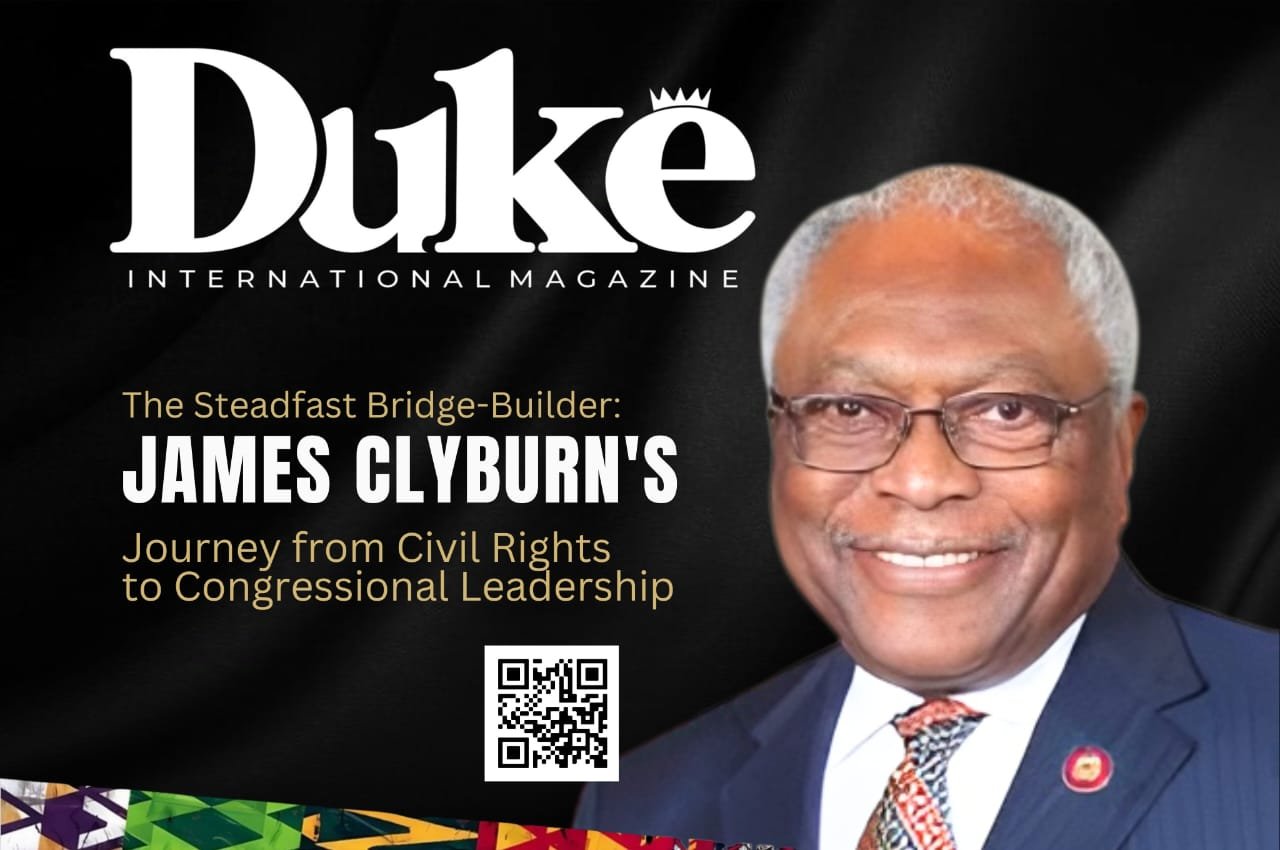
In the annals of American public service, few have woven a thread so consistently from the struggle for civil rights to the highest echelons of political power as James Enos Clyburn. Described as a “champion of civil rights and preserver of our national history,” his life’s work represents a profound commitment to justice, equity, and pragmatic leadership.
From a childhood in the segregated South to wielding influence as a cornerstone of the United States Congress, Clyburn’s story is one of resilience, principle, and an unwavering dedication to uplifting marginalised communities.
His journey began in Sumter, South Carolina, where he was born the son of an activist minister and a civic-minded beautician. The realities of the Jim Crow South shaped his early consciousness. In a telling childhood episode, a client in his mother’s beauty shop admonished the young Clyburn for expressing political ambitions, fearing such talk could bring danger to his family.
His mother, however, encouraged him to hold fast to his dreams. He embraced activism early, becoming president of his local National Association for the Advancement of Colored People youth chapter at just twelve years old. His commitment deepened at South Carolina State College, where he organised sit-ins and marches, and where a defining moment occurred: he met his future wife, Emily, in jail following a student demonstration in 1960.
Before his electoral politics, Clyburn dedicated himself to community service and state government. He worked as a teacher, an employment counsellor, and as a director of youth and community development programmes.
In 1971, he broke a significant barrier by becoming the first African American advisor to a governor of South Carolina, serving under Governor John C. West. He was later appointed as the state’s Human Affairs Commissioner, a role he held for nearly eighteen years, building a reputation as a fair mediator.
His “lifelong dream” of serving in Congress was realised in 1992, when he was elected to represent South Carolina’s Sixth District, becoming the state’s first African American congressman since the Reconstruction era. His rise within the Democratic leadership was steady and historic.
He served as Chairman of the Congressional Black Caucus, was unanimously elected Chair of the House Democratic Caucus, and in 2006, was elected House Majority Whip. In this role, the third-ranking position in the House, he became the first African American to hold the post multiple times, responsible for marshalling votes and setting the legislative agenda.
Clyburn’s legislative legacy is anchored by a focus on equitable development and historical preservation. He is the architect of the “10-20-30” federal funding formula, a pioneering anti-poverty initiative that directs resources to persistent-poverty counties. A steadfast advocate for rural communities, he fought for decades to expand broadband access, arguing it is the essential utility of the twenty-first century.
His passion for preserving heritage led him to sponsor legislation creating the Gullah/Geechee Cultural Heritage Corridor, the Reconstruction Era National Historical Park, and to champion the restoration of buildings at Historically Black Colleges and Universities.
In 2020, at a critical juncture for the nation, Clyburn’s influence reached a zenith. His endorsement of Joe Biden just before the South Carolina primary is widely credited with revitalising Biden’s campaign, setting him on a path to the presidency.
This act cemented Clyburn’s role as a kingmaker and a pillar of the Democratic Party. His decades of service have been recognised with numerous honours, including the Presidential Medal of Freedom, the nation’s highest civilian award, which he received in 2024.
Through over three decades in Congress, James Clyburn has remained, at his core, the community organiser from Sumter. He has built a legacy not on fleeting headlines, but on the tangible foundations of economic justice, historical remembrance, and the steadfast belief that government can and should be a force for levelling the playing field for all Americans.