

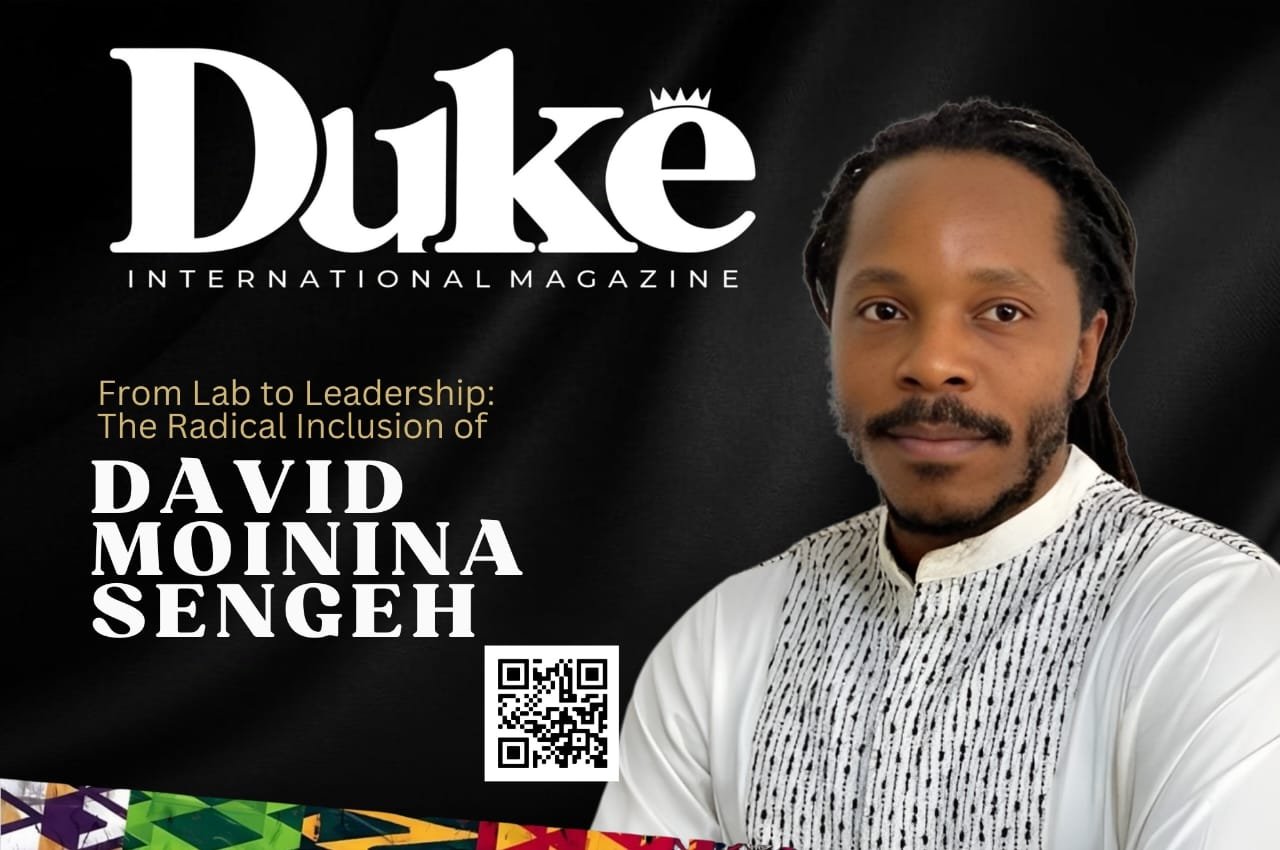
In July 2023, David Moinina Sengeh, a biomechatronics engineer and former research scientist, became Sierra Leone’s Chief Minister, a role akin to a prime minister, tasked with coordinating the nation’s entire government agenda.
His appointment marks the extraordinary ascent of a man who has consistently turned personal history into national, and universal progress. His journey—from developing comfortable prosthetic limbs for civil war amputees to leading an African nation—is united by a powerful, animating principle: radical inclusion.
Sengeh’s work is rooted in the landscape of his childhood. Growing up in Sierra Leone in the wake of a brutal civil war that left thousands with amputations, he observed a painful truth: many who had lost limbs did not wear their prosthetics.
He learned that the devices were often simply too uncomfortable, a “sore problem” that pushed people to the margins of society. This observation did not lead him to pity, but to a biomedical engineering degree at Harvard University and later a doctorate at the Massachusetts Institute of Technology.
At the Massachusetts Institute of Technology Media Lab, Sengeh’s research revolutionised prosthetic design. He used magnetic resonance imaging scans to map the complex anatomy of residual limbs, identifying precise pressure points. He then employed three-dimensional modelling and printing to create customised, comfortable prosthetic sockets that could be made quickly and affordably.
This work, which earned him the prestigious Lemelson-Massachusetts Institute of Technology Student Prize, was a direct application of empathy through science, designed to reintegrate individuals into daily life.
Even before his doctorate, Sengeh’s vision was scaling. In 2007, he co-founded the non-governmental organisation Global Minimum and its flagship programme, Innovate Salone (later Innovate Challenges). His philosophy was a deliberate shift in narrative: from ‘Aid to Africa’ to ‘Made in Africa’.
The programme created Sierra Leone’s first national innovation challenge for secondary school students, providing mentorship to transform their ideas into tangible local solutions. It famously launched the career of a young, self-taught inventor named Kelvin Doe, whom Sengeh mentored and brought to the Massachusetts Institute of Technology as a visiting practitioner.
This drive to foster homegrown talent defined his next chapter. As a research scientist and manager at International Business Machines Research Africa in Nairobi, he led a team designing artificial intelligence systems to address critical healthcare gaps on a continent with a chronic shortage of doctors.
In 2018, Sierra Leone’s President Julius Maada Bio recruited Sengeh home to become the nation’s first Chief Innovation Officer. A year later, he was appointed Minister of Basic and Senior Secondary Education. He brought a technologist’s precision to the role, implementing digital tools like a geographic information system to map educational access and ensure resources reached the neediest areas.
His most profound battle, however, was against a centuries-old exclusion. He moved to overturn a policy banning visibly pregnant girls from attending school. To his shock, he met resistance not just in government, but within his own family and community. Undeterred, he built coalitions, gathered data, and advocated tirelessly.
This campaign is the core narrative of his 2023 book, Radical Inclusion, published as part of Melinda French Gates’ Moment of Lift Books imprint. The book frames his success—the policy was changed—as a universal parable for identifying and dismantling systemic exclusion everywhere.
Beyond the laboratory and the cabinet room, Sengeh is a study in polymathic vitality.
· A Global Voice: He chairs the advisory board for the United Nations Educational, Scientific and Cultural Organization’s Global Education Monitoring Report and is a senior fellow of the Technology, Entertainment, and Design conference.
· Creative Pursuits: He is also an afrobeat rapper and a clothing designer, pursuits he views as integral to connecting with youth and culture.
For a Duke University audience, Sengeh’s career offers a compelling framework for impactful work. It demonstrates that deep technical expertise—in engineering, artificial intelligence, or data science—finds its highest purpose when directed by profound empathy and a relentless commitment to bringing everyone into the fold.
He embodies the idea that the most complex problems, from a painful prosthetic to a nation’s educational equity, require solutions that are as human-centred as they are innovative.