

Honoring Black excellence across fields and borders, Duke International Magazine spotlights Tunde Onakoya, changing lives across Africa beyond the chessboard and Chef JJ Johnson, who centers rice and justice at every table. Two leaders, one legacy: purpose-driven greatness.

Tunde Onakoya: The Exceptional Man Who Moves Beyond the Board to Change Lives Across Africa

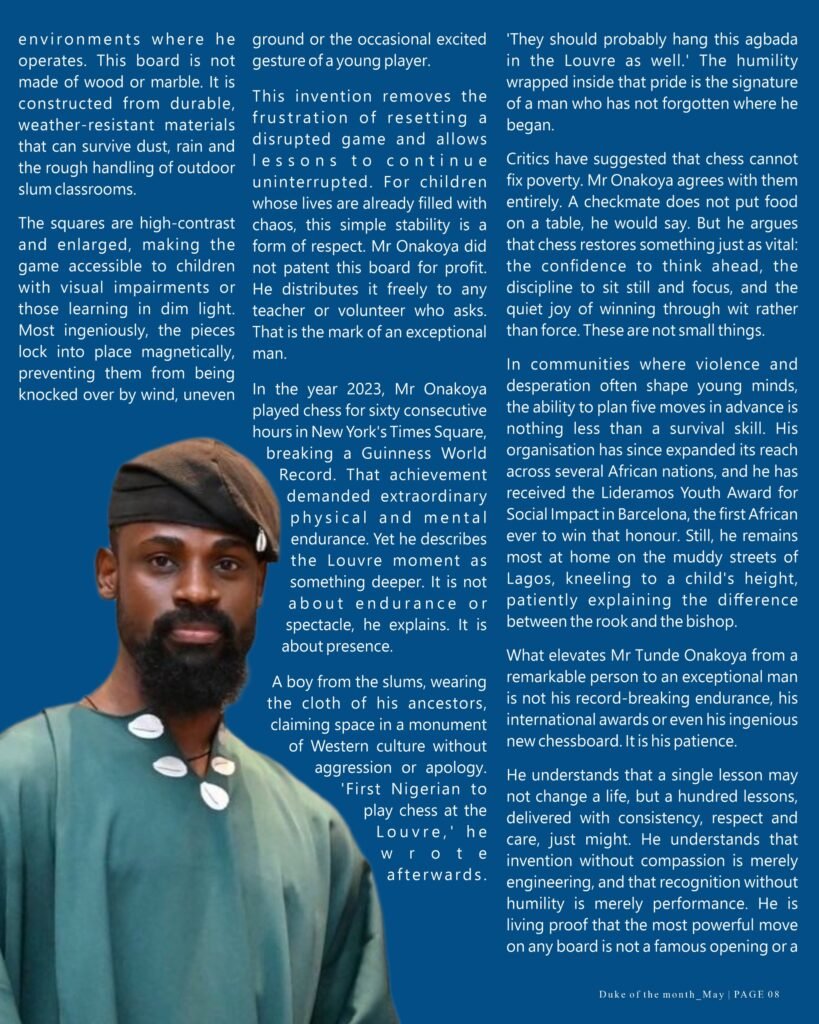
Some men play chess. A rare few master it. But only an exceptional man uses the game to lift entire communities from the margins of existence. Mr Tunde Onakoya is that man. Born into the crowded and unforgiving streets of Ikorodu, a suburb of Lagos where dreams often die before they are named, he learned to play on a borrowed board.
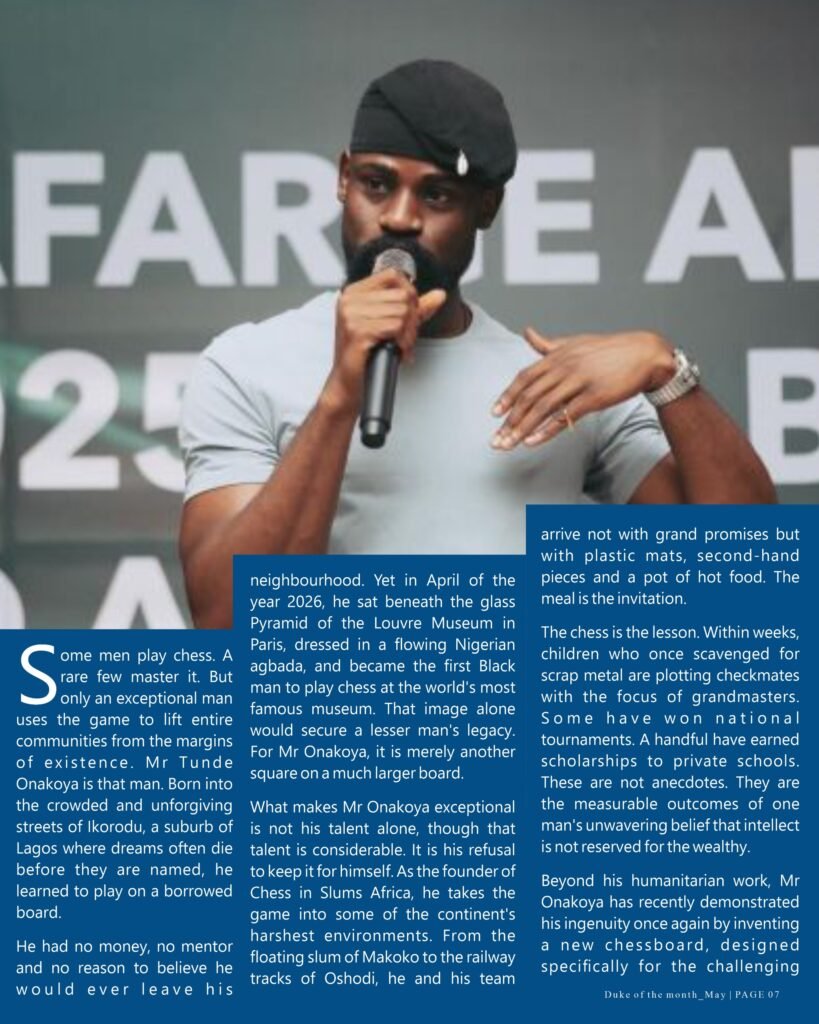
He had no money, no mentor and no reason to believe he would ever leave his neighbourhood. Yet in April of the year 2026, he sat beneath the glass Pyramid of the Louvre Museum in Paris, dressed in a flowing Nigerian agbada, and became the first Black man to play chess at the world’s most famous museum. That image alone would secure a lesser man’s legacy. For Mr Onakoya, it is merely another square on a much larger board.
What makes Mr Onakoya exceptional is not his talent alone, though that talent is considerable. It is his refusal to keep it for himself. As the founder of Chess in Slums Africa, he takes the game into some of the continent’s harshest environments. From the floating slum of Makoko to the railway tracks of Oshodi, he and his team arrive not with grand promises but with plastic mats, second-hand pieces and a pot of hot food. The meal is the invitation.
The chess is the lesson, within weeks, children who once scavenged for scrap metal are plotting checkmates with the focus of grandmasters. Some have won national tournaments, a handful have earned scholarships to private schools. These are not anecdotes, they are the measurable outcomes of one man’s unwavering belief that intellect is not reserved for the wealthy.
Beyond his humanitarian work, Mr Onakoya has recently demonstrated his ingenuity once again by inventing a new chessboard, designed specifically for the challenging environments where he operates. This board is not made of wood or marble, it is constructed from durable, weather-resistant materials that can survive dust, rain and the rough handling of outdoor slum classrooms.
The squares are high-contrast and enlarged, making the game accessible to children with visual impairments or those learning in dim light. Most ingeniously, the pieces lock into place magnetically, preventing them from being knocked over by wind, uneven ground or the occasional excited gesture of a young player.
This invention removes the frustration of resetting a disrupted game and allows lessons to continue uninterrupted. For children whose lives are already filled with chaos, this simple stability is a form of respect. Mr Onakoya did not patent this board for profit. He distributes it freely to any teacher or volunteer who asks. That is the mark of an exceptional man.
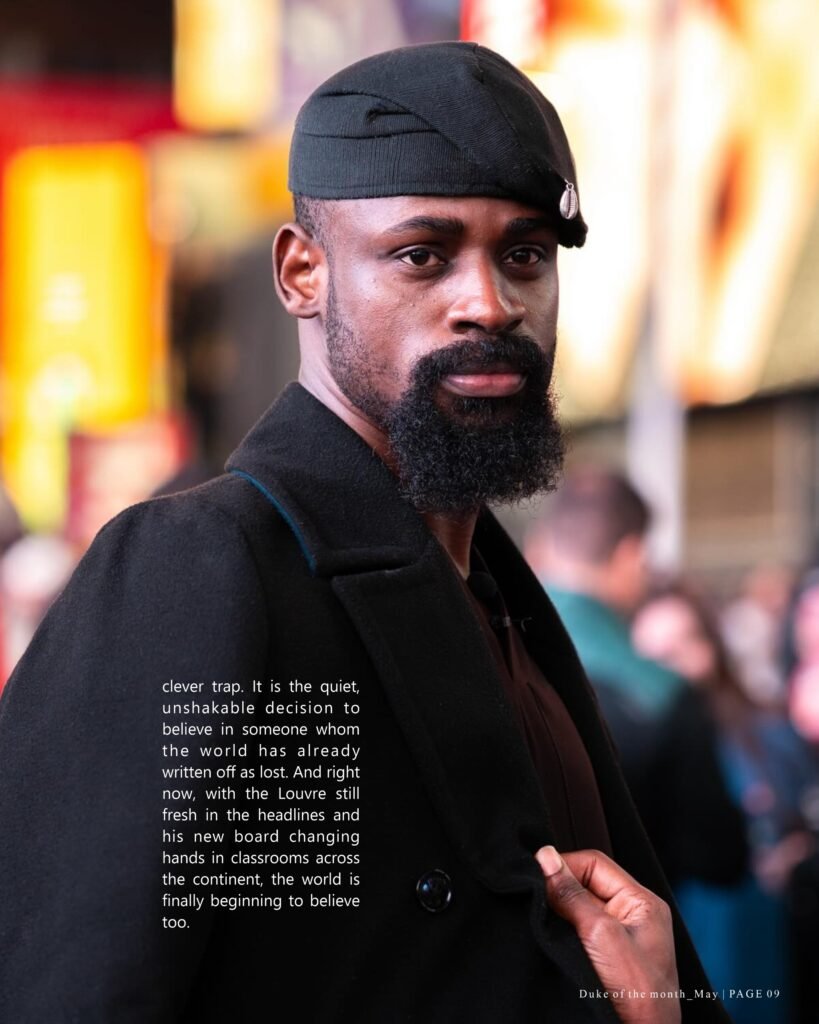
In the year 2023, Mr Onakoya played chess for sixty consecutive hours in New York’s Times Square, breaking a Guinness World Record. That achievement demanded extraordinary physical and mental endurance. Yet he describes the Louvre moment as something deeper. It is not about endurance or spectacle, he explains. It is about presence.
A boy from the slums, wearing the cloth of his ancestors, claiming space in a monument of Western culture without aggression or apology. ‘First Nigerian to play chess at the Louvre,’ he wrote afterwards. ‘They should probably hang this agbada in the Louvre as well.’ The humility wrapped inside that pride is the signature of a man who has not forgotten where he began.
Critics have suggested that chess cannot fix poverty, Mr Onakoya agrees with them entirely. A checkmate does not put food on a table, he would say. But he argues that chess restores something just as vital: the confidence to think ahead, the discipline to sit still and focus, and the quiet joy of winning through wit rather than force. These are not small things.
In communities where violence and desperation often shape young minds, the ability to plan five moves in advance is nothing less than a survival skill. His organisation has since expanded its reach across several African nations, and he has received the Lideramos Youth Award for Social Impact in Barcelona, the first African ever to win that honour.
Still, he remains most at home on the muddy streets of Lagos, kneeling to a child’s height, patiently explaining the difference between the rook and the bishop. What elevates Mr Tunde Onakoya from a remarkable person to an exceptional man is not his record-breaking endurance, his international awards or even his ingenious new chessboard. It is his patience. He understands that a single lesson may not change a life, but a hundred lessons, delivered with consistency, respect and care, just might.
He understands that invention without compassion is merely engineering, and that recognition without humility is merely performance. He is living proof that the most powerful move on any board is not a famous opening or a clever trap, it is the quiet, unshakable decision to believe in someone whom the world has already written off as lost.
And right now, with the Louvre still fresh in the headlines and his new board changing hands in classrooms across the continent, the world is finally beginning to believe too.
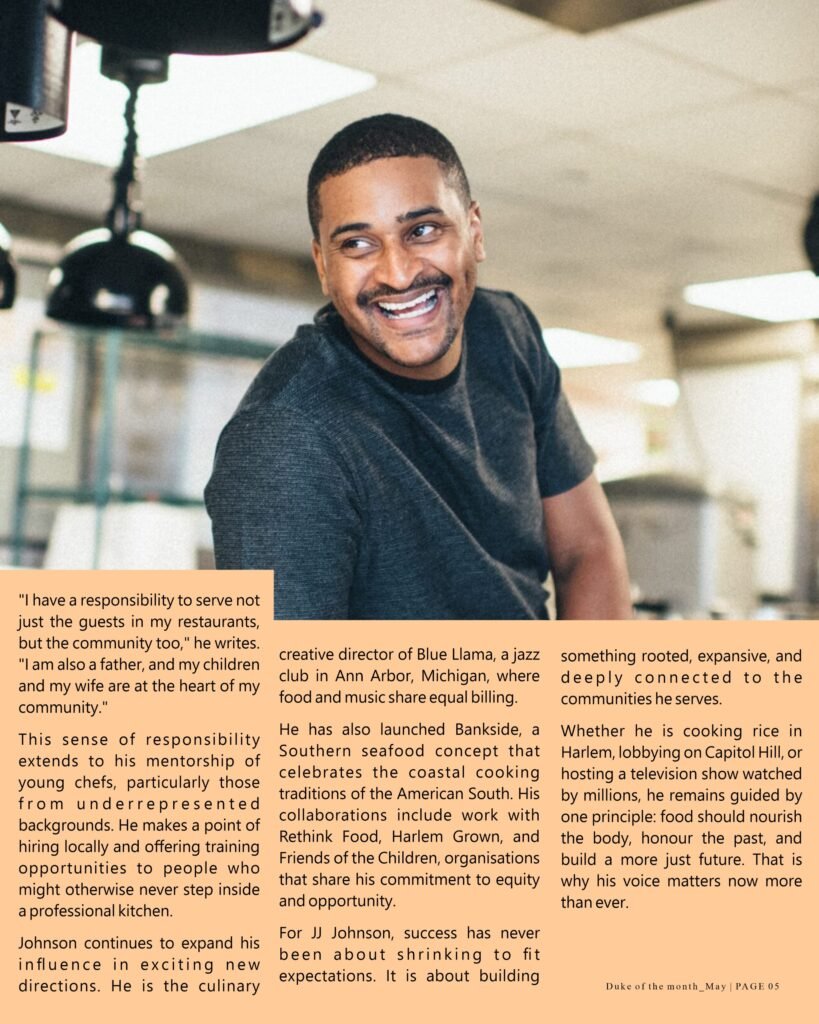
JJ Johnson: The Chef Who Places Rice and Justice at the Heart of The Table
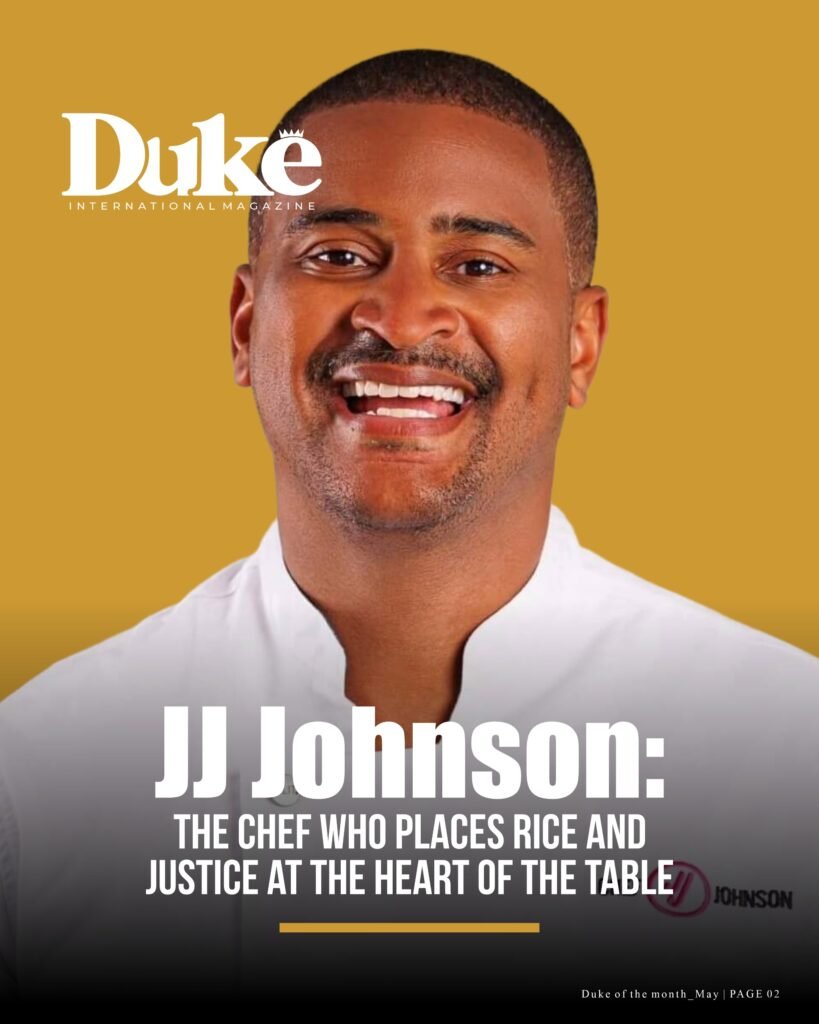
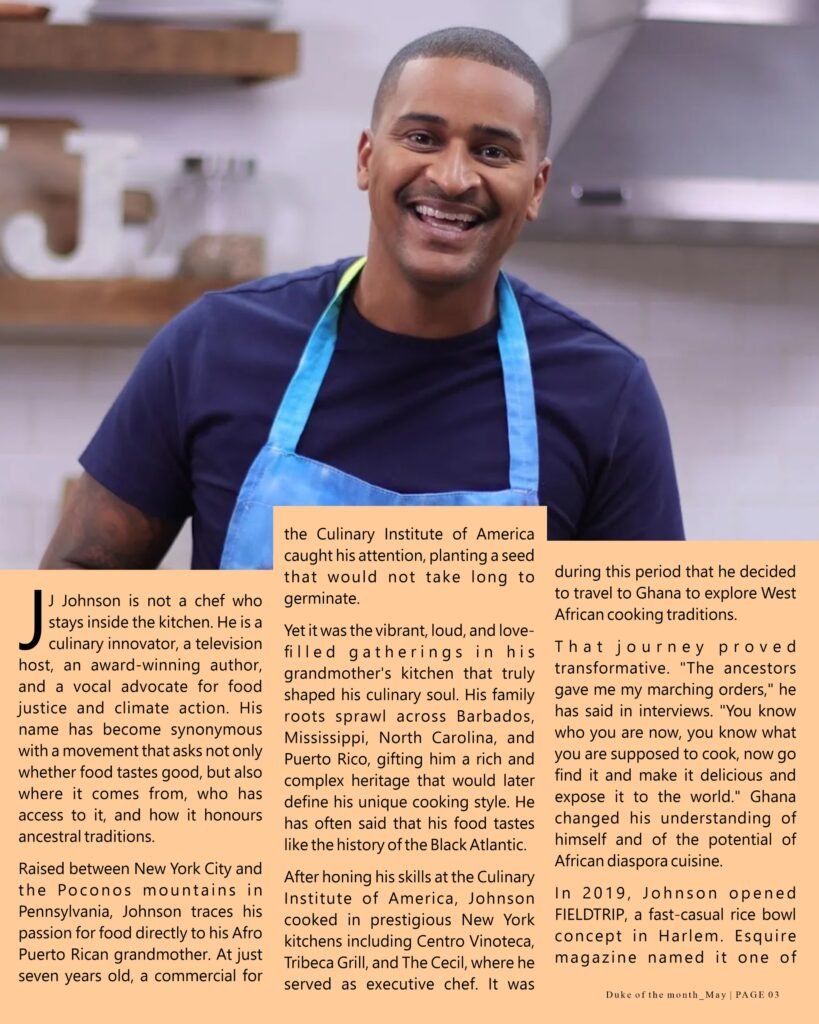
JJ Johnson is not a chef who stays inside the kitchen. He is a culinary innovator, a television host, an award-winning author, and a vocal advocate for food justice and climate action. His name has become synonymous with a movement that asks not only whether food tastes good, but also where it comes from, who has access to it, and how it honours ancestral traditions.
Raised between New York City and the Poconos mountains in Pennsylvania, Johnson traces his passion for food directly to his Afro Puerto Rican grandmother. At just seven years old, a commercial for the Culinary Institute of America caught his attention, planting a seed that would not take long to germinate.
Yet it was the vibrant, loud, and love-filled gatherings in his grandmother’s kitchen that truly shaped his culinary soul. His family roots sprawl across Barbados, Mississippi, North Carolina, and Puerto Rico, gifting him a rich and complex heritage that would later define his unique cooking style. He has often said that his food tastes like the history of the Black Atlantic.
After honing his skills at the Culinary Institute of America, Johnson cooked in prestigious New York kitchens including Centro Vinoteca, Tribeca Grill, and The Cecil, where he served as executive chef. It was during this period that he decided to travel to Ghana to explore West African cooking traditions.
That journey proved transformative. “The ancestors gave me my marching orders,” he has said in interviews. “You know who you are now, you know what you are supposed to cook, now go find it and make it delicious and expose it to the world.” Ghana changed his understanding of himself and of the potential of African diaspora cuisine. In 2019, Johnson opened FIELDTRIP, a fast-casual rice bowl concept in Harlem. Esquire magazine named it one of America’s Best New Restaurants, and it was the only fast-casual spot on the entire list.
The motto printed on the wall and stamped onto cups is deceptively simple: “Rice is culture”. Johnson explains that rice appears in every culture touched by the African diaspora, from Jollof and peas and rice to arroz con gandules and Hoppin’ John. “Rice is memory,” he says. The Harlem location was designed with an accessible price point, ensuring that high-quality ingredients remain available to the community rather than being reserved for wealthy diners alone.
FIELDTRIP has since expanded to Rockefeller Center, Morningside Heights, and the Atlantis Paradise Island in the Bahamas. During the height of the Covid-19 pandemic, Johnson began donating meals to frontline workers at a local Harlem hospital. What started as a small gesture eventually grew into a massive operation, providing over 220,000 meals to neighbours in need. This effort cemented his reputation as a chef who truly feeds his community.
Johnson’s first cookbook, Between Harlem and Heaven, co-authored with Alexander Smalls, won a James Beard Foundation Book Award, one of the highest honours in the culinary world. His second book, The Simple Art of Rice, was named one of the New York Times Best Cookbooks of 2023.
Each recipe tells a story of migration, survival, and celebration. He also hosts Just Eats with Chef JJ on Cleo TV, now in its fifth season, where he blends cooking demonstrations with conversations about culture and wellness. Beyond the plate, Johnson has become a leading voice on sustainability and food equity.
He serves as a culinary advisor to Edible Garden, a hydroponic farming company, and has worked closely with the James Beard Foundation’s Climate Solutions for Restaurant Survival campaign. He has even taken his advocacy to Washington, DC, lobbying Congress to protect climate funding and support local food systems. He is not afraid to speak truth to power, and he does so with the same warmth and clarity that he brings to his cooking.
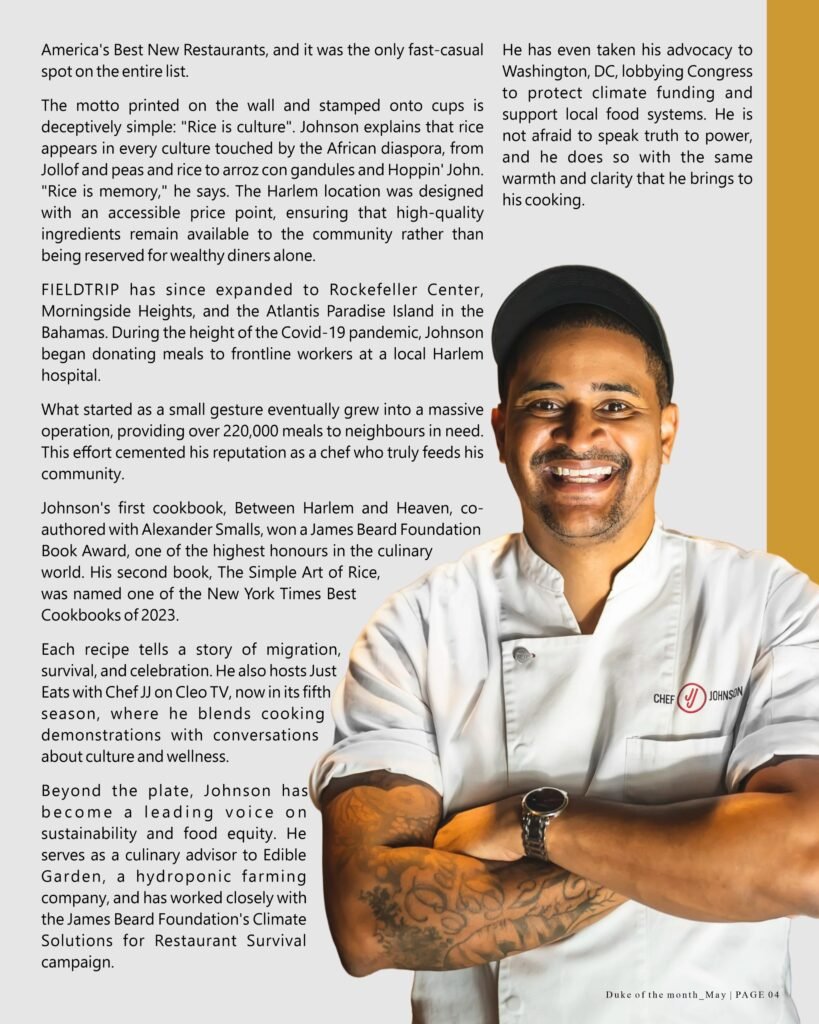
“I have a responsibility to serve not just the guests in my restaurants, but the community too,” he writes. “I am also a father, and my children and my wife are at the heart of my community.” This sense of responsibility extends to his mentorship of young chefs, particularly those from underrepresented backgrounds. He makes a point of hiring locally and offering training opportunities to people who might otherwise never step inside a professional kitchen.
Johnson continues to expand his influence in exciting new directions. He is the culinary creative director of Blue Llama, a jazz club in Ann Arbor, Michigan, where food and music share equal billing. He has also launched Bankside, a Southern seafood concept that celebrates the coastal cooking traditions of the American South.
His collaborations include work with Rethink Food, Harlem Grown, and Friends of the Children, organisations that share his commitment to equity and opportunity. For JJ Johnson, success has never been about shrinking to fit expectations. It is about building something rooted, expansive, and deeply connected to the communities he serves.
Whether he is cooking rice in Harlem, lobbying on Capitol Hill, or hosting a television show watched by millions, he remains guided by one principle: food should nourish the body, honour the past, and build a more just future. That is why his voice matters now more than ever.