

This month’s Duke of the Month recognises two Nigerians whose work has shaped very different parts of national life. Olu Jacobs, who died at 84, carried the discipline of British stage and screen into Nollywood and helped give the industry a sense of craft and history. Tosin Eniolorunda built Moniepoint into payment infrastructure used by millions of businesses and customers across Nigeria.

Olu Jacobs: The Lion of Lufodo Who Bridged Two Continents
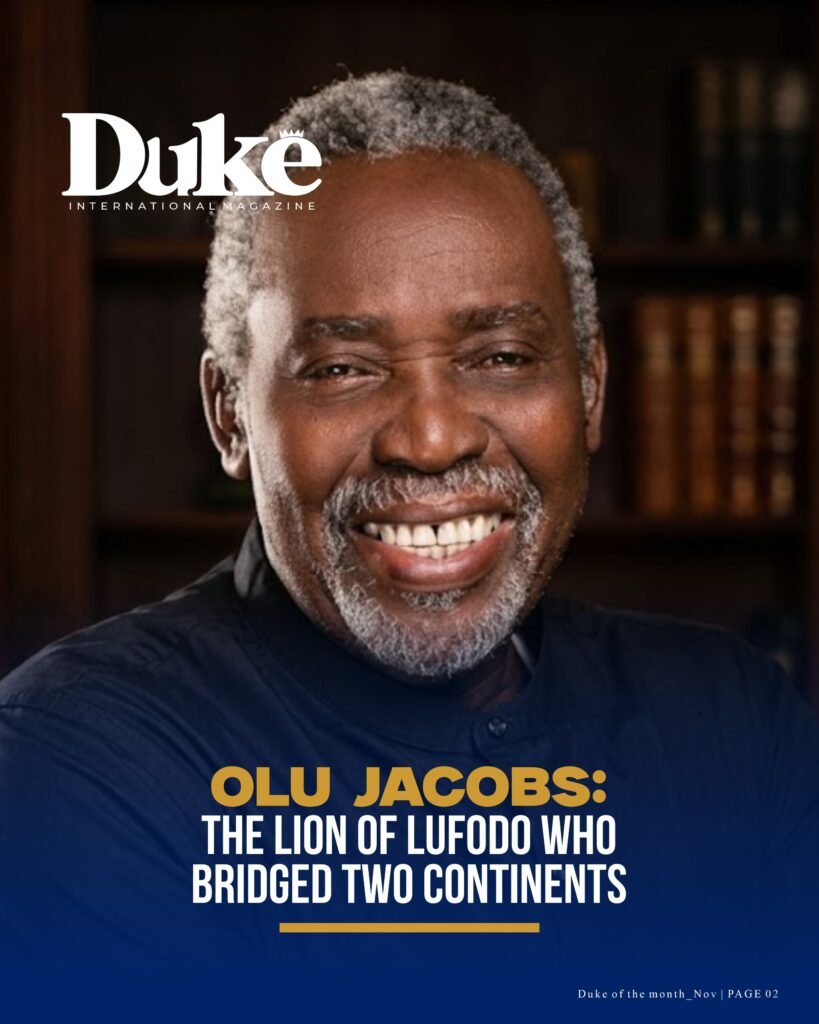
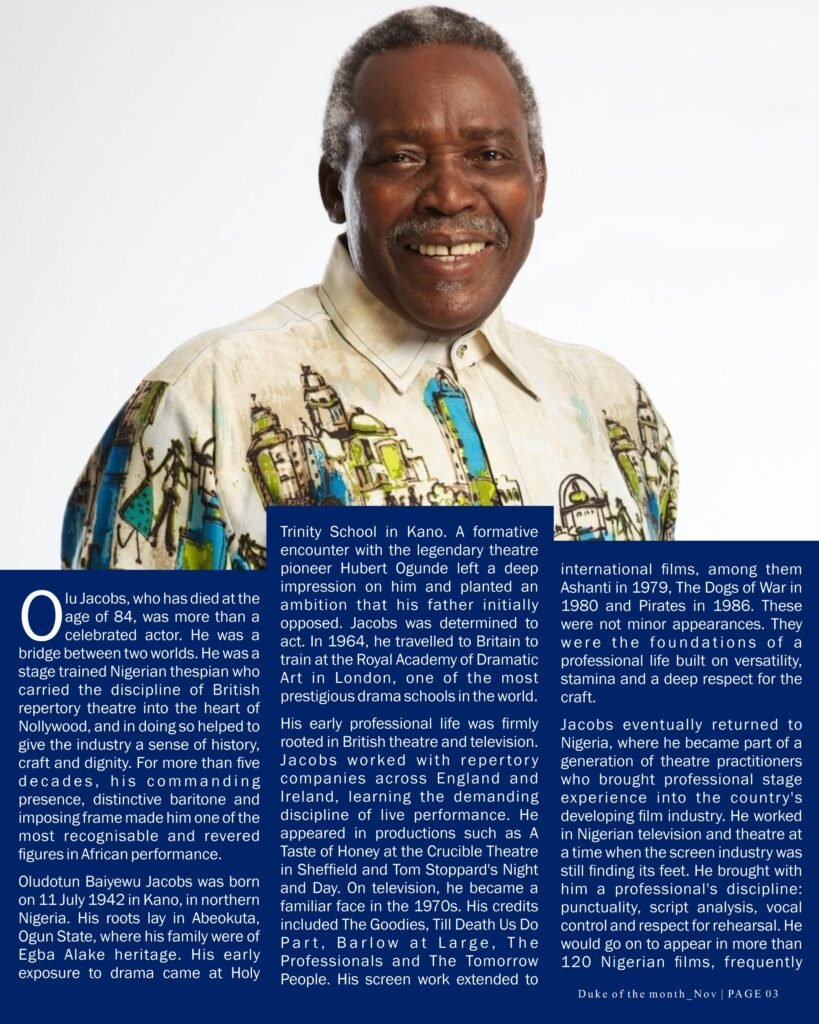
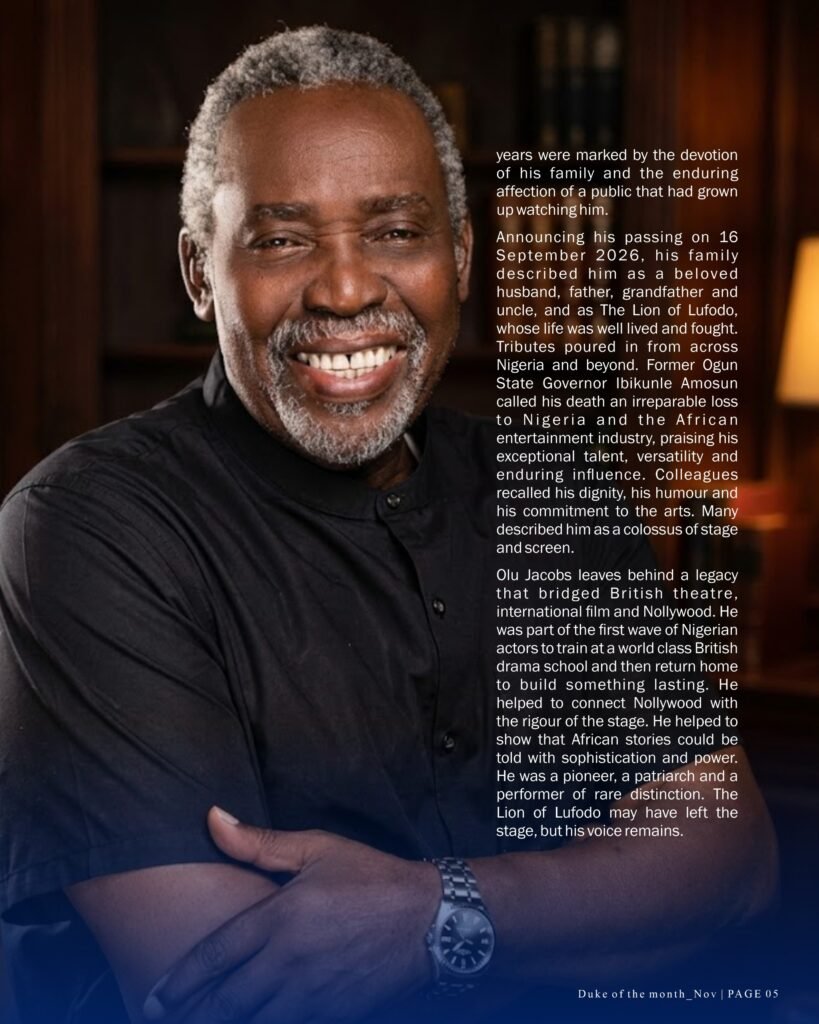
Olu Jacobs, who has died at the age of 84, was more than a celebrated actor. He was a bridge between two worlds. He was a stage trained Nigerian thespian who carried the discipline of British repertory theatre into the heart of Nollywood, and in doing so helped to give the industry a sense of history, craft and dignity.
For more than five decades, his commanding presence, distinctive baritone and imposing frame made him one of the most recognisable and revered figures in African performance.
Oludotun Baiyewu Jacobs was born on 11 July 1942 in Kano, in northern Nigeria. His roots lay in Abeokuta, Ogun State, where his family were of Egba Alake heritage. His early exposure to drama came at Holy Trinity School in Kano.
A formative encounter with the legendary theatre pioneer Hubert Ogunde left a deep impression on him and planted an ambition that his father initially opposed. Jacobs was determined to act. In 1964, he travelled to Britain to train at the Royal Academy of Dramatic Art in London, one of the most prestigious drama schools in the world.
His early professional life was firmly rooted in British theatre and television. Jacobs worked with repertory companies across England and Ireland, learning the demanding discipline of live performance. He appeared in productions such as A Taste of Honey at the Crucible Theatre in Sheffield and Tom Stoppard’s Night and Day. On television, he became a familiar face in the 1970s.
His credits included The Goodies, Till Death Us Do Part, Barlow at Large, The Professionals and The Tomorrow People. His screen work extended to international films, among them Ashanti in 1979, The Dogs of War in 1980 and Pirates in 1986. These were not minor appearances. They were the foundations of a professional life built on versatility, stamina and a deep respect for the craft.
Jacobs eventually returned to Nigeria, where he became part of a generation of theatre practitioners who brought professional stage experience into the country’s developing film industry. He worked in Nigerian television and theatre at a time when the screen industry was still finding its feet. He brought with him a professional’s discipline: punctuality, script analysis, vocal control and respect for rehearsal.
He would go on to appear in more than 120 Nigerian films, frequently portraying kings, elders, traditional rulers, generals, fathers and men of authority. These roles became synonymous with his screen persona. Yet he was never merely a symbol of power. He could be imperious or tender, stern or warm, and his craft prevented his authority figures from becoming mere caricatures.
Among his notable Nollywood credits were Oloibiri, Dry, The Royal Hibiscus Hotel, Adesuwa, Heroes & Zeros and Dancing Heart. For his performance in Dancing Heart, he won the Africa Movie Academy Award for Best Actor in a Leading Role in 2007. In 2013, he received the Industry Merit Award at the Africa Magic Viewers’ Choice Awards.
In 2016, he was jointly honoured with the AMAA Lifetime Achievement Award alongside his wife, the acclaimed actress Joke Silva. In 2011, the Federal Government conferred on him the national honour of Member of the Order of the Federal Republic in recognition of his contribution to Nigerian cinema.
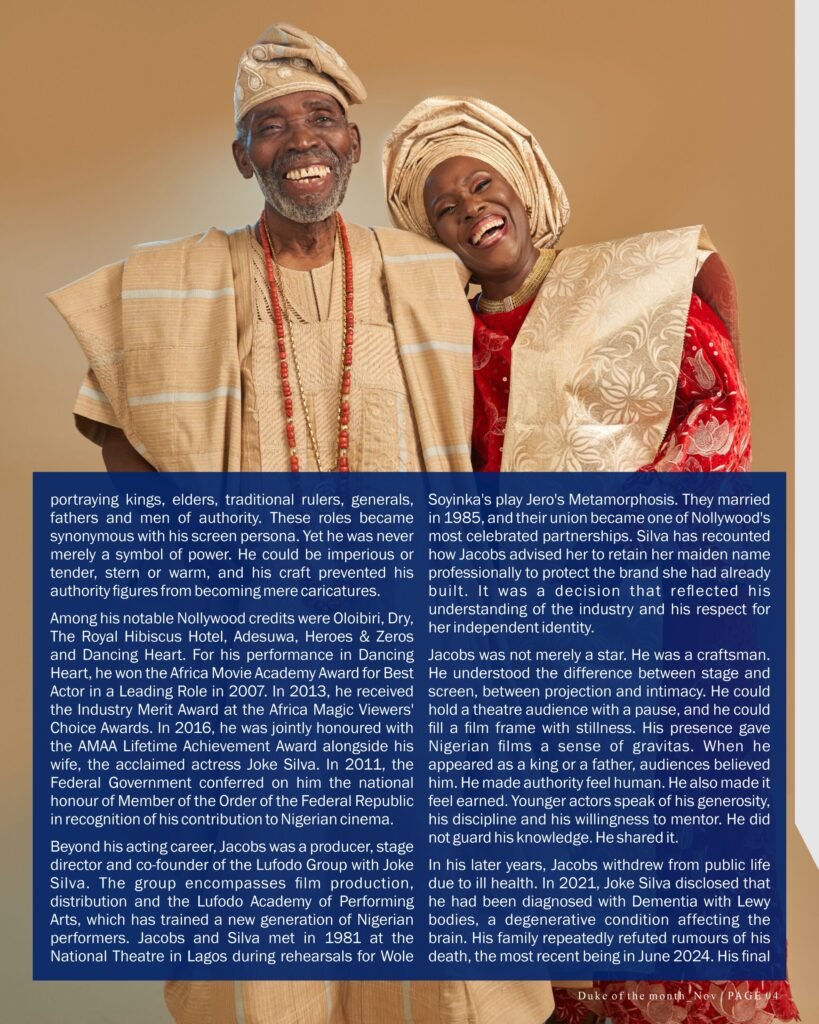
Beyond his acting career, Jacobs was a producer, stage director and co-founder of the Lufodo Group with Joke Silva. The group encompasses film production, distribution and the Lufodo Academy of Performing Arts, which has trained a new generation of Nigerian performers. Jacobs and Silva met in 1981 at the National Theatre in Lagos during rehearsals for Wole Soyinka’s play Jero’s Metamorphosis.
They married in 1985, and their union became one of Nollywood’s most celebrated partnerships. Silva has recounted how Jacobs advised her to retain her maiden name professionally to protect the brand she had already built. It was a decision that reflected his understanding of the industry and his respect for her independent identity.
Jacobs was not merely a star. He was a craftsman. He understood the difference between stage and screen, between projection and intimacy. He could hold a theatre audience with a pause, and he could fill a film frame with stillness. His presence gave Nigerian films a sense of gravitas.
When he appeared as a king or a father, audiences believed him. He made authority feel human. He also made it feel earned. Younger actors speak of his generosity, his discipline and his willingness to mentor. He did not guard his knowledge. He shared it.
In his later years, Jacobs withdrew from public life due to ill health. In 2021, Joke Silva disclosed that he had been diagnosed with Dementia with Lewy bodies, a degenerative condition affecting the brain.
His family repeatedly refuted rumours of his death, the most recent being in June 2024. His final years were marked by the devotion of his family and the enduring affection of a public that had grown up watching him.
Announcing his passing on 16 September 2026, his family described him as a beloved husband, father, grandfather and uncle, and as The Lion of Lufodo, whose life was well lived and fought. Tributes poured in from across Nigeria and beyond.
Former Ogun State Governor Ibikunle Amosun called his death an irreparable loss to Nigeria and the African entertainment industry, praising his exceptional talent, versatility and enduring influence. Colleagues recalled his dignity, his humour and his commitment to the arts. Many described him as a colossus of stage and screen.
Olu Jacobs leaves behind a legacy that bridged British theatre, international film and Nollywood. He was part of the first wave of Nigerian actors to train at a world class British drama school and then return home to build something lasting.
He helped to connect Nollywood with the rigour of the stage. He helped to show that African stories could be told with sophistication and power. He was a pioneer, a patriarch and a performer of rare distinction. The Lion of Lufodo may have left the stage, but his voice remains.
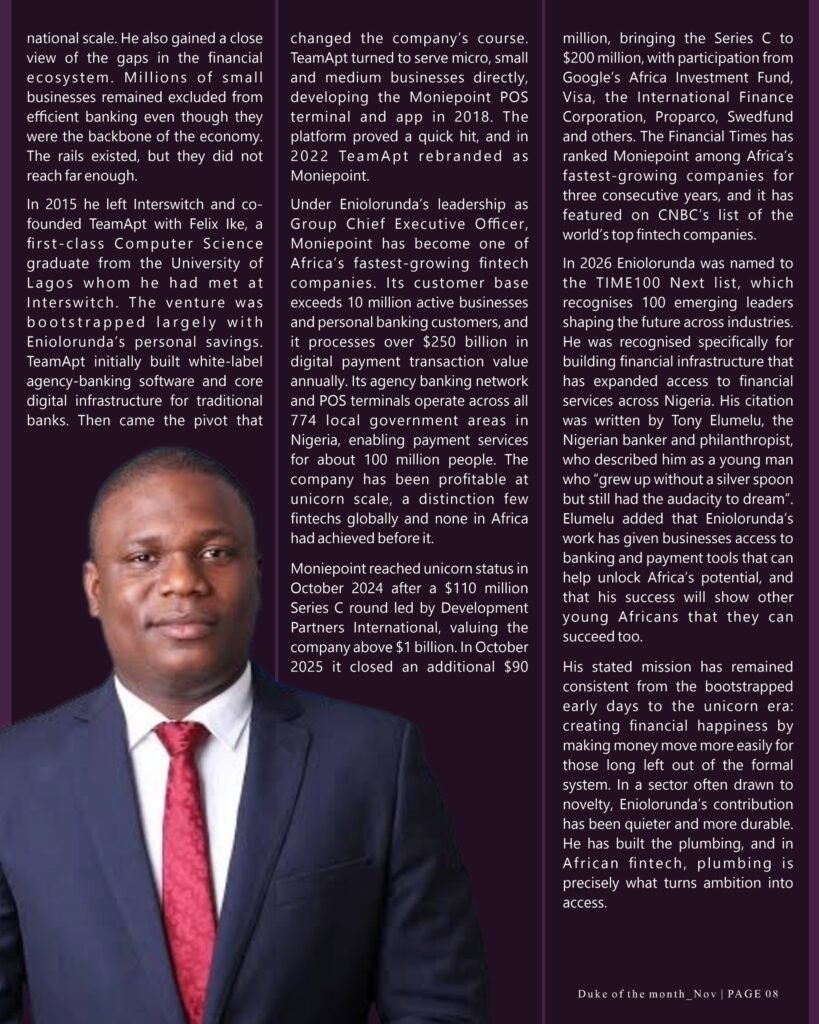
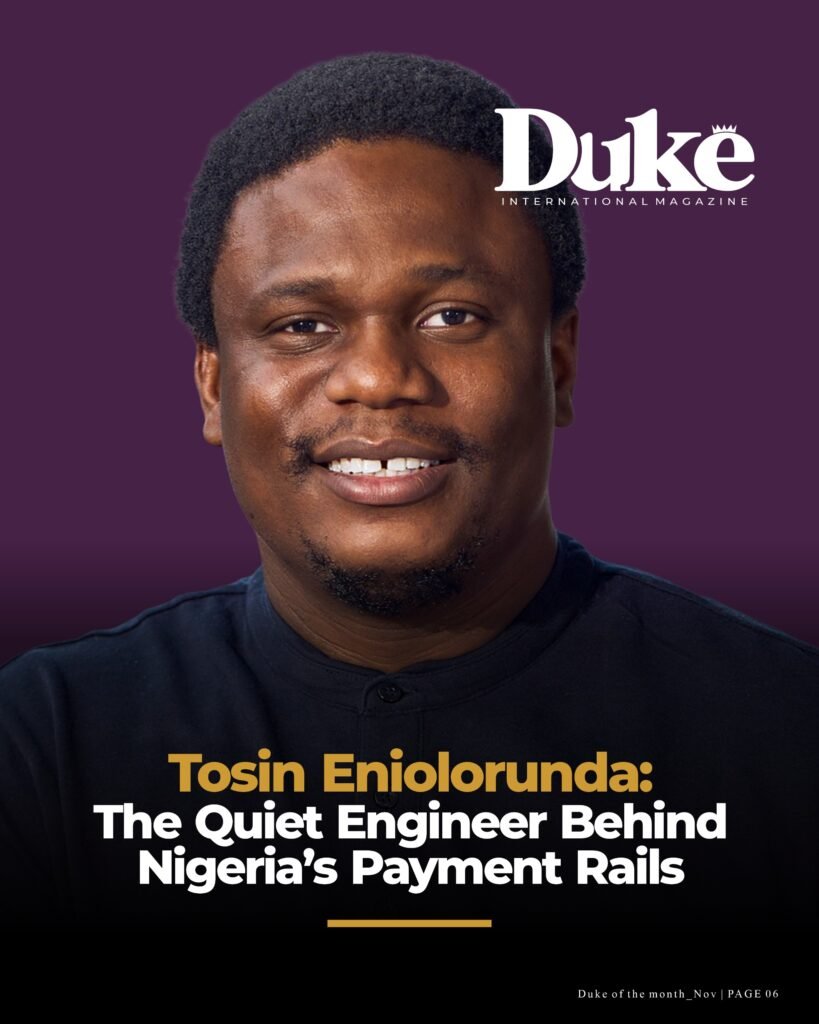
Tosin Eniolorunda: The Quiet Engineer Behind Nigeria’s Payment Rails
Walk into a market in Ibadan, a roadside shop in Kano or a fuel station in Lagos, and the chances are that a small Moniepoint terminal will be within reach. A trader taps a card, a customer transfers money, a receipt is printed, and the transaction settles in seconds.
The moment looks ordinary. Yet behind it sits one of the most consequential pieces of financial infrastructure built in Africa in the past decade, and behind that infrastructure sits an engineer from Ibadan who spent his early career making payment terminals work before he set out to make them reach everyone.
Oluwatosin Michael Eniolorunda was born in Lagos in September 1985, the first of three children to Rotimi, an engineering contractor, and Ajoke, a teacher. He is from Ose local government in Ondo State, but he spent his formative years in Ibadan, Oyo State, where discipline, curiosity and academic excellence shaped his outlook.
He attended the University of Ibadan Staff School from 1990 to 1995 and then Command Day School, Odogbo, Ibadan, for his secondary education. There he was a member of the Junior Engineers, Technicians and Scientists Club, an early sign of the analytical mind that would later define his career.
He was admitted to Obafemi Awolowo University in 2002 and graduated with a BSc in Mechanical Engineering in 2007. While there he discovered that building software was far easier than building hardware, and he generated income by building software and hardware projects for fellow students. That realisation would redirect his career. The mechanical engineer was becoming a software builder.
In 2009 Eniolorunda joined Interswitch, at a moment when digital payments in Nigeria were finding their feet. He rose through roles including software engineer, senior software manager, unit head of application development and product manager.
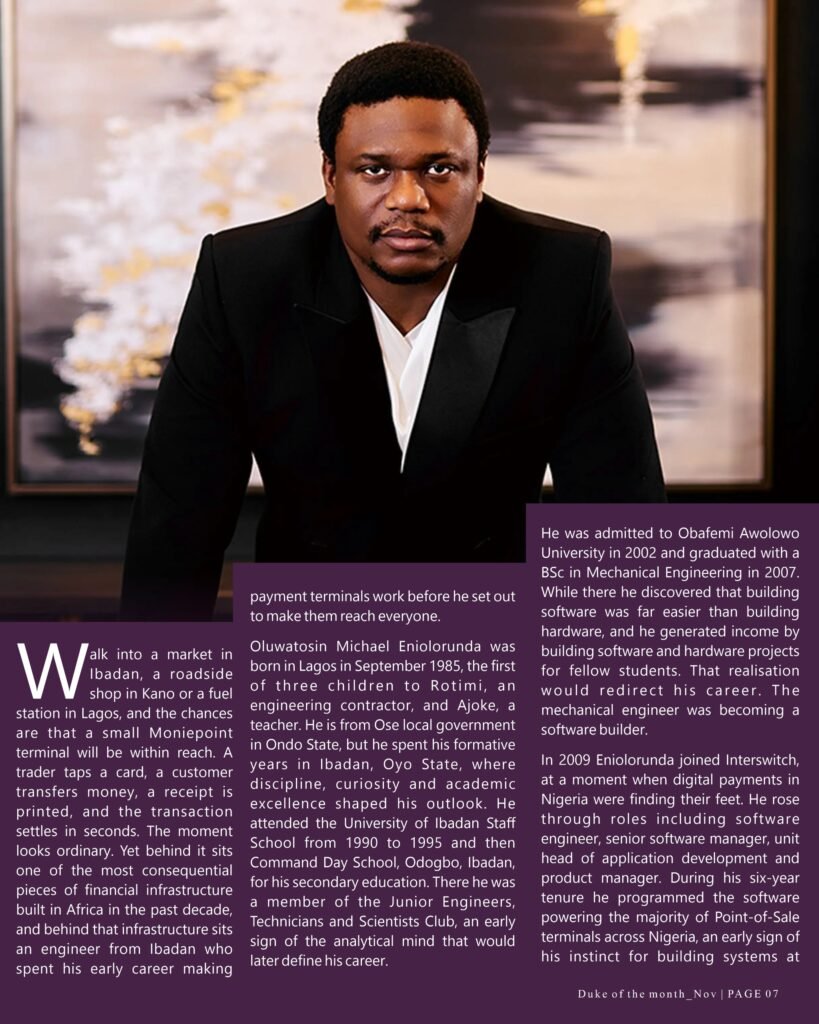
During his six-year tenure he programmed the software powering the majority of Point-of-Sale terminals across Nigeria, an early sign of his instinct for building systems at national scale.
He also gained a close view of the gaps in the financial ecosystem. Millions of small businesses remained excluded from efficient banking even though they were the backbone of the economy. The rails existed, but they did not reach far enough.
In 2015 he left Interswitch and co-founded TeamApt with Felix Ike, a first-class Computer Science graduate from the University of Lagos whom he had met at Interswitch. The venture was bootstrapped largely with Eniolorunda’s personal savings.
TeamApt initially built white-label agency-banking software and core digital infrastructure for traditional banks. Then came the pivot that changed the company’s course. TeamApt turned to serve micro, small and medium businesses directly, developing the Moniepoint POS terminal and app in 2018. The platform proved a quick hit, and in 2022 TeamApt rebranded as Moniepoint.
Under Eniolorunda’s leadership as Group Chief Executive Officer, Moniepoint has become one of Africa’s fastest-growing fintech companies. Its customer base exceeds 10 million active businesses and personal banking customers, and it processes over $250 billion in digital payment transaction value annually.
Its agency banking network and POS terminals operate across all 774 local government areas in Nigeria, enabling payment services for about 100 million people. The company has been profitable at unicorn scale, a distinction few fintechs globally and none in Africa had achieved before it.
Moniepoint reached unicorn status in October 2024 after a $110 million Series C round led by Development Partners International, valuing the company above $1 billion. In October 2025 it closed an additional $90 million, bringing the Series C to $200 million, with participation from Google’s Africa Investment Fund, Visa, the International Finance Corporation, Proparco, Swedfund and others.
The Financial Times has ranked Moniepoint among Africa’s fastest-growing companies for three consecutive years, and it has featured on CNBC’s list of the world’s top fintech companies.
In 2026 Eniolorunda was named to the TIME100 Next list, which recognises 100 emerging leaders shaping the future across industries. He was recognised specifically for building financial infrastructure that has expanded access to financial services across Nigeria.
His citation was written by Tony Elumelu, the Nigerian banker and philanthropist, who described him as a young man who “grew up without a silver spoon but still had the audacity to dream”. Elumelu added that Eniolorunda’s work has given businesses access to banking and payment tools that can help unlock Africa’s potential, and that his success will show other young Africans that they can succeed too.
His stated mission has remained consistent from the bootstrapped early days to the unicorn era: creating financial happiness by making money move more easily for those long left out of the formal system.
In a sector often drawn to novelty, Eniolorunda’s contribution has been quieter and more durable. He has built the plumbing, and in African fintech, plumbing is precisely what turns ambition into access.