

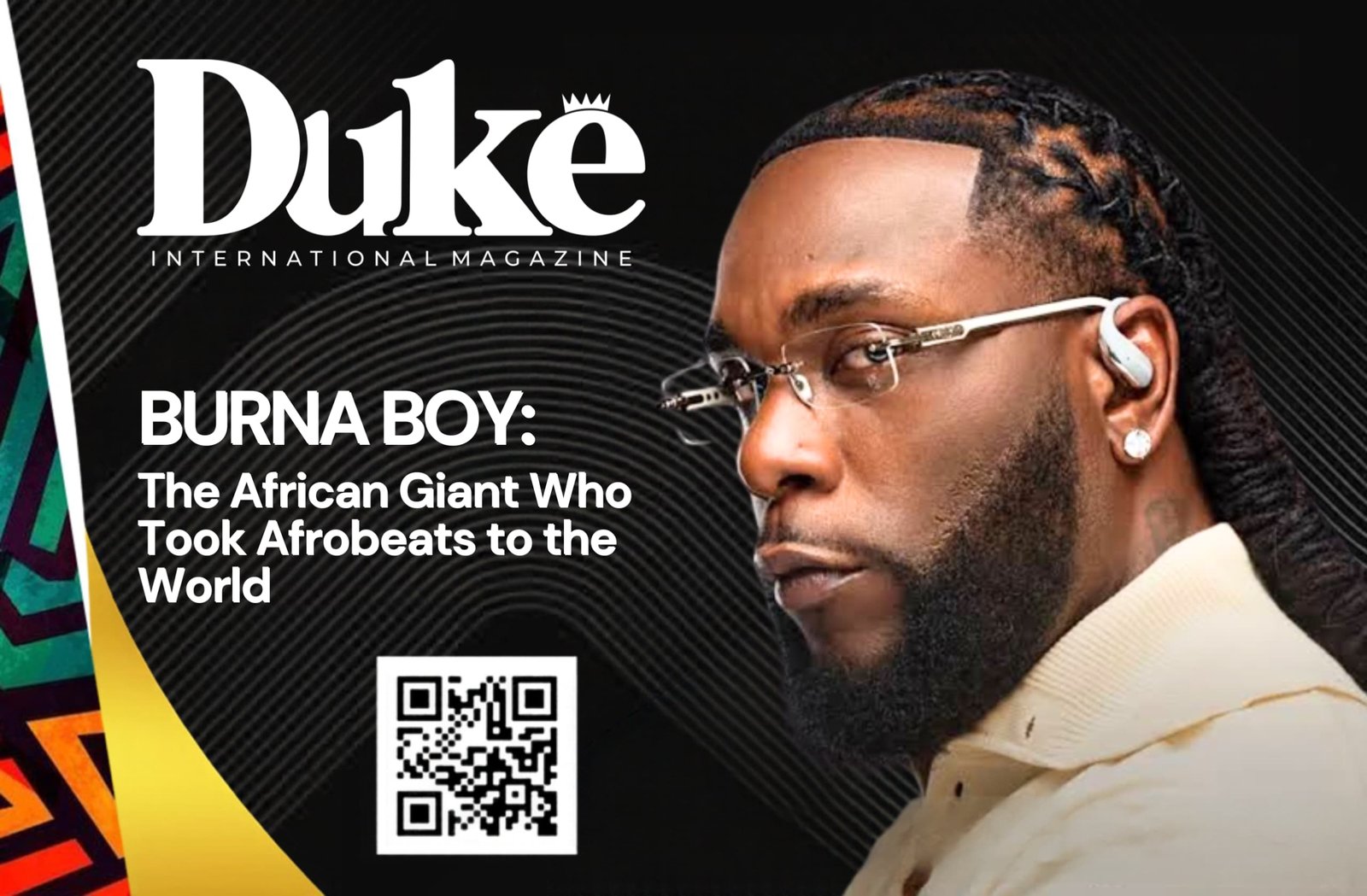
Damini Ebunoluwa Ogulu, known to the world as Burna Boy, has long since outgrown the title of a Nigerian music star. He is now a global phenomenon and a cultural ambassador whose influence stretches far beyond the recording studio.
With a record 13 Grammy nominations, the most of any Nigerian artiste, and a historic win for Best Global Music Album in 2021 for Twice As Tall, his place in music history is already secured. Yet his story is one of constant evolution, turning personal vision into a worldwide movement.
Born in Port Harcourt, Burna Boy’s lineage is steeped in musical royalty. His grandfather, Benson Idonije, was the first manager of the legendary Fela Kuti. This heritage is palpable in his artistry, but Burna Boy has never been one to simply follow a well-worn path.
Instead, he coined the term “Afro-fusion” to describe his sound, a rich blend of Afrobeats, hip-hop, reggae, R&B and dancehall. His music, often featuring lyrics in English, Yoruba and Nigerian Pidgin, carries the spirit of Pan-Africanism and Black expression to every corner of the globe.
His impact is not confined to the airwaves. Burna Boy is a record-breaker in the live arena. In April 2025, he became the first African artiste to headline Stade de France.
He returned to that same stadium on 25 October 2026 to headline the halftime show of the NFL Paris Game between the Pittsburgh Steelers and the New Orleans Saints, electrifying the crowd with hits including “Ye” and “Last Last”. The performance was part of a record seven international halftime shows staged by the NFL across the 2026 season.
Burna Boy’s 2026 was defined by a series of historic firsts. In July, he became the first Nigerian artiste to perform at the FIFA World Cup final halftime show, sharing the stage with Colombian superstar Shakira at MetLife Stadium in New Jersey.
The duo performed “Dai Dai,” the official anthem of the 2026 tournament, which they had also debuted at the opening ceremony. The song topped the Billboard Global 200 for two weeks following the performance.
Three months later, on 26 October 2026, Burna Boy made history again as the first Nigerian entertainer to present an award at the Ballon d’Or ceremony at the London Palladium. He presented the Socrates Award to Arsenal forward Bukayo Saka, recognising the player’s charitable work with BigShoe, an organisation providing medical assistance to children.
Before presenting the award, Burna Boy spoke about his own football academy in Nigeria, which he established to support the development of the sport back home. “Hopefully, inshallah, one day I’ll come back here to see one of my people getting an award in Ballon d’Or,” he said.
From the breakout single “Like To Party” in 2012 to these global stages, Burna Boy’s journey is a testament to the power of artistic conviction. He has not just adapted to the global stage; he has reshaped it, proving that music truly knows no boundaries.

