

This month, Duke Magazine celebrates two Black men redefining leadership in their fields: Marcus Freeman, the quiet revolutionary changing college football at Notre Dame, and Edward Blackmon Jr., the understated architect of justice and political representation. Though their arenas differ, both embody the same powerful truth—excellence doesn’t need to be loud to leave a lasting mark.

The Quiet Revolutionary: How Marcus Freeman is Redefining Leadership at Notre Dame
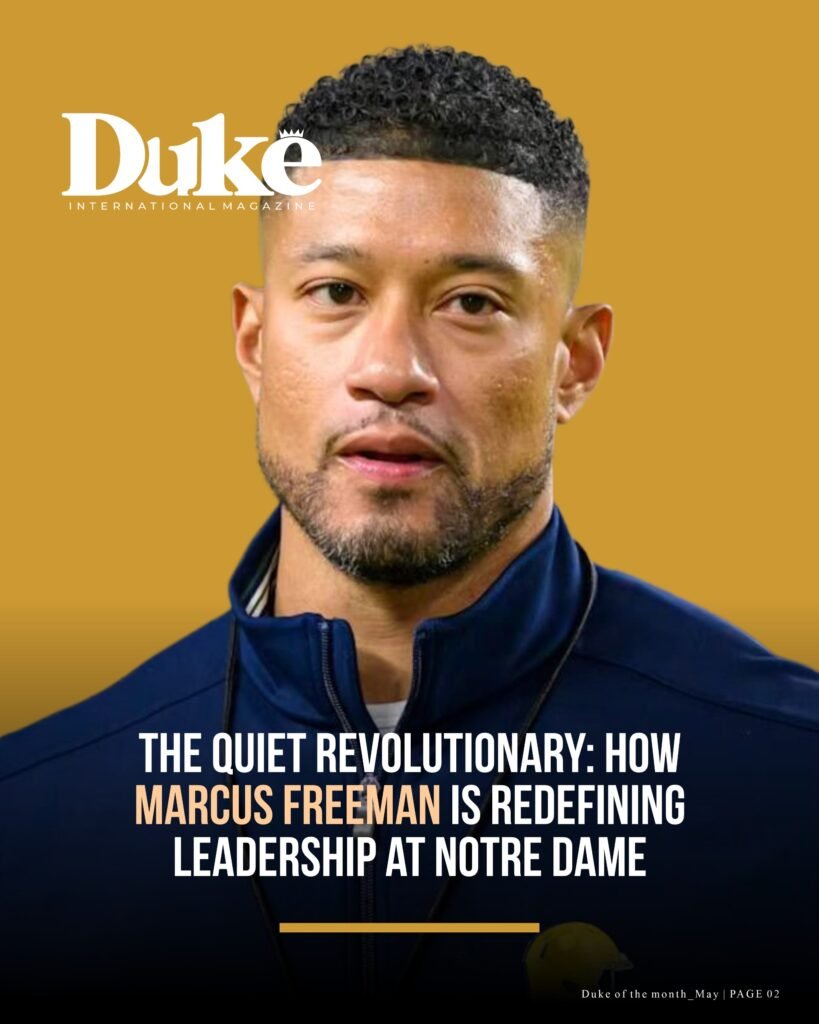
In an age of college football defined by transactional relationships, where name, image and likeness deals and the transfer portal have reshaped the sport into something resembling a free market, there exists a head coach who still believes that football is fundamentally about the formation of young men.
That coach is Marcus Freeman, the thirty-nine year old leader of the Notre Dame Fighting Irish, and his philosophy stands as a powerful counterweight to the cynicism that has crept into amateur athletics.
When Freeman was appointed head coach in December 2021, the circumstances could hardly have been more chaotic. His predecessor had departed for Louisiana State University in a manner that left a sour taste across the South Bend campus, informing his players of his exit via text message. Into this vacuum stepped Freeman, a thirty-five year old defensive coordinator who had never served as a head coach at any level.
The decision was widely regarded as a significant gamble, yet the university’s former athletic director had a clear vision. What the athletic director discovered when he spoke with the players only reinforced his conviction. They told him to preserve what Freeman had begun to build. One running back revealed that he would intentionally alter his daily path through the athletic complex simply to stop and greet Freeman. This was not a transactional relationship, it was something deeper.
Freeman’s journey to this moment was neither linear nor expected. Born in Dayton, Ohio, to an Air Force officer and a Korean immigrant, he grew up in a household that valued discipline, service and humility. As a player at Ohio State, Freeman started thirty seven games and earned All-Big Ten honours twice.
Drafted by the Chicago Bears, his professional career was extinguished before it could begin when a physical revealed an enlarged heart valve, forcing him to retire in 2010. But Freeman was not ready to abandon the game he loved. He returned to Ohio State as a graduate assistant and discovered that coaching was not a consolation prize but his calling.
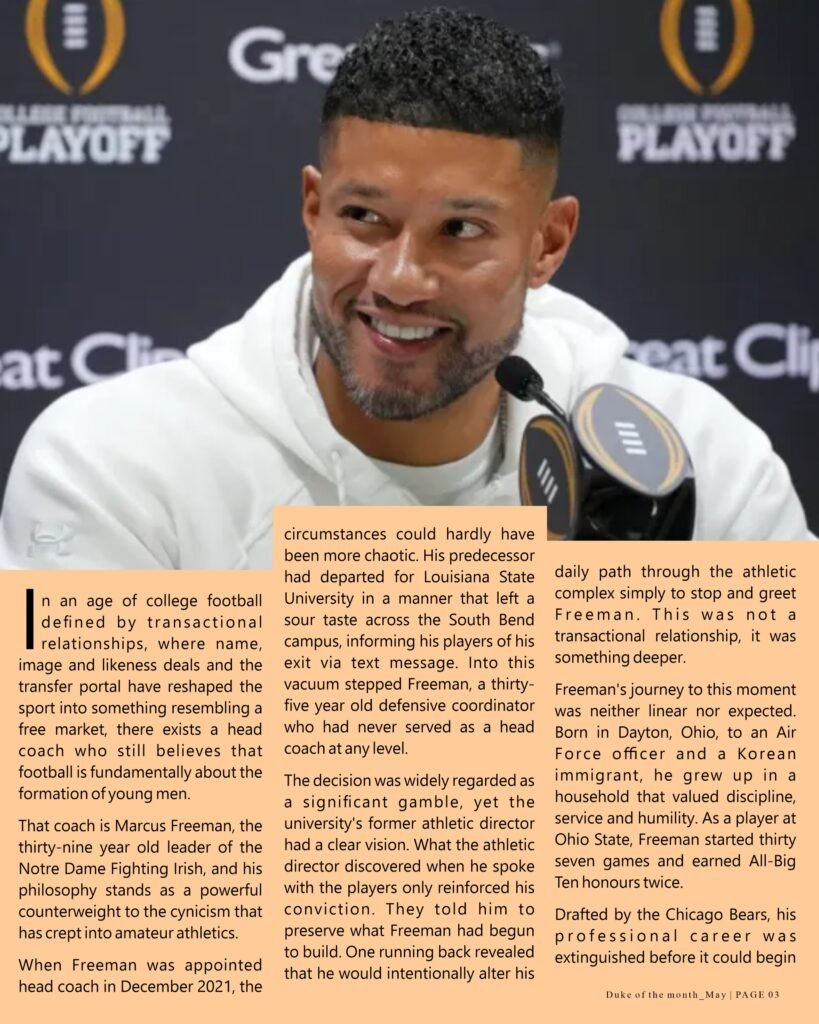
To understand Marcus Freeman is to understand that he views coaching not as a job but as a form of ministry. “We have to serve these young people,” he said. “Whatever our young people need, that is who we are.” This mindset manifests in the smallest details.
Freeman keeps chewing gum in his vehicle because he knows he will encounter students and staff across campus and does not wish to impose stale breath upon them. Former players speak of Freeman with rare affection. One linebacker explained: “He is his genuine self on a daily basis, which allows people to open up to him. It never felt like a transactional relationship.”
The most revealing window into Freeman’s leadership is the mantra he has instilled throughout the programme: Choose Hard. The phrase originated in the Notre Dame weight room, where Freeman pushed himself through a difficult workout alongside his players.
He realised that every individual faces a daily choice between coasting and striving. The sign now greets everyone who enters the football facility. “When you walk into Notre Dame football, you have to have that mindset,” Freeman explained. “We are going to choose hard today in practice, choose hard today in meetings, choose hard today in the weight room.”
This philosophy extends to how Freeman handles adversity. Two games into his first full season, the Irish lost at home to a heavy underdog, then lost to a team that would finish with only three victories. Critics sharpened their knives. Then came the 2023 loss to Ohio State, which might have broken a lesser leader.
With the game hanging in the balance, Notre Dame had only ten defenders on the field for the final two plays at the goal line. Ohio State scored the winning touchdown. Freeman took full responsibility. He did not name players or assistants. He stood before the media and his team and owned the failure completely.
The true test arrived early in the 2024 season. After a gritty road victory over Texas A&M, the Irish returned home as heavy favourites against Northern Illinois. They lost. The morning after, Freeman sat down with a pen and paper.
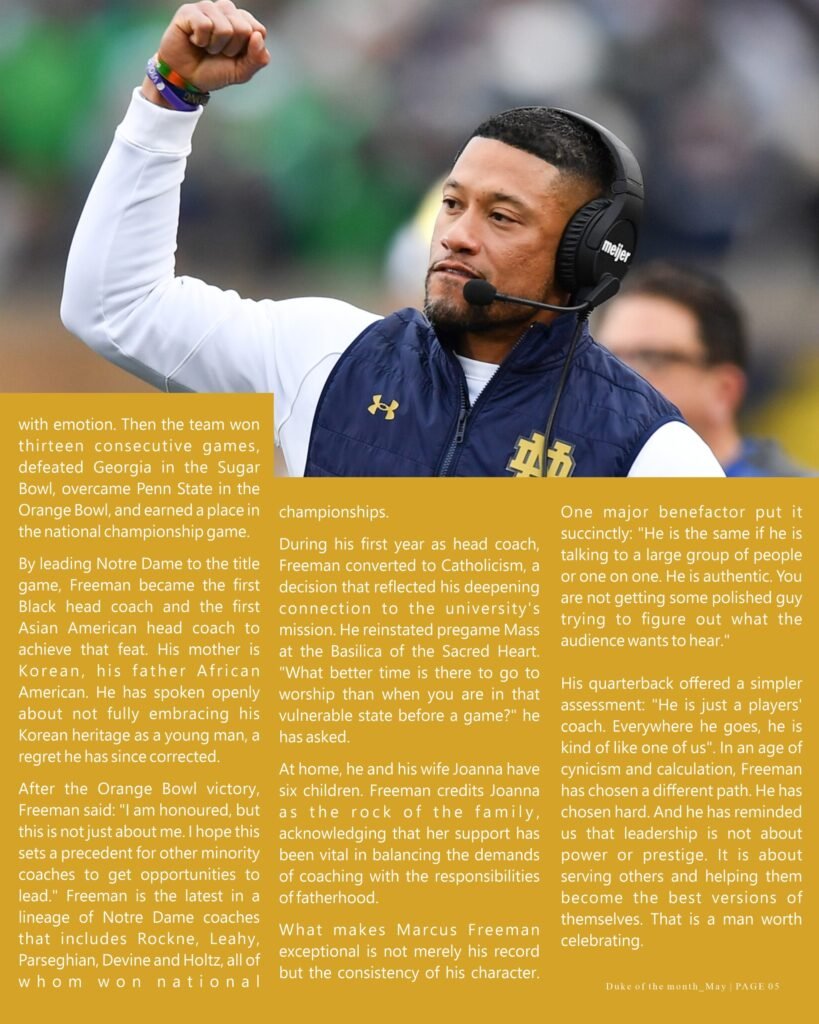
He wrote a letter that he read aloud to his staff and then to the entire team. “There is a reason we lost on Saturday,” he wrote. “We were not ready to handle success yet. Sometimes you have to lose to win. There is no reward without pain, no success without struggle. Not denied, just delayed.” The meeting room filled with emotion. Then the team won thirteen consecutive games, defeated Georgia in the Sugar Bowl, overcame Penn State in the Orange Bowl, and earned a place in the national championship game.
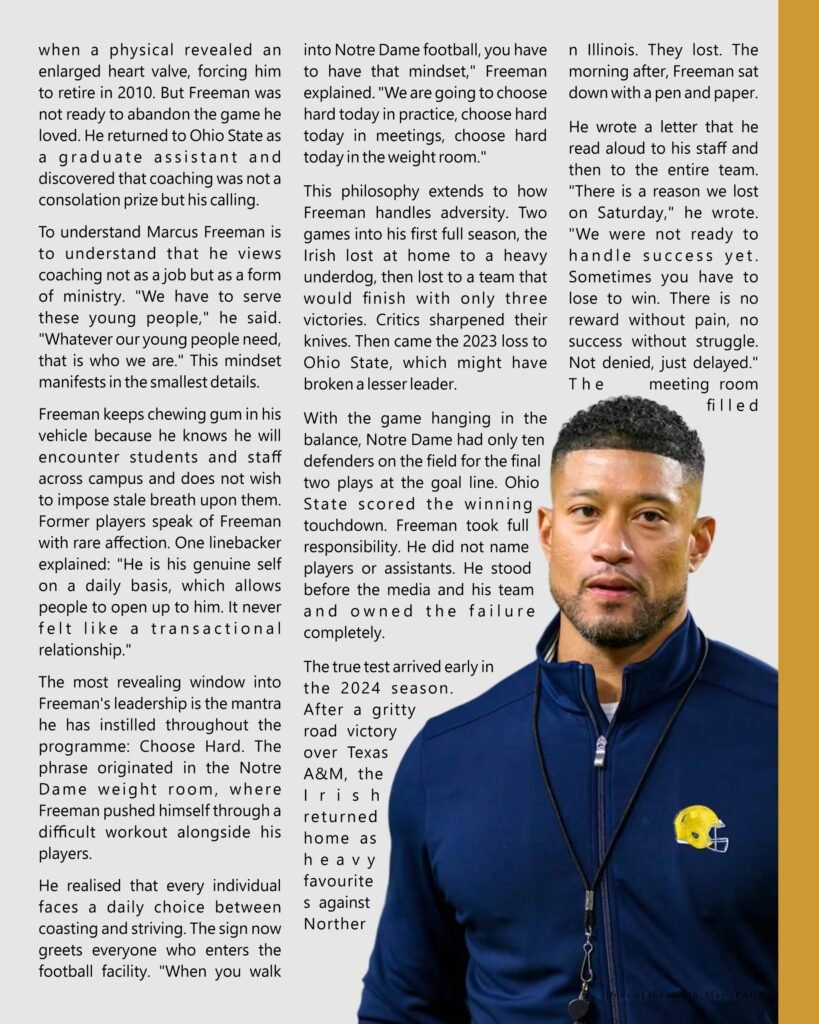
By leading Notre Dame to the title game, Freeman became the first Black head coach and the first Asian American head coach to achieve that feat. His mother is Korean, his father African American. He has spoken openly about not fully embracing his Korean heritage as a young man, a regret he has since corrected.
After the Orange Bowl victory, Freeman said: “I am honoured, but this is not just about me. I hope this sets a precedent for other minority coaches to get opportunities to lead.” Freeman is the latest in a lineage of Notre Dame coaches that includes Rockne, Leahy, Parseghian, Devine and Holtz, all of whom won national championships.
During his first year as head coach, Freeman converted to Catholicism, a decision that reflected his deepening connection to the university’s mission. He reinstated pregame Mass at the Basilica of the Sacred Heart. “What better time is there to go to worship than when you are in that vulnerable state before a game?” he has asked.
At home, he and his wife Joanna have six children. Freeman credits Joanna as the rock of the family, acknowledging that her support has been vital in balancing the demands of coaching with the responsibilities of fatherhood.
What makes Marcus Freeman exceptional is not merely his record but the consistency of his character. One major benefactor put it succinctly: “He is the same if he is talking to a large group of people or one on one. He is authentic. You are not getting some polished guy trying to figure out what the audience wants to hear.”
His quarterback offered a simpler assessment: “He is just a players’ coach. Everywhere he goes, he is kind of like one of us”. In an age of cynicism and calculation, Freeman has chosen a different path. He has chosen hard. And he has reminded us that leadership is not about power or prestige. It is about serving others and helping them become the best versions of themselves. That is a man worth celebrating.
Edward Blackmon Junior: The Quiet Architect of Justice and Political Representation
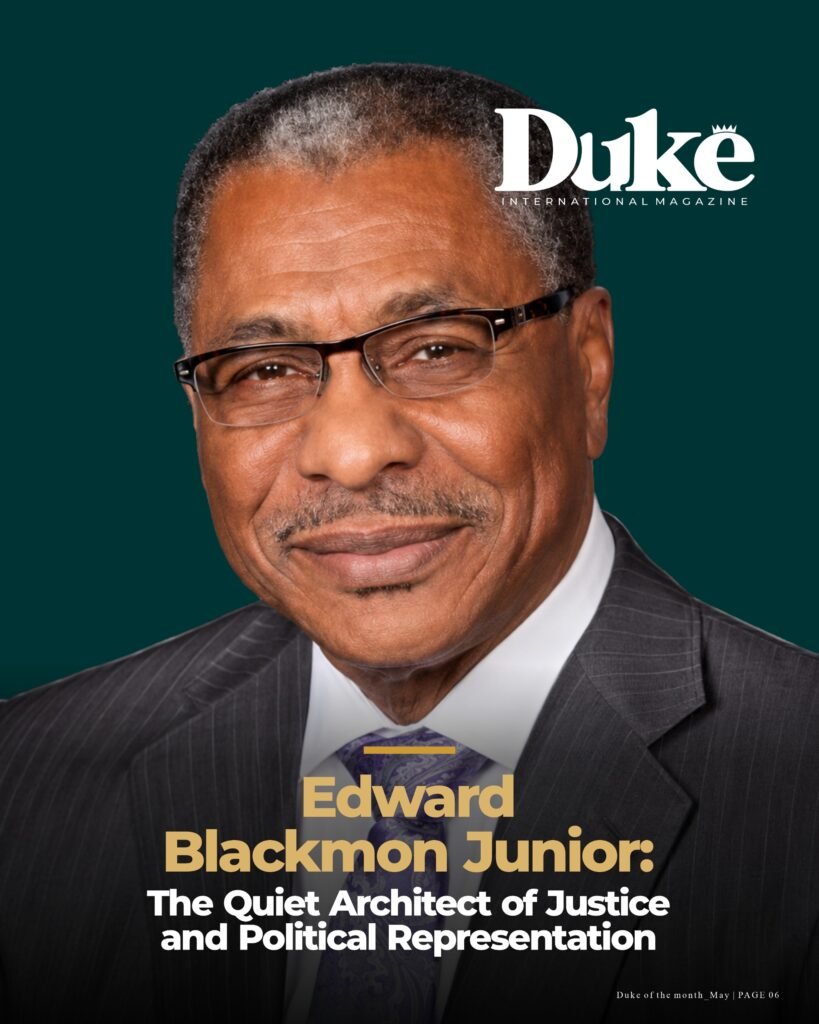
For more than four decades, Edward Blackmon Junior has occupied a distinctive and deeply respected position within the political and legal landscape of Mississippi, yet his name remains far less known than his contributions would merit. In a state once defined by its fierce resistance to civil rights, Blackmon has functioned as both a legislative craftsman and a constitutional guardian, shaping laws that govern voting rights, education, and criminal justice with a precision born of long experience.
Born and raised in the rural community of Pickens, Mississippi, Blackmon came of age during the most turbulent years of the American civil rights movement. That environment, charged with both peril and possibility — instilled in him an unshakable conviction that the law could be a tool for liberation rather than oppression.
After earning his law degree from the University of Mississippi School of Law in 1974, he returned to his home district and began what would become a lifetime of public service.
Elected as a Democrat to the Mississippi House of Representatives in 1980, Blackmon represented the people of Canton and the surrounding areas of Madison County for over forty years.
Unlike the fiery orators who often dominate news coverage, Blackmon cultivated a reputation as a legislator who worked in the shadows of the committee room and the fine print of the bill. He rose to become the Speaker Pro Tempore, a position that reflected the deep trust his colleagues placed in his understanding of parliamentary procedure and his unfailing sense of fairness.
His legal career outside the legislature was equally significant. As a principal in the law firm of Blackmon and Blackmon, he handled hundreds of cases involving personal injury, employment discrimination, and wrongful death. It was this dual perspective, as both a lawmaker and a practising attorney, that allowed him to see legislation not as abstract policy but as a living instrument with real consequences for ordinary people.
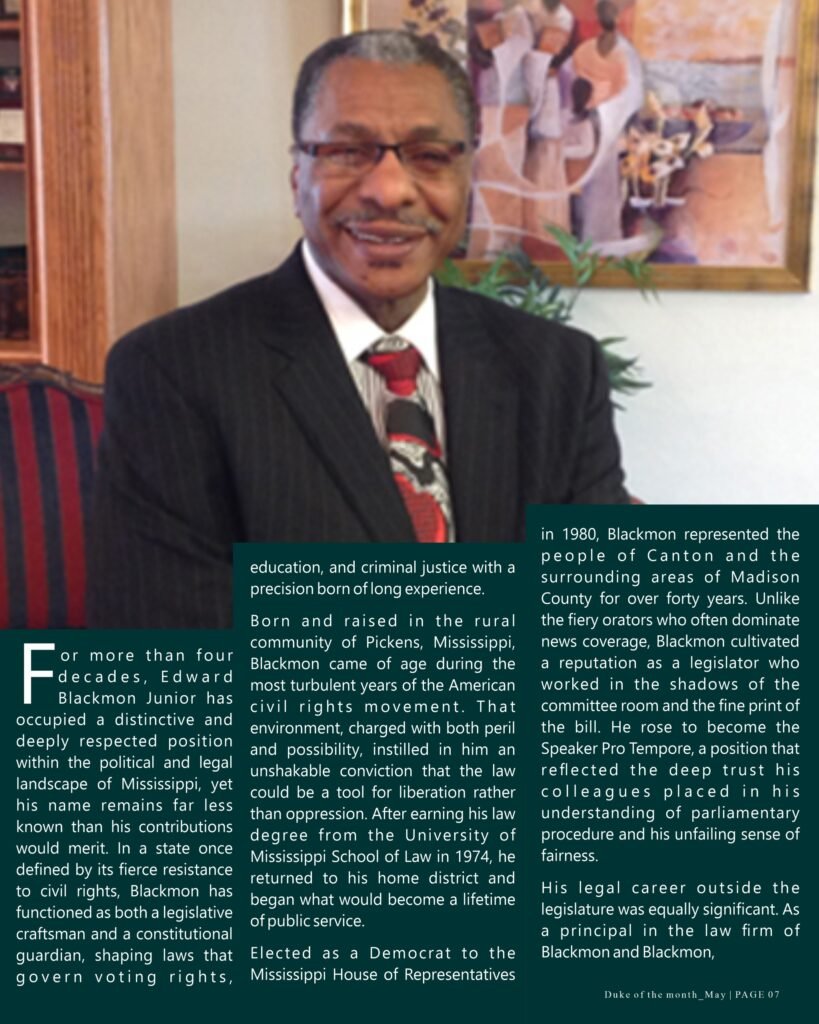
Perhaps the most underappreciated aspect of Blackmon’s career is his role in the battle for voting rights in the twenty-first century. Following the United States Supreme Court’s 2013 decision in Shelby County v. Holder, which effectively disabled a key provision of the Voting Rights Act, many Southern states moved quickly to alter election laws. Blackmon was among the first legal minds in Mississippi to recognise the danger.
He filed multiple lawsuits challenging new voting requirements and redistricting maps, arguing that they disproportionately harmed minority voters. His litigation helped to restore federal oversight in several jurisdictions, and his legal arguments have been cited in subsequent voting rights cases across the country.
In the legislature, he was the quiet force behind numerous bills aimed at expanding access to the ballot, including measures to simplify voter registration and to restore voting rights to people who had completed felony sentences. These efforts did not always succeed, but Blackmon’s persistence ensured that the debate never disappeared from the chamber floor.
Beyond voting rights, Blackmon’s legislative record touched nearly every facet of Mississippi life. He wrote and negotiated laws to increase funding for rural schools, to create oversight boards for law enforcement agencies, and to expand healthcare access in underserved communities.
He approached each issue with the same methodical temperament: first, he studied the existing law; second, he consulted the people most affected by it; and third, he drafted a remedy that could survive both political scrutiny and judicial review.
Colleagues from both parties described him as a man of his word. In an era of performative politics and partisan theatre, Blackmon refused to grandstand. He did not chase media attention. He did not issue press releases for every minor victory. Instead, he worked the corridors of the state capitol in Jackson with a quiet courtesy that disarmed opponents and built coalitions where none seemed possible.
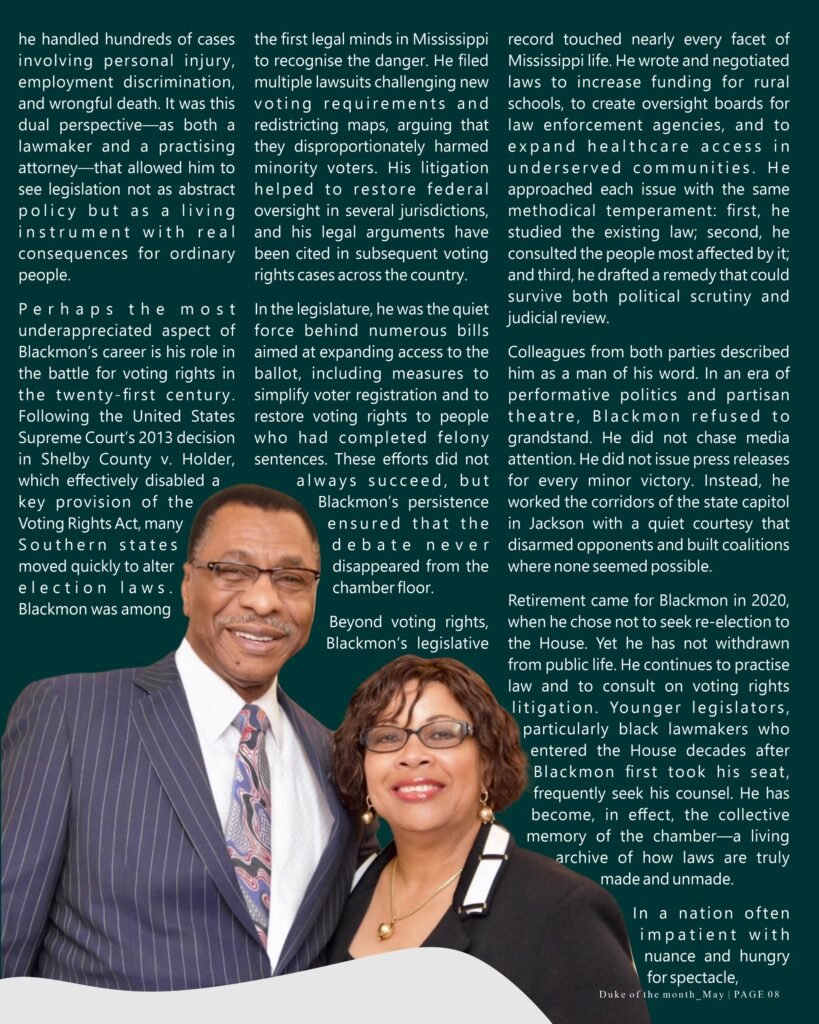
Retirement came for Blackmon in 2020, when he chose not to seek re-election to the House. Yet he has not withdrawn from public life. He continues to practise law and to consult on voting rights litigation. Younger legislators, particularly black lawmakers who entered the House decades after Blackmon first took his seat, frequently seek his counsel. He has become, in effect, the collective memory of the chamber, a living archive of how laws are truly made and unmade.
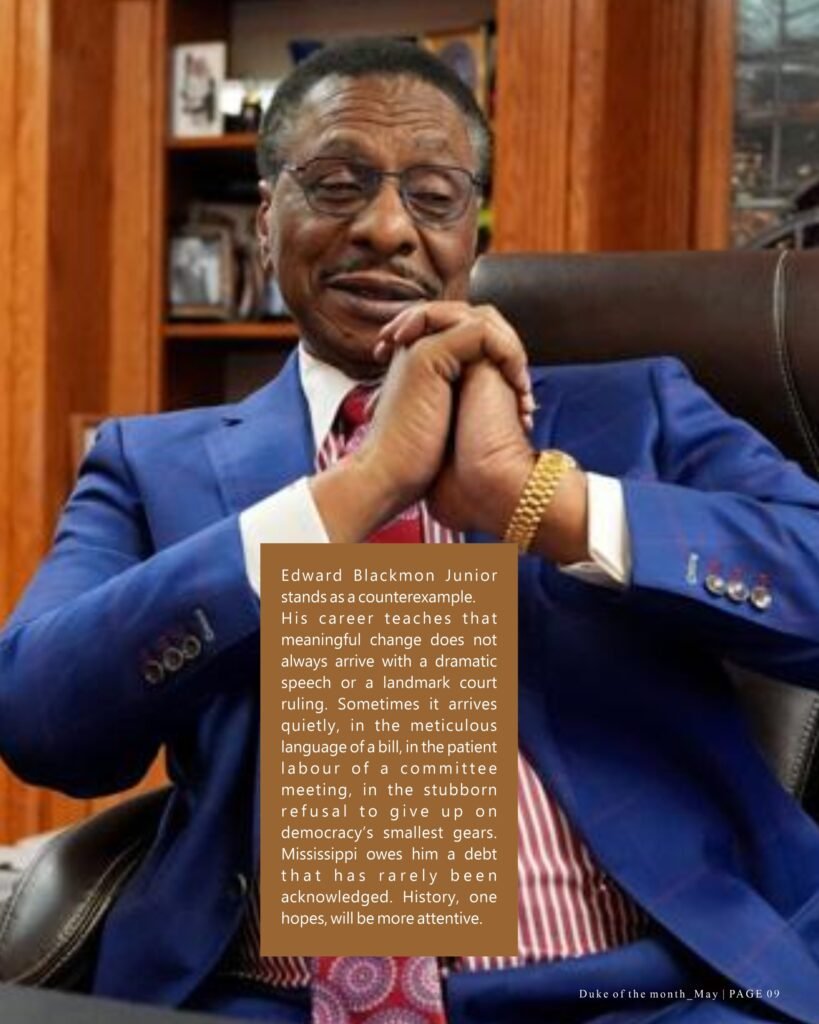
In a nation often impatient with nuance and hungry for spectacle, Edward Blackmon Junior stands as a counterexample. His career teaches that meaningful change does not always arrive with a dramatic speech or a landmark court ruling.
Sometimes it arrives quietly, in the meticulous language of a bill, in the patient labour of a committee meeting, in the stubborn refusal to give up on democracy’s smallest gears. Mississippi owes him a debt that has rarely been acknowledged. History, one hopes, will be more attentive.