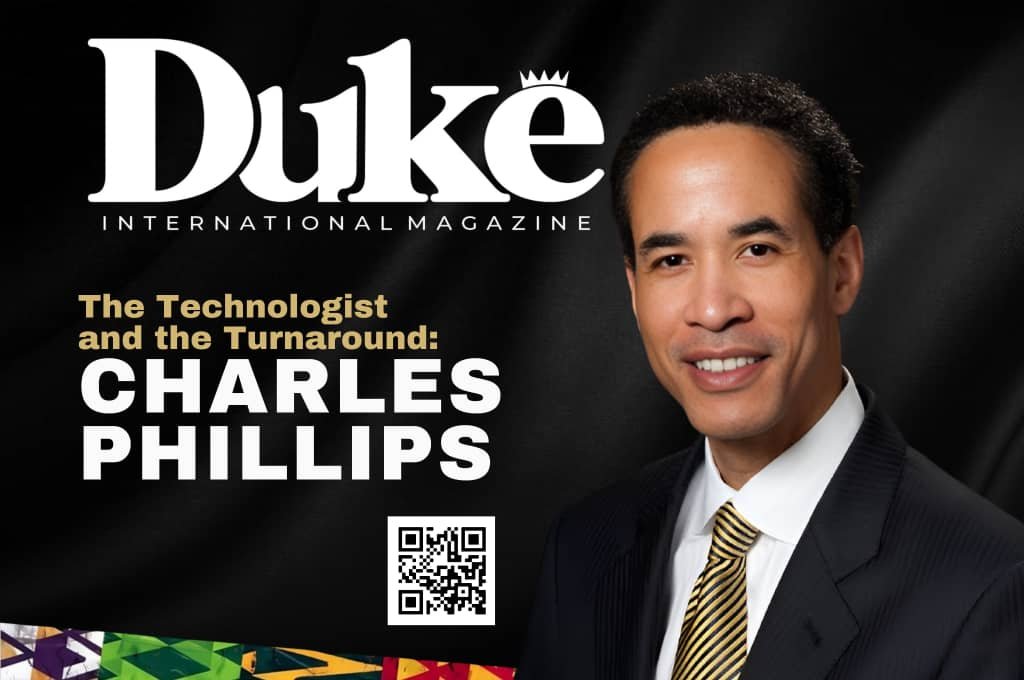
Charles Edward Phillips Junior belongs to a rare category of business leader: the analyst who learns to lead, the lawyer who thinks like an engineer, and the military officer who operates with equal ease on Wall Street and in Silicon Valley. Born in Little Rock, Arkansas, in 1959 to an Air Force father, he spent his childhood moving between American states and European posts, an early education in adaptation .
His father expected one of his four sons to serve, and Phillips obliged, enrolling at the United States Air Force Academy. There he earned a bachelor’s degree in computer science, but when his eyesight fell short of pilot standards, he accepted a commission in the Marine Corps instead, rising to the rank of captain and managing computer systems at Camp Lejeune .
His formal education did not end with the military. He completed a Master of Business Administration at Hampton University, a historically Black university in Virginia, and later added a Juris Doctor from New York Law School, a combination of credentials that would prove unusually potent in the upper reaches of corporate technology .
Upon leaving the Marines in 1986 at his wife Karen’s urging, he moved to New York and began the civilian phase of his career at the Bank of New York Mellon, then moved through SoundView Technology Group and Kidder Peabody before landing at Morgan Stanley in 1994 .
At Morgan Stanley, Phillips became a managing director in the investment banking technology group and, for ten consecutive years, was ranked the number one enterprise software industry analyst by Institutional Investor . He cultivated relationships with hedge fund managers, venture capitalists, and technology chief executives, acquiring a reputation as one of the most connected and aggressive analysts on the Street.
Among those he advised was Larry Ellison, the co-founder and chief executive of Oracle Corporation. In 2003, Ellison recruited Phillips to Oracle as co-president and a member of the board of directors .
The seven years that followed were transformative for Oracle and for Phillips. He led the company’s field organisation and oversaw revenue growth of nearly three hundred per cent . More visibly, he orchestrated a historic acquisition spree, guiding the purchase of more than seventy companies including PeopleSoft, Siebel Systems, Hyperion Solutions, and BEA Systems .
By the middle of the decade, he was one of the highest-profile African-American executives in the technology industry, described by InformationWeek as ‘Oracle’s Secret Weapon’ . Yet his tenure was not without controversy. In 2010, news of an eight-year extramarital affair became public through billboards paid for by his former mistress, and a public remark about Oracle’s acquisition budget forced the company to issue a retraction . Within months, Phillips had resigned.
He resurfaced in October 2010 as chief executive officer of Infor, the world’s third-largest provider of enterprise software and the largest privately owned software company at the time . The move was widely interpreted as a bid for redemption, and Phillips approached it with characteristic intensity. Within four months, he led Infor’s two billion dollar acquisition of Lawson Software, a competitor in the health care sector, and relocated the company’s headquarters from suburban Atlanta to Manhattan’s Silicon Alley. Over the next nine years, he remade Infor in his own image.
His strategy was one of deliberate differentiation. Rather than challenge Oracle and SAP on their own terms, he directed Infor toward niche acquisitions and ‘micro-verticals’—highly specialised software for particular industries . He invested heavily in user experience, creating an internal design agency called Hook & Loop to ensure that enterprise software could be beautiful as well as functional, guided by the motto ‘work is beautiful’ .
He saw the shift to cloud computing earlier than many of his competitors and positioned Infor as the first ‘industry cloud company’, moving the bulk of its applications and revenues to Amazon Web Services . By the time he stepped down as chief executive in 2019 to become chairman, Infor had more than seventeen thousand employees, operated in one hundred and ninety countries, and counted over seventy million cloud subscribers . In 2020, the company was sold for a thirteen billion dollar enterprise valuation .
Phillips did not retire. With several partners, he co-founded Recognize, a technology investment and transformation firm managing more than one billion dollars in assets . He also maintains an extensive portfolio of board directorships, including American Express, Compass, and the Apollo Theater, where he serves as chairman . He co-chairs the Black Economic Alliance Foundation, sits on the Council on Foreign Relations, and is a member of the State Bar of Georgia .
Alongside his wife Karen, he directs the Phillips Charitable Organizations, which provide financial assistance to single parents, engineering students, and wounded veterans . In 2012, he was inducted into the Arkansas Black Hall of Fame . He has served on President Barack Obama’s Economic Recovery Advisory Board and the board of the Federal Reserve Bank of New York .
Charles Phillips is not a man who pauses easily. His career has been marked by rapid ascent, public setback, and methodical reconstruction. He has been an officer, an analyst, a dealmaker, a chief executive, and an investor. Across each incarnation, one quality remains constant: an engineer’s conviction that systems, whether of software or of organisations, can be diagnosed, repaired, and improved.