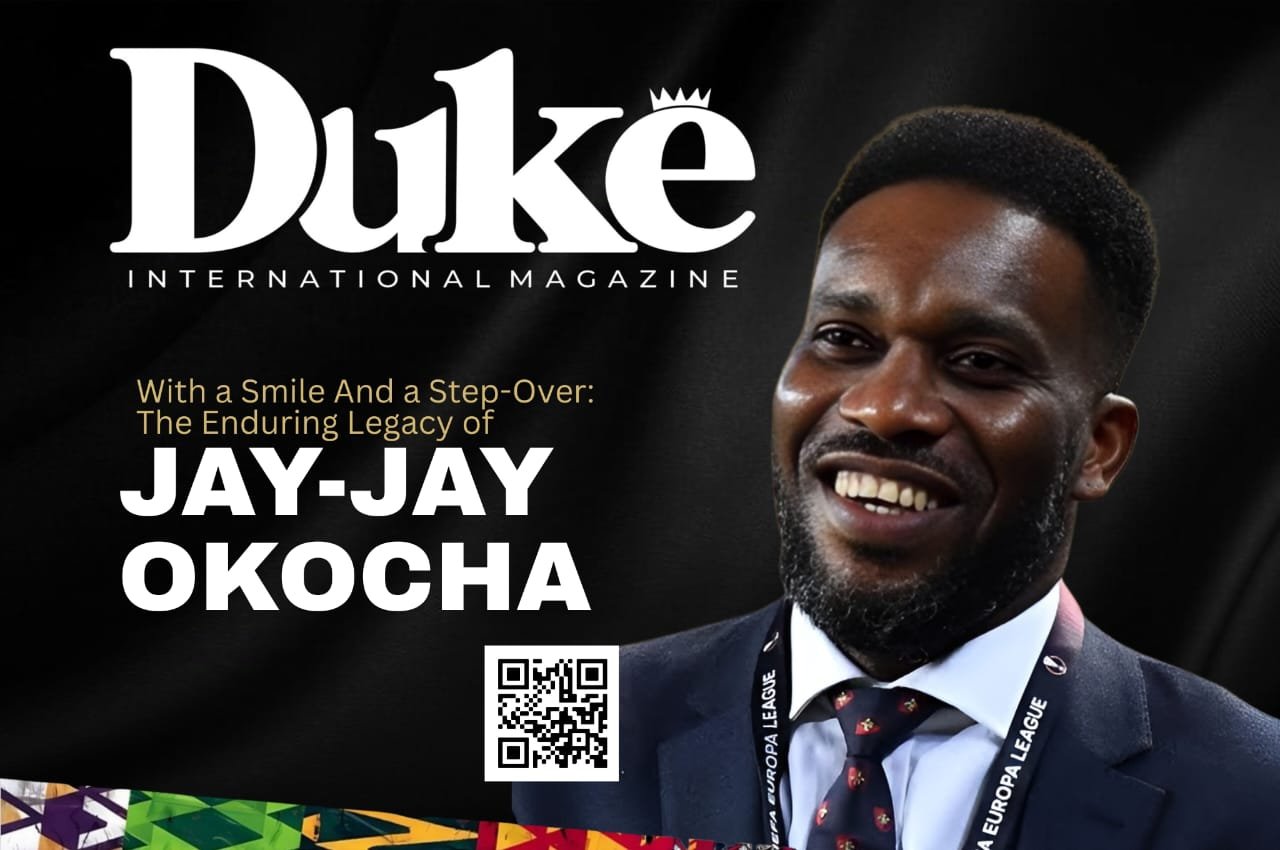
In the storied history of football, few names evoke a sense of pure, unadulterated joy quite like Jay-Jay Okocha. For a generation of fans, the Nigerian magician embodied a rare fusion of street-football flair and elite athletic prowess, a player whose very nickname—bestowed because he was so good they named him twice, the nickname became a testament to his genius.
His journey began not on manicured academy pitches, but on the streets of Enugu, Nigeria. There, a young Augustine Azuka Okocha learned the game with whatever round object he could find, developing an improvisational style and love for expression that would define his career. “It was our only toy,” he once recalled. “It was where we could express our joy, our freedom”.
A fortuitous holiday to Germany in 1990 catalysed his professional path. While visiting, he trained with third-division side Borussia Neunkirchen, impressing the coach enough to earn a contract.
This leap of faith led him to the Bundesliga with Eintracht Frankfurt, where he announced himself to the world with a goal of breathtaking audacity in 1993. Against Karlsruhe, he dribbled past multiple defenders, famously wrong-footing the great Oliver Kahn twice before scoring, a strike voted Germany’s Goal of the Year.
His talent took him across Europe, with successful spells at Fenerbahçe and Paris Saint-Germain, where he became the most expensive African player at the time and served as a mentor to a young Ronaldinho. However, it was in the unlikely setting of Bolton, in north-west England, that his legend was cemented in the Premier League.
Arriving in 2002, Okocha became the sparkling focal point of Sam Allardyce’s eclectic, multi-cultural squad. He played with a contagious smile and a fearless attitude, executing backheels, scoops, and dizzying step-overs often in his own penalty area.
His brilliance was both aesthetic and effective; a spectacular solo goal against West Ham United was vital in securing Bolton’s survival and later voted the club’s best Premier League goal. As captain, he led the team to a League Cup final and European qualification, embodying a thrilling brand of football that defied pragmatism.
Concurrently, Okocha was the heartbeat of Nigeria’s golden generation. He was instrumental in qualifying the Super Eagles for their first World Cup in 1994, a campaign they crowned by winning the African Cup of Nations that same year.
Two years later, he was a key figure in the celebrated “Dream Team” that won Olympic gold in Atlanta. He would captain his nation to multiple African Cup of Nations tournaments, being named the best player in the 2004 edition.
While his career yielded individual accolades, including being named one of Pelé’s top 125 living footballers, his true legacy lies in the feeling he inspired. Jay-Jay Okocha was proof that at the highest level, artistry and effectiveness could coexist.
He remains a timeless icon, a player who did not just play football, but celebrated it with every touch, reminding the world that the game, at its best, is an expression of joy.