

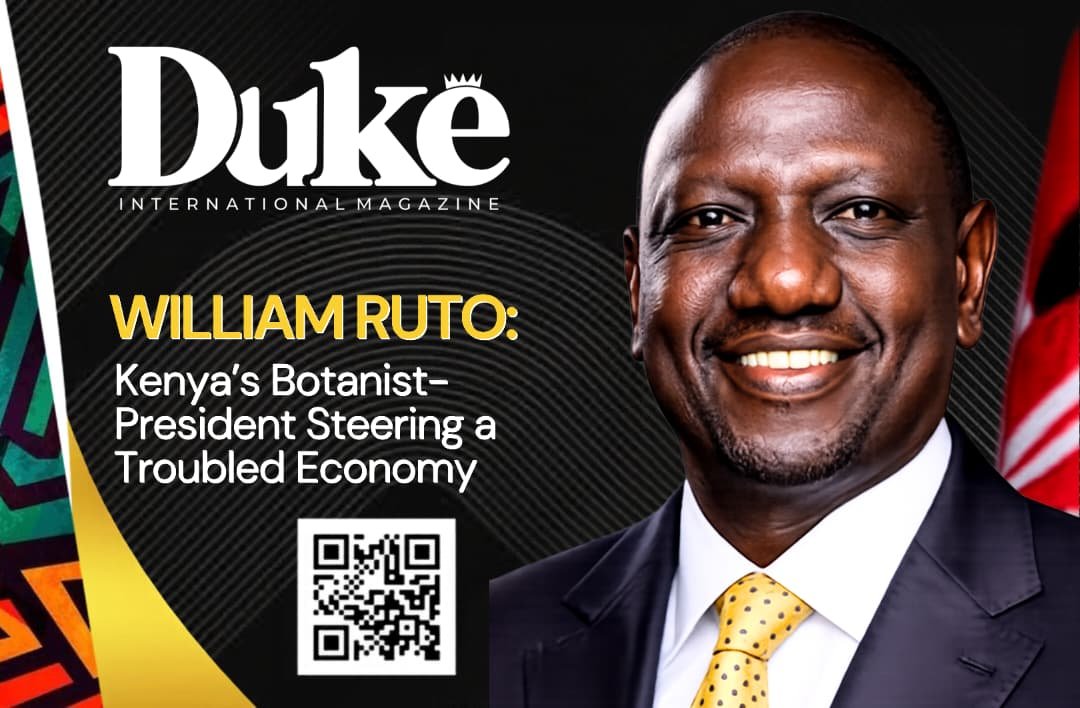
William Samoei Ruto, Kenya’s fifth president, occupies a unique place in the country’s political history. A botanist by training and Kenya’s first head of state to hold a doctorate, Ruto rose from selling peanuts and chickens at the roadside in Uasin Gishu County to the highest office in the land, sworn in on 13 September 2022.
His journey through KANU, a long stint as deputy president under Uhuru Kenyatta, and finally victory on a United Democratic Alliance ticket has been marked by sharp political turns and a reputation for resilience.
Ruto’s presidency has been defined by an economic agenda he calls the Bottom-Up Economic Transformation Agenda, or BETA. The pitch is simple enough: direct government support to the small traders, farmers, and low-income households who form the backbone of Kenya’s informal economy.
In practice, his administration points to a set of headline numbers. Inflation fell from 9.6 per cent in 2022 to 4.1 per cent in 2025, and the shilling stabilised at around KSh129 to the dollar after touching KSh162.
A fertiliser subsidy cut the price of a 50-kilogram bag from KSh7,500 to KSh2,000, helping push maize production from 44.3 million bags to 71 million bags. The Hustler Fund has extended credit to borrowers previously shut out of formal lending, and the government says 707,000 Kenyans have secured jobs abroad, with a further 350,000 finding work in the digital economy.
The record is not without its shadows. Ruto’s tenure has been contested over taxation, the cost of living, public spending, and police conduct during protests. His administration withdrew the Finance Bill 2024 after nationwide demonstrations, and he has since faced scrutiny over judicial overreach and accountability for protest-related violence, with the government stating that KSh1.2 billion has been paid to victims.
Supporters credit him with staving off a debt crisis and restoring macroeconomic stability; critics argue that the recovery has been uneven and that the burden has fallen hardest on those BETA was meant to help.
Abroad, Ruto has positioned himself as an economic diplomat and a voice for African-led solutions. He has pushed trade deals and investment ties, overseen the restoration of ambassadorial relations with the Democratic Republic of the Congo after a diplomatic rupture, and framed Kenya’s foreign policy as an instrument of national development.
At home, he remains a divisive figure: admired for his command of policy detail and his up-from-poverty story, criticised for the distance between the rhetoric of Usawa ni Sawa and the lived experience of many Kenyans.
With his re-election bid already taking shape, Ruto’s central challenge is to convince voters that the stabilisation he presides over will translate, in tangible terms, into the transformation he promised.

