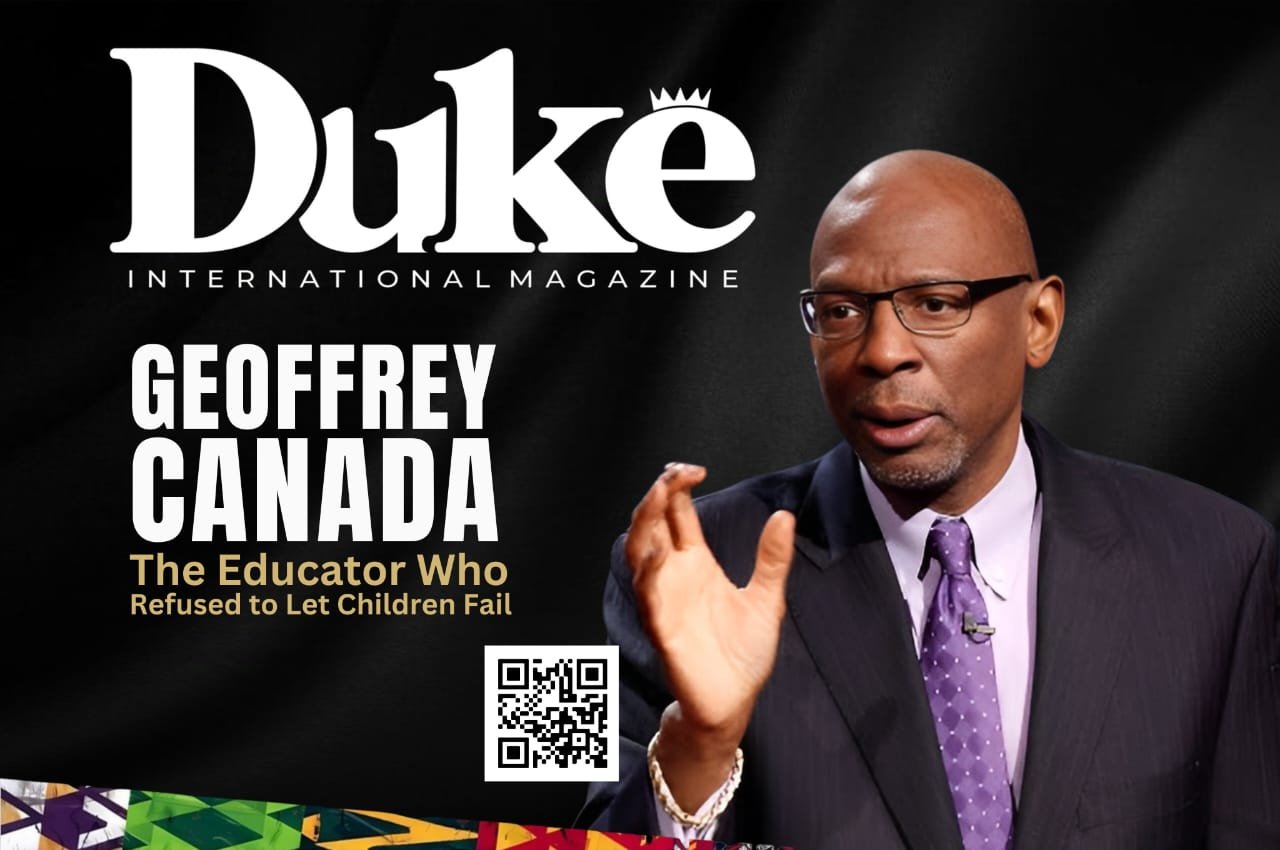
In the landscape of American education, Geoffrey Canada stands as a singular figure whose work has fundamentally altered the conversation about how to help children trapped in poverty. As the long-time president of the Harlem Children’s Zone, Canada has spent decades demonstrating that with enough resources, commitment, and comprehensive support, the cycle of intergenerational poverty can indeed be broken.
Canada’s own beginnings could have told a different story. Born in the South Bronx in 1952, he was raised by a single mother in a neighbourhood defined by abandoned houses, violence, and pervasive chaos. His father played little part in his upbringing, and for a time, Canada carried a knife and a gun for protection, learning the harsh lessons of the streets that he would later document in his acclaimed memoir, Fist Stick Knife Gun.
Yet his mother, Mary Canada, possessed only a couple of years of college education but understood intuitively that learning extended beyond the classroom. She bombarded her sons with books and educational experiences from infancy, an intervention that would prove transformative.
When Canada was in his mid-teens, his mother sent him to live with his grandparents on Long Island, a move that expanded his horizons. He earned a scholarship from the Fraternal Order of Masons during his senior year of high school, which helped pave his way to Bowdoin College in Maine, where he graduated in 1974 with a degree in psychology and sociology.
From there, he pursued a master’s degree in education at Harvard University, graduating in 1975. It was at Harvard that he encountered professors who not only shaped his understanding of educational theory but also demonstrated the importance of putting that knowledge into practice.
After a period teaching in Boston, Canada returned to New York in 1983 to work with the Rheedlen Centers for Children and Families. Initially, he believed the organisation was making a genuine difference, but when he examined the data more closely, looking at graduation rates and long-term outcomes, he realised that children who left their programmes often slipped back into difficulty. This uncomfortable truth prompted a radical reimagining of what was possible.
With the support of Stanley Druckenmiller, a hedge fund manager who became a committed partner, Canada proposed an audacious experiment: draw a line around a ninety-seven block area of Central Harlem and saturation it with comprehensive services.
The organisation, renamed the Harlem Children’s Zone, would follow children from birth all the way through to college, providing parenting classes, early childhood education, after-school programmes, health services, and support inside schools. The goal was not merely to help some children succeed but to prove that generational poverty could be ended entirely.
The New York Times Magazine called it one of the most ambitious social experiments of its time. The approach was place-based and unrelenting: if children needed something, the organisation would either provide it or help them find it. Canada’s philosophy was simple but demanding. He later told an audience that half the reason such efforts fail is because people do not ask for what they truly need.
The impact of the Harlem Children’s Zone eventually caught the attention of President Barack Obama, who announced plans in 2009 to replicate the model in twenty other cities across the United States through his Promise Neighborhoods initiative. Canada became a prominent figure in the national education debate, appearing in the documentary Waiting for Superman, on 60 Minutes, and on The Oprah Winfrey Show.
He was named one of Time magazine’s one hundred most influential people in the world and one of Fortune’s fifty greatest leaders. Yet despite this acclaim, he continued to insist that the real work happened on the ground, in the lives of individual children.
In 2014, Canada made the deliberate decision to step down as chief executive of the Harlem Children’s Zone, handing the role to Anne Williams-Isom. He believed that for any institution to fulfil its mandate, it must not only outlast its founder but remain great after the founder steps away. He continued to serve as president, remaining connected to the organisation and to the young people who had always been his primary focus.
Reflecting on his life’s work, Canada has spoken of a mentor from his own childhood in the Bronx, a man who simply told him, “Geoff, not you. I am going to make sure you don’t end up like the other kids.” That single act of protection, Canada said, was something he has spent his entire career trying to repay.
At a celebration marking his forty years with the organisation, he looked out at the thousands of children whose lives had been touched by his vision and posed a question that captured his enduring ambition: “Why not save them all?”.