

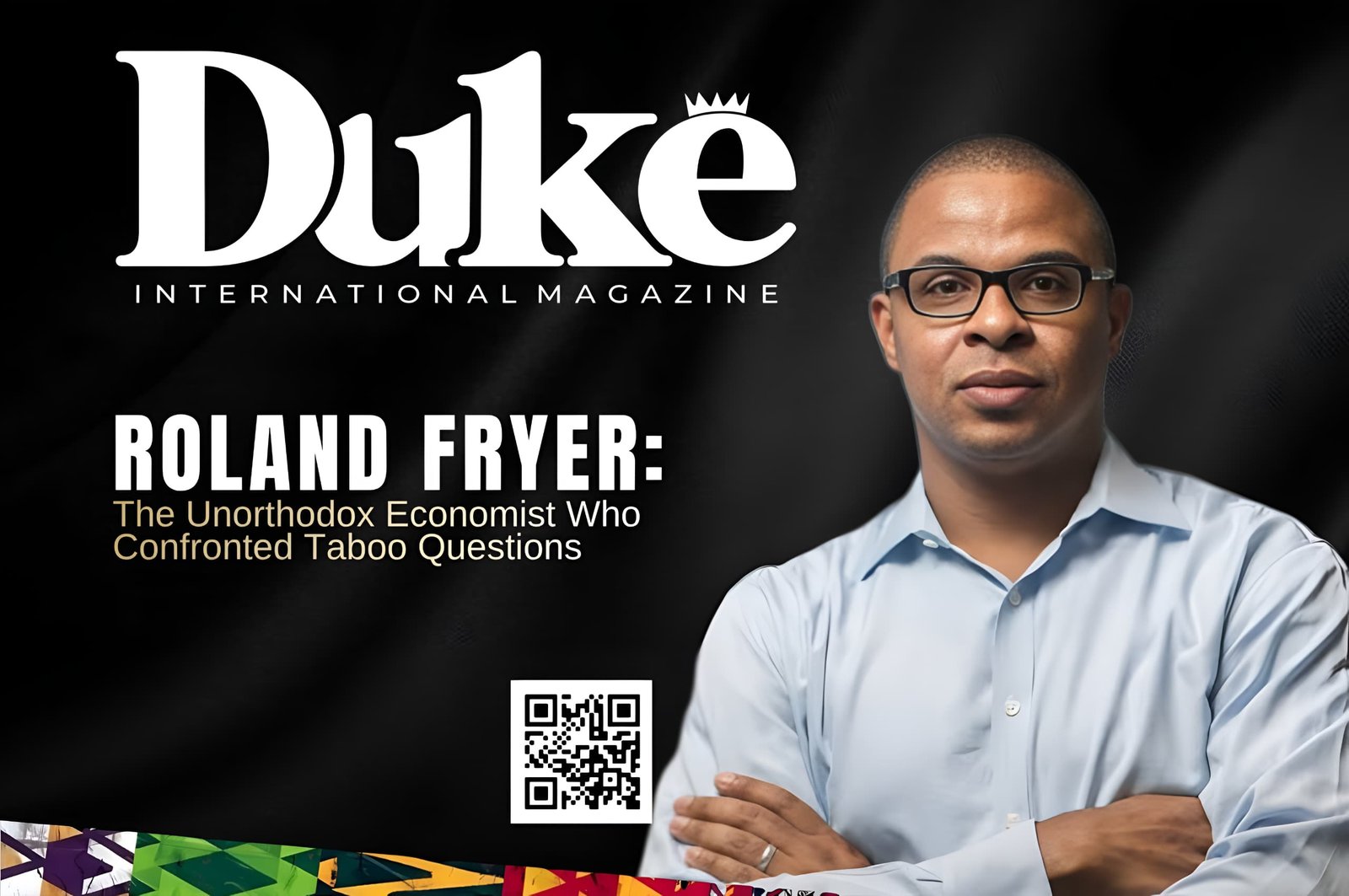
Roland Gerhard Fryer Jr. does not fit the mould of a conventional academic. Born in Daytona Beach, Florida, in June 1977, his early years were defined by upheaval. At the age of four, he was relocated to Lewisville, Texas, to live with his father, an abusive alcoholic who was later convicted of rape, leaving the young Fryer effectively to fend for himself.
By his teenage years, he had become what he later described as a “full fledged gangster”, selling drugs and running with a crowd that seemed destined for a tragic end. It was a brush with the police at fifteen, being detained and treated like a drug dealer, that proved to be the turning point, prompting him to abandon the only life he had known.
His escape route was athletics. A star in both football and basketball at Lewisville High School, Fryer earned an athletic scholarship to the University of Texas at Arlington. Once there, however, he never suited up for the Mavericks. Instead, he discovered a passion for the “cold-blooded, no-nonsense rationalism” of economics.
Graduating magna cum laude in just two and a half years, he completed his doctorate at Pennsylvania State University by 2002, followed by postdoctoral work at the University of Chicago under the Nobel laureate Gary Becker.
Fryer’s ascent through the academic ranks was meteoric. In 2007, at the age of thirty, he became the youngest African American ever to be awarded tenure at Harvard University. His research agenda was singular and audacious: to apply rigorous empirical methods to the most sensitive questions surrounding race and inequality in America.
He explored why black students underperform in schools, developed formal models to explain the phenomenon of “acting white”, and even analysed the economic history of the Ku Klux Klan. His willingness to place any hypothesis on the table, including genetics, earned him both praise and fierce criticism, yet his work garnered the highest honours.
In 2011, he received a MacArthur “Genius” Fellowship, and in 2015, he was awarded the John Bates Clark Medal, given to the most outstanding American economist under the age of forty.
His academic rigour soon crossed into the realm of public policy. Under New York City Mayor Michael Bloomberg, Fryer served as Chief Equality Officer for the Department of Education, where he designed and oversaw the “Opportunity NYC” programme, a pioneering experiment that offered financial incentives to students in low-performing schools.
He later founded the Education Innovation Laboratory at Harvard, seeking to translate research into practical interventions that could close the racial achievement gap.
Fryer’s career, however, took a dramatic turn in 2018. Following Title IX complaints alleging sexual harassment, Harvard barred him from his research lab and launched an investigation. The allegations centred on verbal conduct—off-colour jokes and inappropriate remarks, with no accusations of physical advances.
In July 2019, a faculty panel suspended Fryer without pay for two years, banned him from supervising graduate students, and permanently closed his laboratory.
Fryer, who had been one of the university’s highest-paid professors, maintained that he had been “unfairly scrutinised” and later expressed regret for fostering a collegial atmosphere that had allowed insensitive jokes to go unchecked. In 2021, Harvard permitted him to return to teaching and research, though with restrictions on his supervisory roles.
Beyond the controversy, Fryer’s intellectual legacy remains formidable. He has since co-founded Equal Opportunity Ventures, an early-stage seed fund, and continues to pursue research that integrates economic theory with big data and artificial intelligence to design policies aimed at increasing social mobility.
In 2025, he received the Academic Freedom Award from the Columbia Academic Freedom Council, an honour that recognised his willingness to defend his principles publicly even at significant personal and professional cost.
For Roland Fryer, the pursuit of truth has always been a personal mission. When asked about the driving force behind his intensity, he has spoken of a sense of guilt, a need to understand why he escaped a childhood that claimed so many of his friends. “Why me?” he has asked. “I’m going to spend the rest of my life using all of my energy, talent and data I can muster to try and figure it out”.