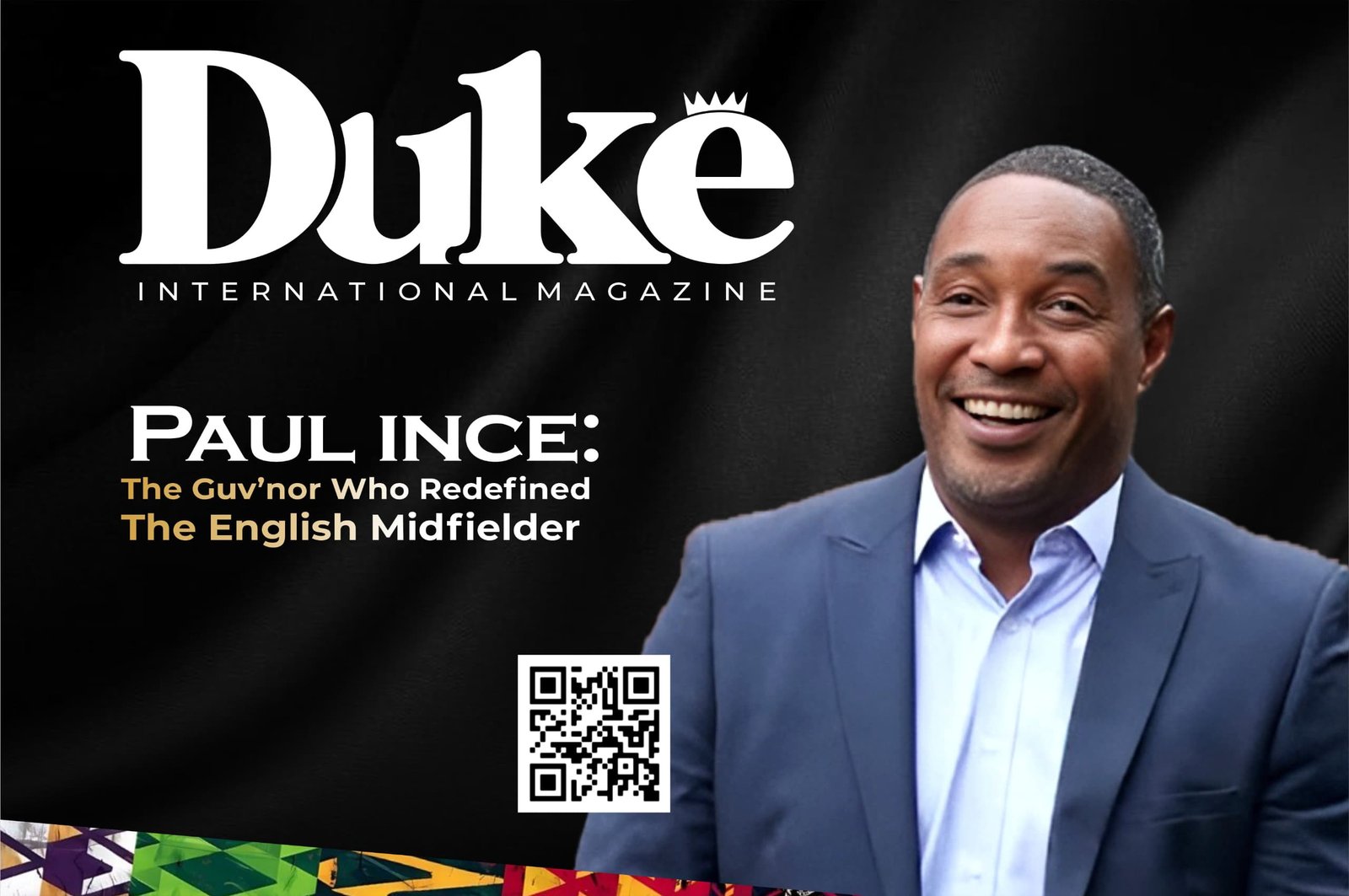
In the pantheon of English football’s great midfield enforcers, few names carry the same weight of authority and swagger as Paul Ince. Long before the modern era of polite possession football, there was a player who patrolled the centre circle like a territorial predator.
His nickname was not earned through public relations; it was bestowed by team-mates and opponents alike who felt his presence long before they saw him. He was, and remains, ‘The Guv’nor’.
Ince’s story begins in Ilford, Essex, where he was born in October 1967. As a young boy supporting West Ham United, he dreamed of wearing the claret and blue. That dream became reality in 1986 when he signed professional terms with the Hammers.
Yet the early years at Upton Park were unspectacular. Ince was a raw, energetic prospect who had not yet found his identity. He would leave West Ham having made just seventy-two league appearances, a respectable total but not one that hinted at the commanding figure he would soon become.
The turning point arrived in 1989, when a certain Alex Ferguson paid Manchester United seven hundred and fifty thousand pounds for his signature. It was a transfer that raised eyebrows.
Ferguson saw something others had missed: a fierce competitive intelligence married to genuine technical ability. At Old Trafford, Ince did not simply play midfield; he colonised it. He became the engine room of the first great Ferguson team, alongside Bryan Robson and later with the emerging youth corps of Ryan Giggs and David Beckham.
Ince was not a traditional English terrier. He could tackle, yes, and with a ferocity that left forwards rolling on the turf. But he could also pass, drive forward with the ball, and score crucial goals. He possessed the rare gift of making the game look simple while imposing his will on opponents.
His partnership with Robson in the early 1990s was a masterclass in midfield mechanics: one the bounding leader, the other the snarling executor. When United won the inaugural Premier League title in 1993, Ince was indispensable. The Double in 1994 confirmed his status as the best box-to-box midfielder in the country.
Yet for all his glory at United, Ince never became a mere company man. He demanded respect and paid it only to those he deemed worthy. This attitude, combined with contract disputes, led to a shocking departure in 1995. Ferguson sold him to Inter Milan for seven million pounds, a record fee for a British player at the time.
The move to Italy was a bold cultural and tactical leap. Ince adapted quickly, learning the defensive discipline of Serie A while adding European experience to his repertoire. He became the first Englishman to captain a major Italian club, leading a star-studded Inter side that included Roberto Carlos and Javier Zanetti.
After two productive years in Milan, Ince returned to England in 1997, but not to Manchester. He joined Liverpool, a transfer that forever soured his relationship with the United faithful. At Anfield, he continued to dictate matches, though his best years were behind him. Brief spells at Middlesbrough and Wolverhampton Wanderers followed, where he transitioned into a player-coach and later a manager.
His time as a manager, including a stint in the Premier League with Blackburn Rovers and later with MK Dons, was competent rather than exceptional. The authority that came so naturally on the pitch proved harder to replicate from the dugout.
No account of Paul Ince is complete without examining his England career. He won fifty-three caps, a respectable tally that many argue should have been higher. He played in two World Cups: Italia 1990, where England reached the semi-finals, and France 1998, where he featured as a more experienced, wily presence.
The defining image of Ince in an England shirt remains the 1990 semi-final against West Germany. Having taken a boot to the face, he played on with blood streaming down his white jersey, his head bandaged, refusing to leave the pitch. It was a portrait of defiance that encapsulated his entire footballing ethos.
Off the pitch, Ince confronted the ugly spectre of racism throughout his career. As one of the first high-profile black players to captain a Premier League club and then the national team, he carried a burden that white players never faced.
He spoke openly about the monkey chants and the abuse, not as a victim but as a man who used hatred as fuel. His rise from the West Ham youth team to the captaincy of Liverpool and England broke barriers and paved the way for the diverse leadership seen in the modern game.
Ince’s legacy is complex. He is not remembered as the most graceful player, nor the most prolific. He is remembered as a fighter, a leader, and a player who refused to be intimidated. In an era of hard men, he was the hardest. In a league of captains, he was the Guv’nor.
Younger fans may know him as the father of Tom Ince, a capable Championship winger, or as the pundit offering forthright opinions on a Saturday evening. But those who watched him in his prime know the truth: Paul Ince was a revolutionary, a player who proved that the English midfield could be both brutal and brilliant. He did not just play the game. He owned it.