

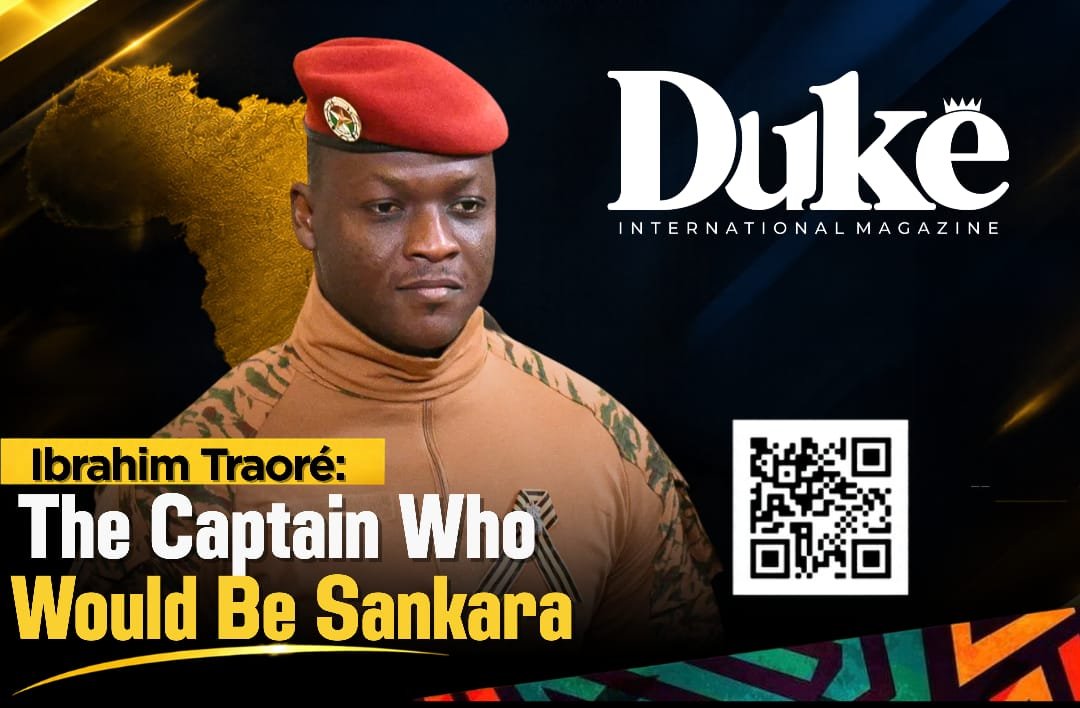
Burkina Faso’s military leader has become the face of a new generation of African soldiers turned presidents. Four years after seizing power, his revolution remains a work in progress.
In Ouagadougou, the face of Ibrahim Traoré looks out from murals, T-shirts and the sides of buildings. For many young Burkinabè, the 38-year-old soldier is not merely a head of state. He is a symbol of defiance.
His rise was swift. Born on 14 March 1988 in Kéra, in western Burkina Faso, he studied geology at the University of Ouagadougou, graduating in 2010. He joined the army in 2009 and received military training abroad, reportedly in Morocco and France. He served in Mali with the United Nations peacekeeping mission and fought jihadists in Burkina Faso’s restive north and east.
In September 2022, as a captain commanding an artillery regiment, he overthrew Lieutenant Colonel Paul-Henri Sandaogo Damiba, eight months after Damiba had taken power. At 34, Traoré became the world’s youngest head of state.
The coup was not just a transfer of power. It was a rupture. He expelled French troops, suspended the constitution and turned towards Russia, China and Turkey. With Mali and Niger, he formed the Alliance of Sahel States, a bloc that has broken from the Economic Community of West African States. For his supporters, this is sovereignty in action.
At home, his programme has been equally bold. He has nationalised several gold mines and, in September 2026, inaugurated the country’s first domestic gold refinery in Ouagadougou. “From now on, gold from Burkina Faso must not only be extracted in Burkina Faso, it must be processed, controlled, valued and certified in Burkina Faso,” he said.
He launched Faso Mebo, a civic infrastructure drive that asks citizens to build roads with local materials. In a continent run largely by ageing presidents, he looks like a break with the past.
Yet the shine is shadowed by war. Jihadist insurgencies linked to al-Qaeda and Islamic State have killed thousands and displaced more than two million people. In parts of the north and east, armed groups control territory and blockade towns.
The army, stretched and accused of abuses, relies on civilian volunteers known as VDPs. Traoré has made security his central promise, but the crisis has deepened under his watch.
His critics are less impressed by the revolutionary rhetoric. Political activity has been restricted. In February 2026, the government dissolved all political parties. The independent electoral commission was dismantled. Elections have been repeatedly postponed.
Traoré has survived at least five coup attempts since taking power. Journalists have been detained, media outlets suspended, and critics conscripted into the army. His government says it is fighting internal and external enemies. Its opponents say it is building a new authoritarian order.
Abroad, Traoré has become a hero to many young Africans who see him as a leader willing to say no to Paris and Washington. In Bamako, Niamey and Ouagadougou, crowds wave Russian flags and chant anti-French slogans.
The comparison to Thomas Sankara is flattering, but it is also uneasy. Sankara was a Marxist intellectual who championed women’s rights and debt cancellation. Traoré is a soldier who governs by decree.
The question is whether he can turn defiance into delivery. Burkina Faso is rich in gold, but its people remain poor. Its army is fighting a war it has not won. Its alliances with Moscow and the Sahel bloc offer protection and rhetoric, but not yet peace.
Traoré’s story is still being written. What is clear is that he has already changed the political weather of West Africa. Whether he becomes a lasting revolutionary or another strongman in uniform depends on what happens next.
In Ouagadougou, the murals still promise a new dawn. In the north, the gunfire continues. The distance between the two is the measure of his rule.