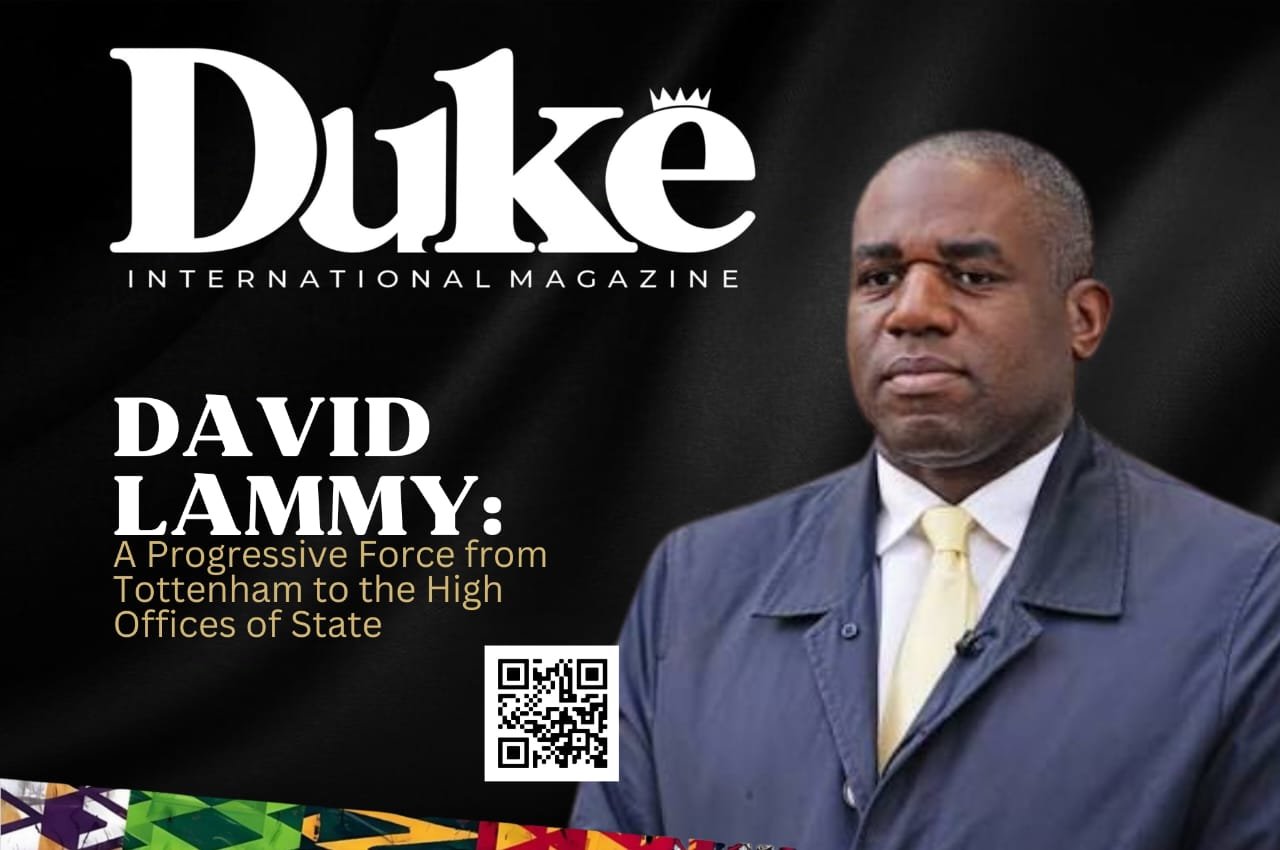
David Lammy has charted an unprecedented path in British political life. A son of Tottenham and a scholar of Harvard, he has risen from the backbenches to become the United Kingdom’s Deputy Prime Minister, Secretary of State for Justice, and Lord Chancellor, marking him as the first person of colour to hold these roles.
His journey from a working-class childhood to the pinnacle of government is a narrative of resilience, intellectual rigour, and an unyielding commitment to social justice.
First elected as the Member of Parliament for Tottenham in June 2000 at the age of 27, Lammy was the youngest MP in the House at the time . He succeeded the revered Bernie Grant, inheriting a constituency he himself grew up in.
His career has unfolded in distinct chapters:
· Ministerial Service (2002-2010): He served for eight years as a minister under Prime Ministers Tony Blair and Gordon Brown, holding portfolios in Health, Constitutional Affairs, Culture, and Higher Education. He was made a Privy Counsellor in 2008.
· Influential Backbencher (2010-2020): During Labour’s years in opposition, Lammy found a powerful independent voice. He led high-profile campaigns, most notably the independent Lammy Review into the treatment of Black, Asian, and Minority Ethnic individuals in the criminal justice system . He was also a fierce advocate for the victims of the Grenfell Tower fire and the Windrush scandal.
· High Office (2020-Present): Appointed Shadow Justice Secretary in 2020 and Shadow Foreign Secretary in 2021, he entered Sir Keir Starmer’s cabinet following the 2024 election as Foreign Secretary . In a September 2025 reshuffle, he was appointed to his current, historic roles as Deputy Prime Minister and Justice Secretary.
Lammy’s political outlook is deeply rooted in his personal history. Born in 1972 to Guyanese immigrant parents, he was raised in Tottenham by his single mother after his father left when he was twelve.
At the age of ten, his life took a pivotal turn when he won a choral scholarship to The King’s School, a state boarding school in Peterborough.
This experience, where he was often the only Black pupil, exposed him to a different England—one of “stability, culture, calm, [and] tradition”—while also making him acutely aware of regional and racial inequalities . He later read law at the School of Oriental and African Studies in London and was called to the bar in 1994.
A Master of Laws degree at Harvard Law School followed, where he was the first Black Briton to study . He credits Harvard with giving him the confidence to pursue a political career.
Lammy’s work is driven by several interconnected convictions:
· Social and Racial Justice: From his review of the justice system to his condemnation of “social apartheid” in university admissions, combating systemic inequality is a central theme.
· The Importance of Community and Belonging: His book, Tribes, explores the human need for connection in an age of polarization. He argues for a communitarian spirit, informed by his Christian faith, to bridge societal divides.
· The Value of Education and Fatherhood: A lifelong advocate for adult education and widening university access, he also chairs the All-Party Parliamentary Group on Fatherhood, speaking openly about the impact of his own father’s absence.
David Lammy’s story is one of breaking barriers while remaining steadfastly connected to his roots. As he continues to serve at the highest level, he embodies a modern, multifaceted British identity: a local constituency MP, a global statesman, and a progressive voice shaped by the experiences of Tottenham, Peterborough, and beyond.