

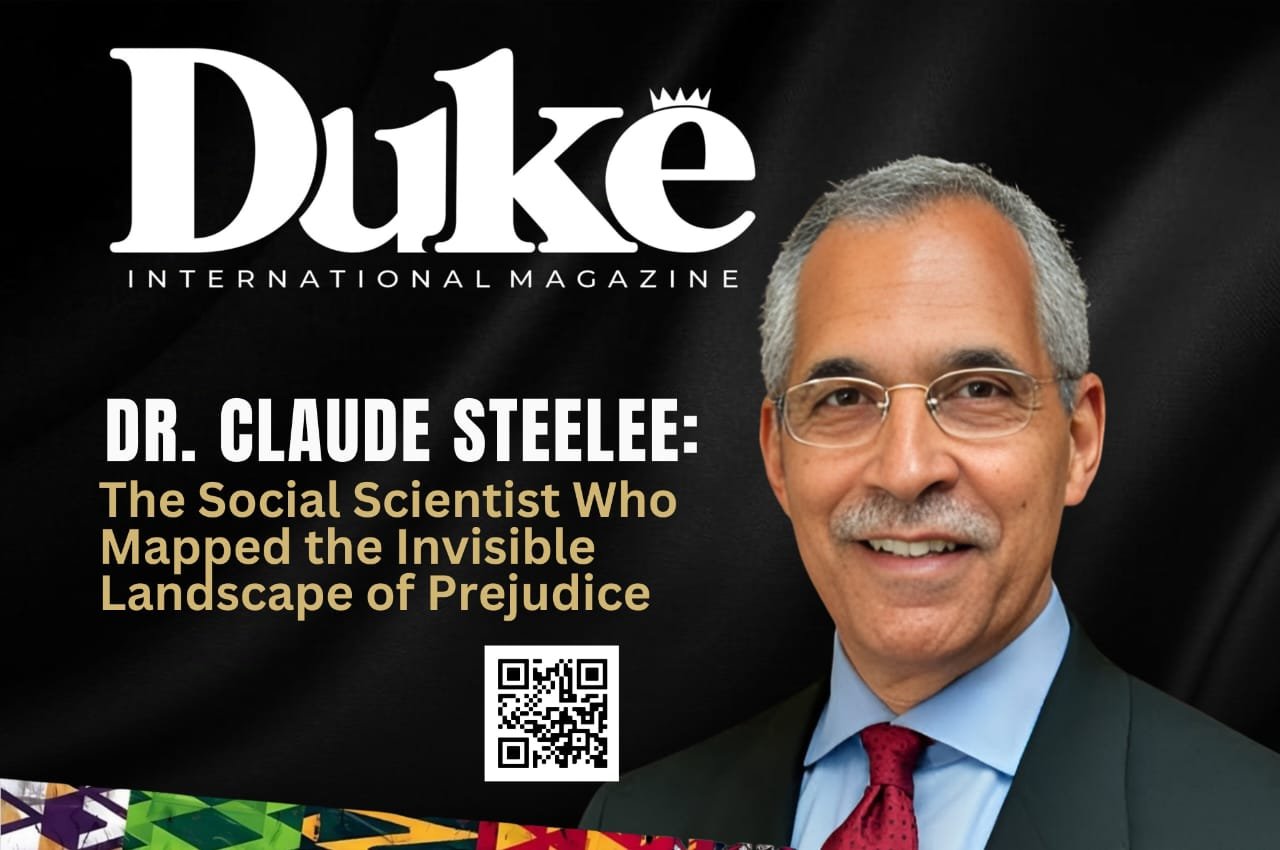
In the world of social psychology, few concepts have resonated as deeply across education, the workplace, and public discourse as that of “stereotype threat.” At the heart of this revolutionary understanding is Claude Steele, a scholar whose journey from a childhood steeped in the American civil rights movement to the pinnacle of academic leadership was driven by a single, powerful question: how do the shadows of societal prejudice shape a person’s mind and, ultimately, their destiny?
Steele’s own beginnings in Chicago, born to an African American father and a white social worker mother who met through activism, instilled in him an early and intimate awareness of social issues. This personal landscape was the fertile ground from which his scientific curiosity grew.
He pursued psychology, seeking to translate the human dramas of inequality and identity into questions that could be tested and understood. For many years, his research explored the intricacies of the self and even the social psychology of addictive behaviours. However, it was a persistent academic puzzle that would define his legacy.
While at the University of Michigan, Steele encountered a baffling chart. It showed that African American students, even those with high university entry scores equivalent to their white peers, were consistently achieving lower grades.
The gap suggested something beyond prior preparation or inherent ability was at work. “Every preconception that I had about what could be causing that underperformance was proven wrong by the data,” Steele later recounted. This mystery launched a rigorous, years-long investigation.
The breakthrough came through a series of elegant experiments. Steele and his colleagues gave a difficult mathematics test to high-achieving women. When presented as a standard test, the women underperformed compared to equally skilled men.
Yet, when the same test was presented as one where gender differences did not exist, their performance rose to match the men’s. This was the crystallising moment. The researchers had identified “stereotype threat” – the debilitating psychological experience that occurs when one fears confirming a negative stereotype about their social group.
Steele describes the inner experience as a state of “churn,” where constant, anxious monitoring drains the mental resources needed for the task at hand. Importantly, the effect is most acute for those who are most invested and talented, creating a cruel paradox where the pressure to disprove a stereotype undermines the very performance that would disprove it. This insight provided a powerful new lens for understanding not only racial and gender achievement gaps but also pressures in countless other social situations.
His work did not stop at diagnosis. Alongside stereotype threat, Steele’s earlier theory of self-affirmation provided a potent antidote. The theory proposes that affirming one’s core values in an unrelated area can fortify self-integrity, making an individual more resilient to specific threats in other parts of their life.
Together, these concepts moved the conversation beyond blaming individuals or groups, and towards understanding the situational pressures embedded in environments like classrooms and boardrooms.
Claude Steele’s influence extends far beyond the laboratory. His 2010 book, Whistling Vivaldi, brought these ideas to a wide public audience. He has ascended to the highest ranks of academic leadership, serving as Provost of Columbia University and Executive Vice Chancellor of the University of California, Berkeley, always advocating for the application of social science to society’s most pressing challenges.
Elected to the National Academy of Sciences and honoured with numerous awards, he is recognised as one of the most influential social scientists of the past half-century. Ultimately, Steele’s career offers a powerful, hopeful narrative. By meticulously charting the invisible topography of prejudice—how it is silently internalised and how it actively hampers potential—he provided the tools to redesign that landscape.
His work insists that brilliance is not a fixed trait but a seed that requires the right conditions to flourish, and that creating “identity safe” environments is not merely an act of fairness, but one of unlocking immense human potential for everyone.