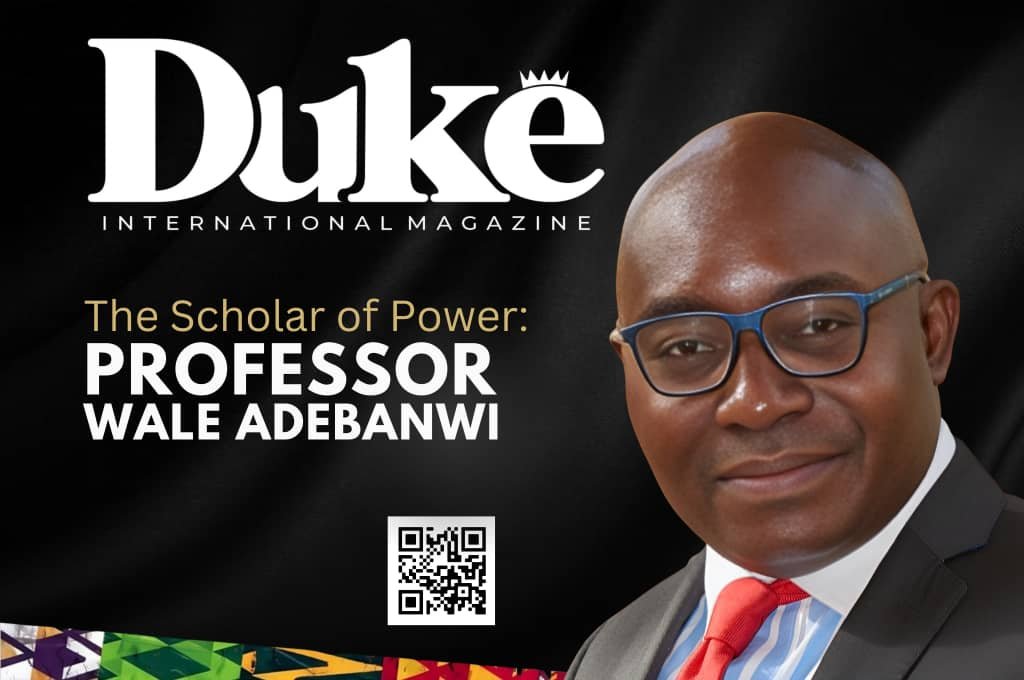
Professor Wale Adebanwi stands as one of the most distinguished Nigerian academics of his generation, a scholar whose work bridges the disciplines of political science and social anthropology to illuminate the intricate workings of power, ethnicity, and elite formation in Africa.
Born in 1969, his intellectual journey began in Lagos and Ibadan before carrying him to Cambridge, Oxford, and finally to the University of Pennsylvania, where he now holds the title of Presidential Penn Compact Professor of Africana Studies and directs the Center for Africana Studies .
His academic formation is itself a study in sustained intellectual ambition. Adebanwi earned his first degree in mass communication from the University of Lagos before completing both a master’s degree and a doctorate in political science at the University of Ibadan.
He then crossed disciplines and continents, undertaking an MPhil and a second PhD in social anthropology at Trinity Hall, Cambridge, as a Bill and Melinda Gates Scholar . This unusual combination of training—in the empirical rigour of political science and the interpretive depth of ethnography—has come to define his distinctive approach to the study of African societies.
Before his transatlantic ascent, Adebanwi taught political science at the University of Ibadan, where he had himself been a student. He then joined the University of California, Davis, as a professor in the Department of African American and African Studies, attaining the rank of full professor in 2016 . Yet it was his appointment the following year at the University of Oxford that secured his place in institutional history.
He became the Rhodes Professor of Race Relations and Director of the African Studies Centre, the first Black scholar ever to hold that professorship . He was also elected a Governing Board Fellow at St Antony’s College and affiliated with the Oxford Martin School. He held these positions until 2021, when he moved to the University of Pennsylvania.
At Penn, Adebanwi holds a secondary appointment in the Department of Political Science and directs the Center for Africana Studies, guiding a programme dedicated to the interdisciplinary study of African and African-descended peoples .
His teaching reflects the breadth of his interests: courses on the political economy of natural resources, the politics of everyday life in Africa, popular culture and youth, and the social history of the African diaspora . In 2024, he was named a Guggenheim Fellow, a recognition of the cumulative weight and originality of his scholarship .
That scholarship is substantial and still accumulating. His sole-authored monographs include Authority Stealing, an examination of anti-corruption politics in post-military Nigeria; Yorùbá Elites and Ethnic Politics in Nigeria, a study of Chief Obafemi Awolowo’s political legacy published by Cambridge University Press; and The Nation as Grand Narrative, an authoritative treatment of the Nigerian press and its role in shaping political meaning .
His most recent work, How to Become a Big Man in Africa, appeared in 2024 from Indiana University Press. The product of two decades of research, it traces the rise of Gani Adams from subaltern origins to elite status within the Oodua People’s Congress, using a single life history to illuminate broader transformations in Nigerian political life .
He has also edited or co-edited ten further volumes, including Democracy and Nigeria’s Fourth Republic and Everyday State and Democracy in Africa. His influence extends beyond his own writing. Adebanwi has served as co-editor of two of the most respected journals in African studies: the Journal of Contemporary African Studies and AFRICA, the journal of the International Africa Institute.
His articles have appeared in Comparative Studies in Society and History, Ethnic and Racial Studies, African Affairs, and the Review of African Political Economy, among others. He has held visiting positions at Rhodes University in South Africa and the African Studies Centre in Leiden, and his research has been supported by the MacArthur Foundation, the Rockefeller Foundation, and the Social Science Research Council .
In 2024, he was elected President of the Association for Africanist Anthropology, a role he will hold until 2026 . It is a fitting leadership position for a scholar who has spent his career moving between disciplines, between continents, and between the granular detail of ethnographic encounter and the grand sweep of political theory.
Professor Wale Adebanwi remains, at root, a student of Nigerian society, but his work has long since transcended national boundaries to shape the wider field of African studies itself.