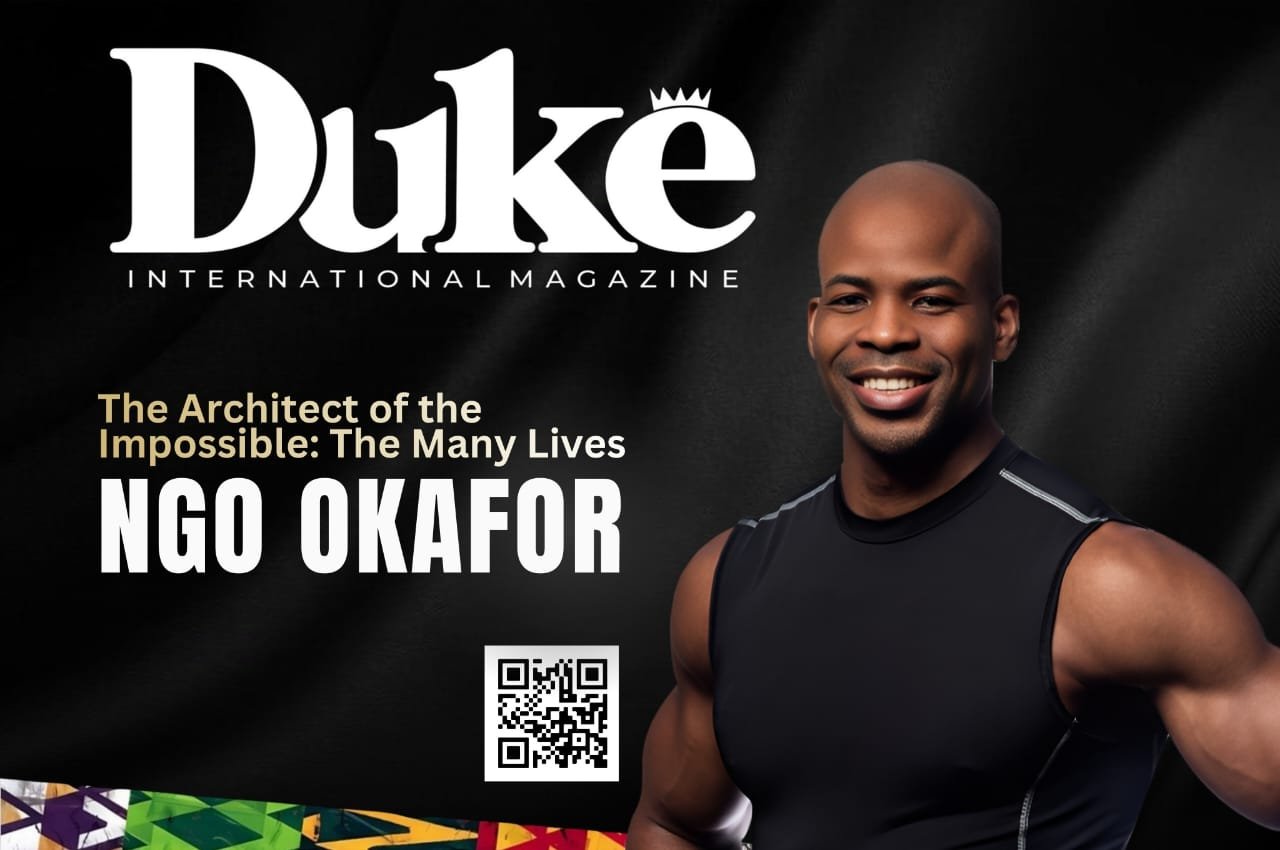
Ngo Okafor possesses the kind of resume that sounds like a work of fiction: a former computer scientist who became a two-time Golden Gloves boxing champion, one of the most downloaded male models in internet history, and a celebrity personal trainer in New York City.
Yet for the man born Ngoli Onyeka Okafor, this remarkable trajectory is not a tale of chance but a testament to a philosophy he calls “The Ngo Effect” — the unwavering belief that the mind controls everything and that the body is merely its servant.
Okafor’s origin story defies the conventional image of a fighter or a fashion model. He was born in Framingham, Massachusetts, in 1974 while his father was completing a PhD at Harvard University, but his family returned to Nigeria shortly before his second birthday. Growing up in Enugu State, his childhood was not one of physical vitality but of profound frailty.
He suffered from chronic respiratory illnesses, including severe asthma and pneumonia, which left him bedridden for much of his early years. While other children played outside, Okafor spent long periods convalescing at the University of Nigeria Teaching Hospital, passing the time by reading the works of Charles Dickens.
It was an experimental treatment at the age of thirteen that finally allowed him to heal, but the psychological scars of those years remained. He was skinny, weak, and an easy target for bullies. Rather than succumbing to self-pity, however, Okafor channelled those feelings of exclusion into a singular drive. He decided to build himself anew, transforming his physique through sheer determination long before he ever stepped into a boxing ring.
Education, however, was his first priority. At the age of eighteen, he returned to the United States to study computer science at the University of Connecticut. Upon graduation, he embarked on a conventional career in information technology, working for the Connecticut Department of Transportation, where he taught engineers and architects how to use computer-aided design software. It was a stable, respectable path, but the pull of other ambitions proved too strong.
A move to New York City to pursue part-time modelling work soon opened new doors. His striking features and chiselled physique, honed by years of disciplined training, quickly caught the attention of the fashion world. He went on to appear on the covers of prestigious publications such as Fortune, Vogue, W, and ESPN Magazine, earning him the distinction of being considered the internet’s most downloaded black male model.
It was during this period, at the age of thirty-one, that Okafor wandered into a boxing gym for what he thought would be a simple workout. For a man often told he was starting a young man’s sport far too late, the gym became an obsession. “It was me against one opponent, my will against their will,” he later recalled.
His will proved formidable. After losing his first Golden Gloves fight in a devastating blow, he used the anger and frustration to fuel an even more intense training regimen. The result was a triumphant comeback: he won the heavyweight championship of the prestigious Golden Gloves tournament in both 2008 and 2009.
Boxing led to acting, with roles in television series such as Law & Order: Special Victims Unit and the film True Story. It also cemented his reputation as a fitness expert of almost mystical effectiveness. In 2010, he founded Iconoclast Fitness in Manhattan’s Flatiron District, a gym designed to be a space where mental and physical transformation occur in tandem.
His client list soon read like a who’s who of entertainment and fashion, including Jennifer Lopez, Naomi Campbell, Brooke Shields, and Mariska Hargitay. What sets Okafor apart from other trainers is his core doctrine: he does not just train the body; he trains the mind.
“I believe that the body is a slave to our minds and will do anything we tell it to do,” he asserts. He teaches clients that visualisation, goal setting, and the rejection of self-imposed limitations are as crucial as any repetition in the gym.
Yet for all his success in the rarefied world of celebrity fitness, Okafor has never forgotten the sick child in Nigeria. He founded the Champion Spirit Foundation, a non-profit organisation that provides facilities in his home country where children can exercise and learn to box free of charge. The goal is to offer them what he found for himself: a way to build self-esteem and a sense of possibility.
From a bedridden boy in Enugu to the owner of a Fifth Avenue gym, Ngo Okafor’s life is a study in the power of reinvention. He does not see his diverse careers as disparate chapters but as a single, continuous narrative of willpower.
As he tells his clients, there is no point in living only half a life. The key to true happiness, he believes, is to pursue your goals aggressively, to outwork everyone, and to remember that the most important muscle is the one between your ears.