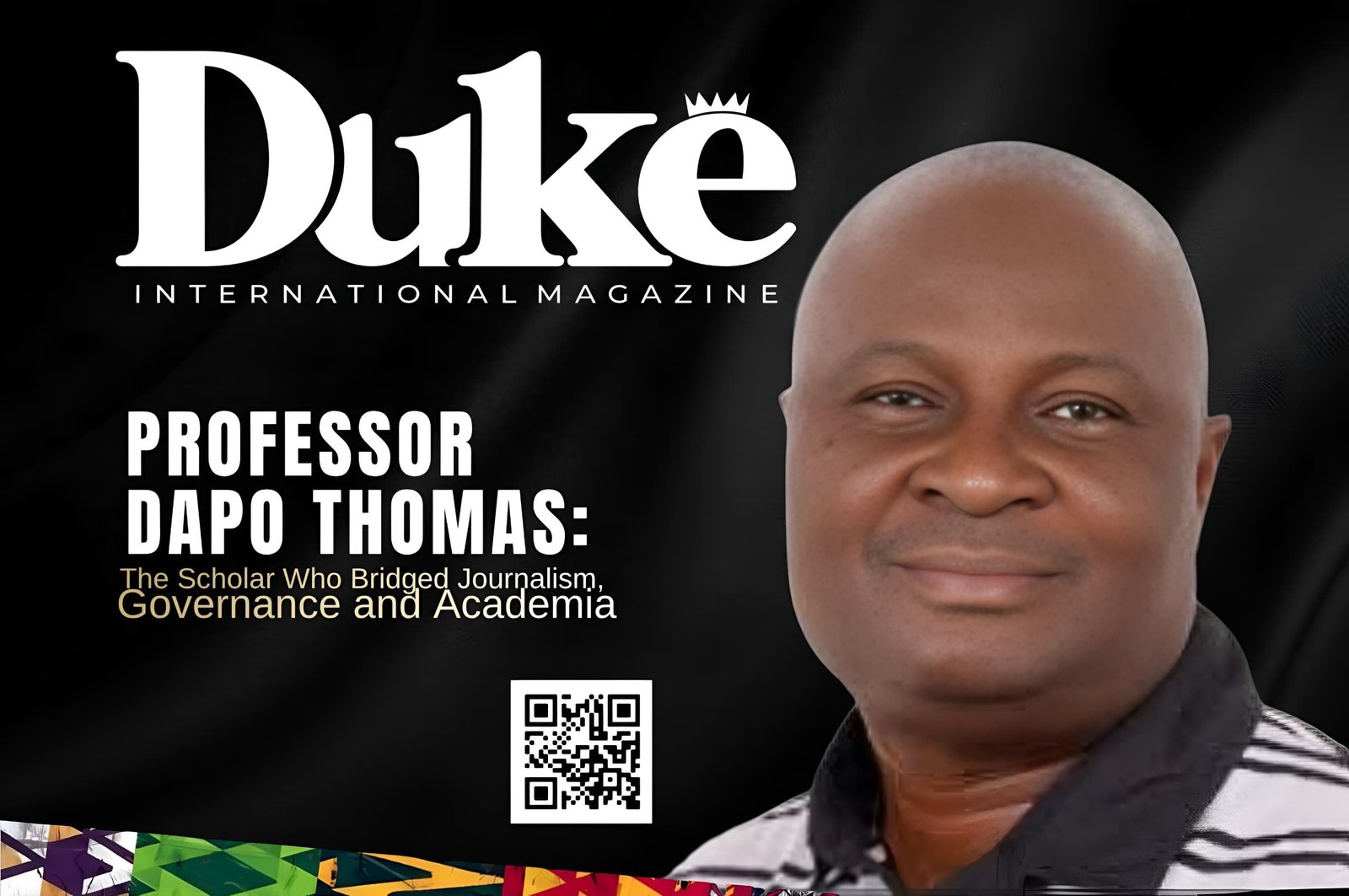
In the landscape of Nigerian intellectual life, few figures embody the synthesis of theory and practice as completely as Professor Dapo Thomas.
A scholar whose career has traversed the bustling newsrooms of tabloid journalism, the corridors of state governance, and the hallowed halls of academia, he represents a rare breed of public intellectual: one who has not merely studied power but has observed it from multiple vantage points, all while maintaining the rigorous detachment of a historian.
Thomas’s academic foundation was laid at the then University of Ife, now Obafemi Awolowo University, where he obtained a first degree in History followed by a Master’s degree in International Relations in 1987. It was a formation that would prove prescient, equipping him with the tools to understand Nigeria’s complex political evolution while nurturing a sensibility for the written word that would define his early career.
Before he ever stood before a lecture hall, Thomas spent seventeen years in journalism, a period that shaped his understanding of Nigerian society in ways the academy alone could not.
Between 1979 and 1996, he worked across a formidable array of publications: The Scoop edited by Ogbeni Tope Awe; Weekend Flight under Alan Aroyewun; Newbreed with Chris Okolie; Nigeria HomeNews in London; TimesWeek at the Daily Times; and Viva Magazine edited by Festus Eriye. This was journalism in its golden and tumultuous eras, and Thomas was immersed in the thick of it.
The transition from journalism to governance came in 1999, when he was appointed Senior Special Assistant on Policy and Programmes to Asiwaju Bola Ahmed Tinubu, then Governor of Lagos State.
It was a role he would hold until 2007, placing him at the heart of executive decision-making during a formative period in Lagos’s modern history. Yet perhaps the most revealing moment of that era occurred not in a policy meeting but at a send-forth ceremony on May 25, 2007, just four days before the swearing-in of the next governor.
Thomas had been selected as one of three speakers to eulogise the outgoing governor. Instead of delivering the expected praises, he used the platform to raise the grievance of special assistants who had been excluded from severance packages, calling the act “Use and Dump” before a room filled with judges, magistrates, legislators and business moguls.
Rather than rebuke him, the governor summoned him after the ceremony, reconstituted the executive council, and approved all the prayers in Thomas’s protest letter. It was, Thomas later reflected, evidence of a leader’s humility and respect for due process.
That same year, he returned fully to academia, joining the Department of History and International Studies at Lagos State University, where he remains a Senior Lecturer to this day. In 2014, he completed his doctorate in Political Science with a specialisation in International Relations at the University of Ibadan, Nigeria’s premier university.
His scholarly output has been substantial, ranging from peer-reviewed dissertations to essays and historical expositions. He is the author of The Political Economy of Nigeria-United States Relations and has written extensively on subjects as diverse as US-Israeli relations, the Egbaland crisis of 1948, and the life history of Oba Ladapo Ademola, the Alake of Egbaland.
His research reflects a restless intellectual curiosity. Recent academic engagements have included papers with titles as varied as “The Electoral Process and The Dramatics of Beneclientelism” and “When the Past is Dead, What Is History Doing Alive?”. His current research, characteristically provocative, asks: “What is God doing behind Israel…is it God the Father or god The United State of America?”
Beyond his scholarship, Thomas has cultivated a reputation as a mentor. In 2020, he hosted seven of his mentees for a week-long retreat at his residence in the Redemption Camp, covering all expenses and delivering lectures on contentment, organisation, spirituality, politics, honesty and investment. For his mentees, the experience was transformative.
One wrote afterwards that Thomas had shown “material things, coupled with the position in life can’t make him proud,” describing him as “an epitome of humility”.
He is a member of the Nigerian Institute of International Affairs and the Nigerian Society for International Affairs, and has served on various committees, including a Lagos State panel on the relocation of the National Youth Service Corps camp. A Lagosian by birth, he remains deeply connected to the intellectual and civic life of the state.
Professor Thomas is married to Boladele, and together they have children. When not engaged in his academic pursuits, he enjoys football, public lecturing, travel, writing and reading.
It is a life that has moved fluidly between observing power, participating in it, and teaching others to understand it—a career defined less by specialisation than by synthesis, and a testament to the enduring value of the generalist intellect in an age of narrowing expertise.