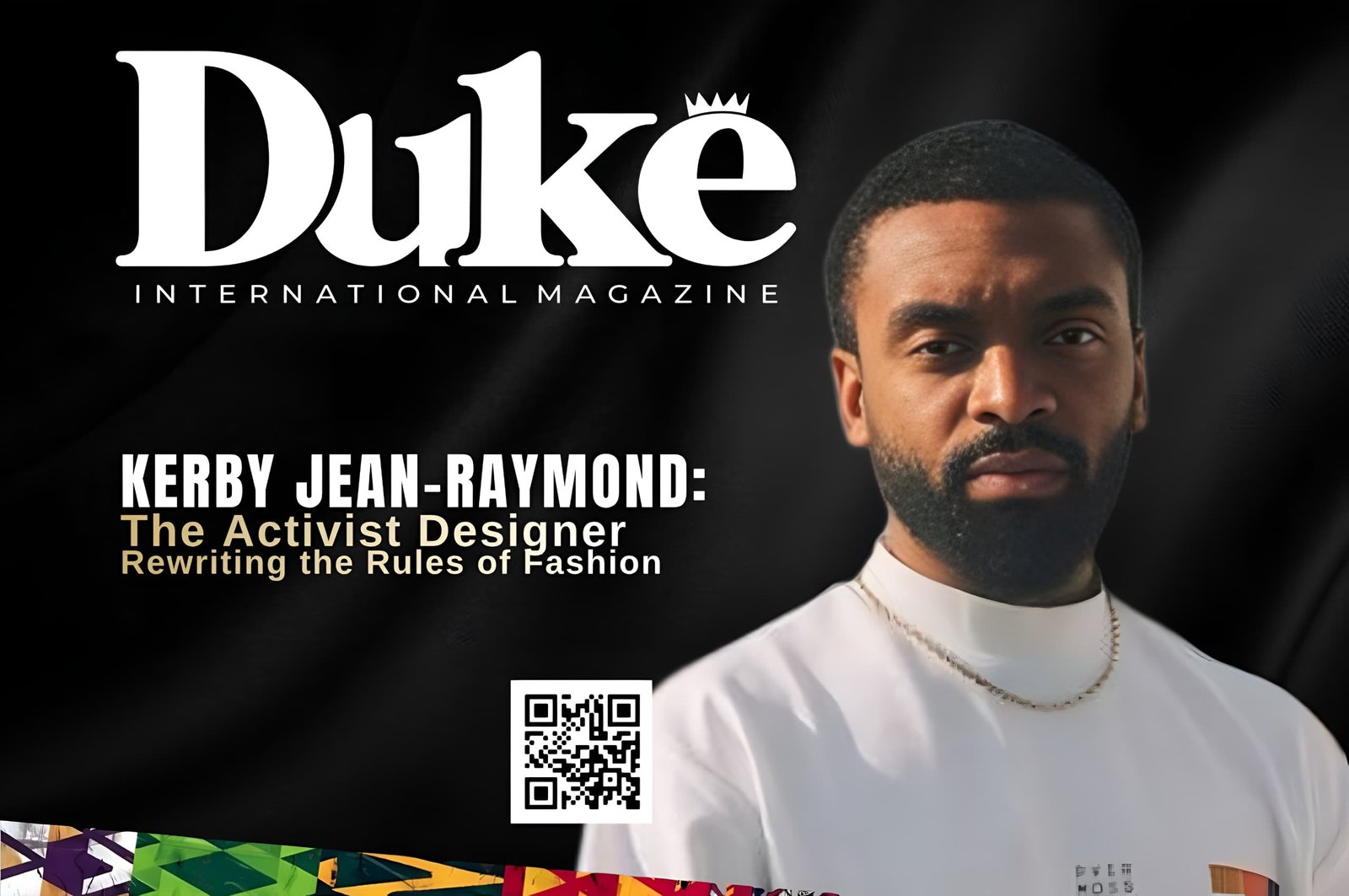
Kerby Jean-Raymond does not simply design clothes. He constructs narratives, challenges entrenched systems and builds platforms for those who have long been left out of fashion’s upper echelons.
As the founder of the New York-based label Pyer Moss, this Haitian-American designer has established himself as one of the most politically conscious and culturally significant voices in the industry, using his collections to engage with the past, present and future of the Black American experience through personal storytelling and provocative showmanship.
Born in New York City in 1986, Jean-Raymond’s journey into fashion began in earnest during his teenage years. Raised in East Flatbush, Brooklyn, within a vibrant Haitian community, he took a job at a sneaker shop at the age of thirteen to help make ends meet.
His natural talent for pattern-making and drawing did not go unnoticed by his teachers, and at just fourteen years old, he secured an internship with the New York designer Kay Unger.
This early break proved transformative. By sixteen, he was entrusted with helping to build the fashion line Marchesa, an experience that saw him working on red-carpet gowns and navigating the upper echelons of the industry at an age when most teenagers are focused on their examinations.
Despite his early success, Jean-Raymond’s path was not one of uninterrupted privilege. He attended the High School of Fashion Industries in Manhattan before going on to Hofstra University, where he graduated with a degree in business administration.
A brief, abortive stint at Brooklyn Law School followed, but fashion ultimately won out. After freelancing for established houses such as Theory, Marc Jacobs and Kenneth Cole, he launched Pyer Moss in 2013.
The label first captured widespread attention during the Spring/Summer 2016 season. At a time when the fashion industry was frequently accused of being insular and apolitical, Jean-Raymond mounted a show that unflinchingly highlighted police brutality, referencing the Black Lives Matter movement through a visceral combination of video, street art and fashion.
He later spoke publicly about his own experiences as a teenage victim of racial profiling by police, a context that lent the collection an undeniable authenticity. Music has always been integral to his creative process; he has described hearing lyrics as a trigger for entire collections, using live choirs, opera and spoken word to set a tone before a single garment has been fully appraised.
His willingness to merge fashion with activism has earned him both critical acclaim and institutional recognition. In 2018, Pyer Moss won the prestigious CFDA/Vogue Fashion Fund, with Jean-Raymond becoming only the second solo Black male designer to receive the award.
That same year, he embarked on a significant partnership with Reebok, which culminated in his appointment as the brand’s Global Creative Director in September 2020.
During his tenure, he made history as the first Black American designer to present a collection on the haute couture calendar in Paris, a show that paid homage to Black invention and ingenuity. He departed Reebok in early 2022, refocusing his energy on his own brand and its ethos as “a small couture business”.
Beyond his own label, Jean-Raymond has demonstrated a deep commitment to fostering the next generation. In 2020, he partnered with the French luxury conglomerate Kering to launch “Your Friends in New York” (YFINY), a platform designed to incubate emerging talents across fashion, music, art and philanthropy.
Conceived as an ecosystem to reimagine how consumers discover and interact with brands, YFINY was born from a meeting with Kering’s Chairman and CEO, François-Henri Pinault, who praised Jean-Raymond’s willingness to “invent a new, singular model, freeing himself from the usual constraints of the fashion system”.
For Kerby Jean-Raymond, fashion has never simply been about commerce or aesthetics. It is a vehicle for history, for protest and for community.
In an industry often criticised for its lack of diversity and its reluctance to engage with difficult subjects, he has built a career that proves the two need not be mutually exclusive. His work stands as a testament to the idea that what we wear can be a powerful form of resistance.