Highlighting the remarkable contributions and achievements of exceptional Black leaders who are shaping our communities and inspiring future generations. Their stories of resilience and excellence embody the spirit of progress and empowerment.
The Pluriversal Scholar: The Life and Legacy of Professor Toyin Falola
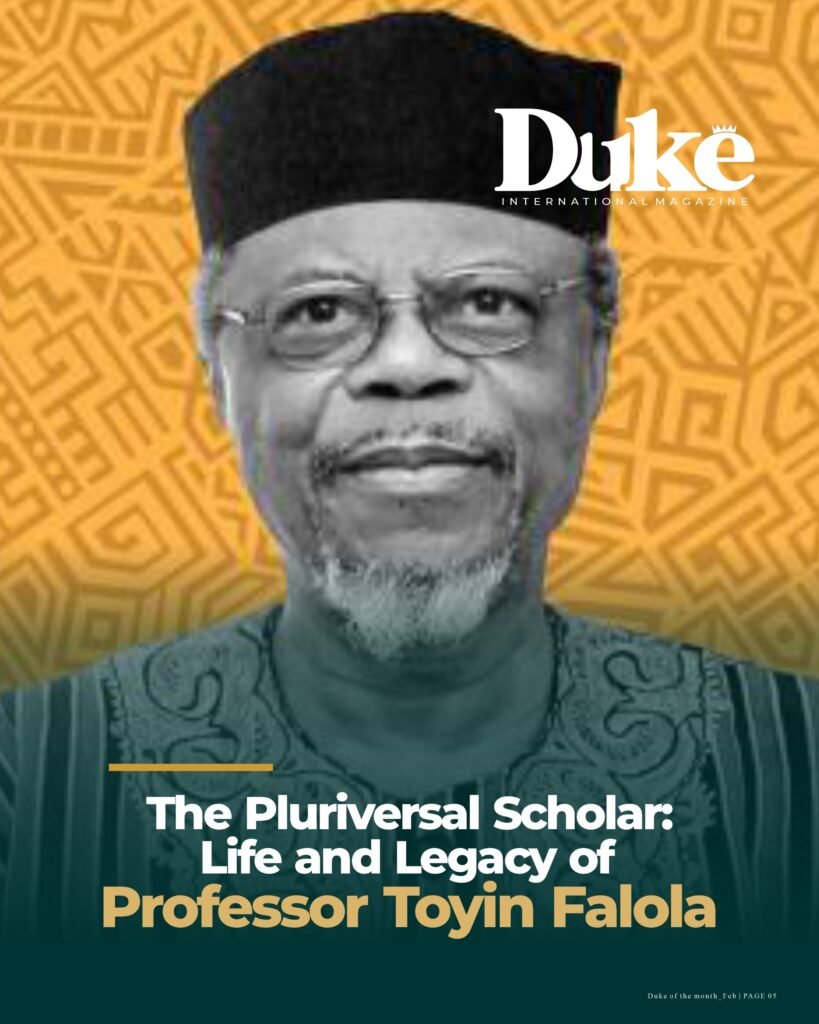
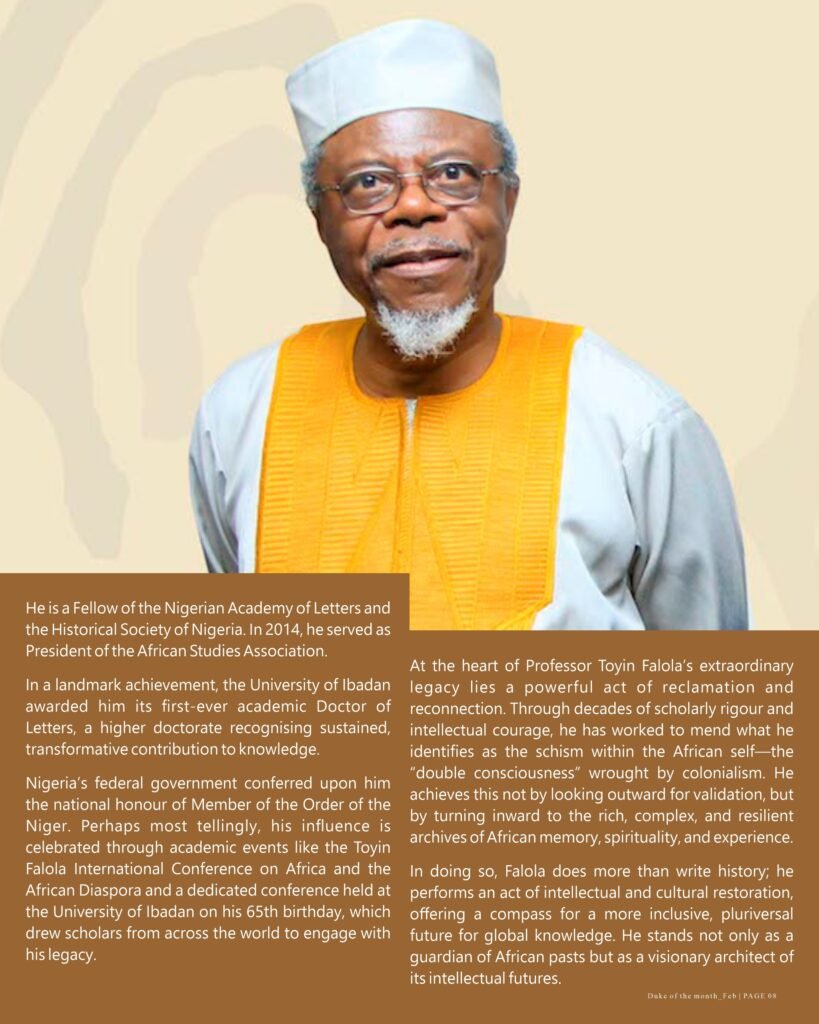
In the landscape of contemporary African scholarship, few figures cast as long and profound a shadow as Professor Toyin Omoyeni Falola. As a historian of formidable intellectual prowess and a teacher of unparalleled dedication, Falola has dedicated his life to a singular, transformative project: the decolonisation and globalisation of African knowledge.
His journey from a polyglot, polyreligious childhood in Ibadan to the Jacob and Frances Sanger Mossiker Chair in the Humanities at the University of Texas at Austin is more than a personal success story; it is a narrative about recentring Africa in the world’s intellectual imagination.
From Indigent to Indigo: The Making of a Scholar
Born in 1953 in Ibadan, southwestern Nigeria, Falola’s early life was marked by a confluence of traditions, growing up in a household that practised Islam, Christianity, and indigenous Yoruba spirituality.
This pluralistic foundation would later become a hallmark of his intellectual framework. His path to academia was not linear. He experienced childhood poverty, dropped out of high school, and worked as a street hawker.
Fellow students at the University of Ife, where he would earn both his Bachelor of Arts and Doctor of Philosophy in history, jokingly called him “indigo”, short for “indigent”.
Yet, even then, his prodigious talent was evident, and he was publishing significant work before many of his own teachers, earning the moniker “prolific writer” upon his graduation.
The Nigeria of the 1980s, where Falola began his academic career as a lecturer, was a nation in crisis, its universities in decline. In pursuit of a more conducive intellectual environment, he embarked on a global journey, holding positions at the University of Cambridge, York University in Canada, and others, before settling at the University of Texas at Austin in 1991.
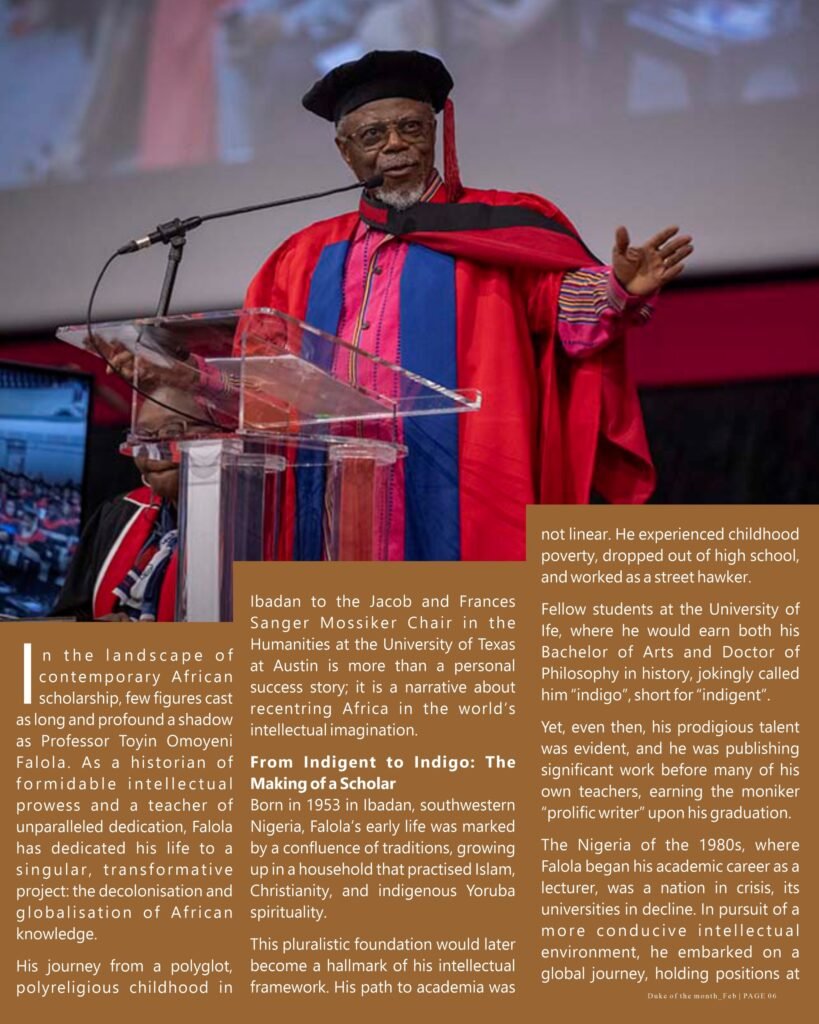
While he left Nigeria, he never departed from it; he maintains deep, active engagements with Nigerian universities, mentoring scholars and shaping discourse, often spending considerable time in the country.
An Intellectual Architecture of Pluriversalism
To describe Falola merely as an African historian is to profoundly understate the scope of his contribution. He is a polymath whose work, spanning well over a hundred books, consciously refuses disciplinary boundaries, engaging with history, philosophy, cultural studies, religion, and politics.
His central philosophical intervention is the advocacy for what he terms “pluriversalism”. This is the powerful idea that the world consists of multiple, equally valid systems of knowledge that are original and complete unto themselves, not merely derivatives of or reactions to a Western-centric “universe” of thought.
This intellectual mission manifests powerfully in his recent work. In Decolonizing African Studies (2022), Falola moves beyond critique to propose a therapeutic recovery of the African self. He bypasses colonial archives, engaging instead with alternative sources like memory, spoken words, and photographs to reconstruct authentic African knowledge systems.
In African Spirituality, Politics, and Knowledge Systems (2022), he explores the unifying power of the spoken word across Christian, Islamic, and Yoruba spiritual traditions, affirming deep cultural continuities and a common humanity.
Meanwhile, his magnum opus Global Yoruba (2024) exemplifies his life’s work, tracing the formation and global diffusion of Yoruba culture with an epic, encyclopaedic breadth that redefines the field.
The Mentor, the Teacher, the Honoured
Beyond the written word, Falola’s impact is deeply human. He is renowned as a generous mentor and a celebrated teacher who has won numerous prestigious teaching awards. He has successfully resisted administrative roles to focus on pedagogy and scholarship, finding his greatest joy in these pursuits.
His generosity of spirit is legendary; he is known for his humility, approachability, and a profound capacity to support and advance the careers of countless other scholars. This has earned him the affectionate reverence of a global network of colleagues and protégés.
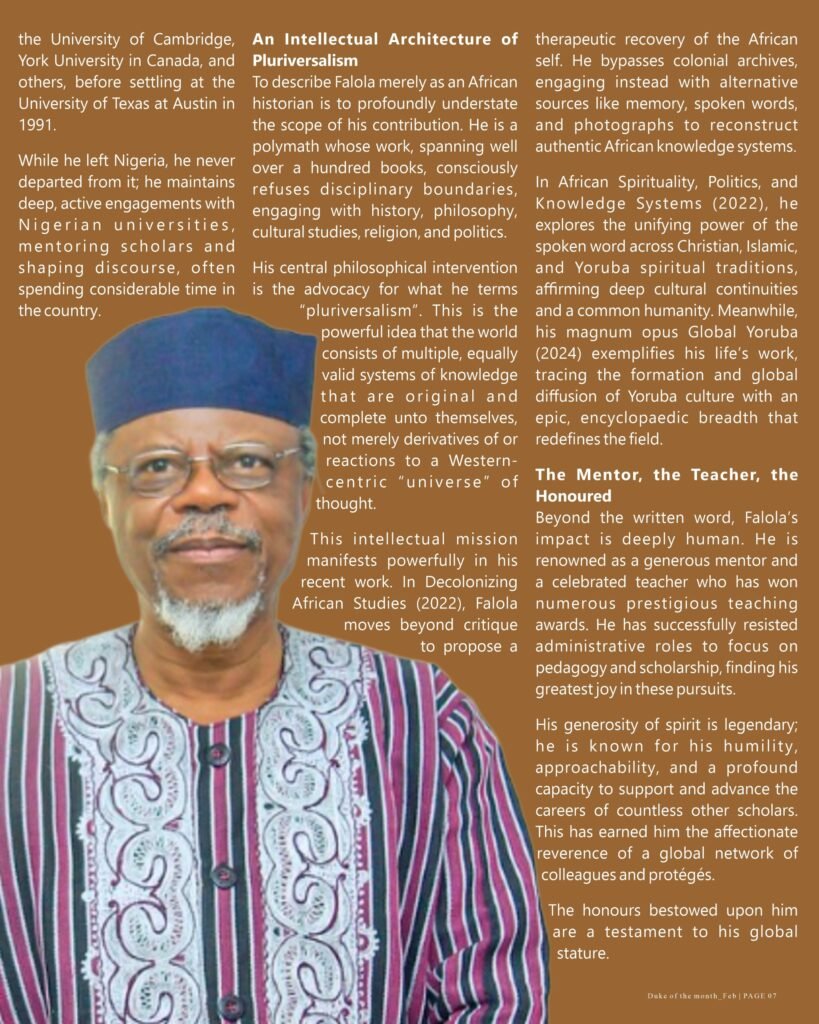
The honours bestowed upon him are a testament to his global stature. He is a Fellow of the Nigerian Academy of Letters and the Historical Society of Nigeria. In 2014, he served as President of the African Studies Association.
In a landmark achievement, the University of Ibadan awarded him its first-ever academic Doctor of Letters, a higher doctorate recognising sustained, transformative contribution to knowledge.
Nigeria’s federal government conferred upon him the national honour of Member of the Order of the Niger. Perhaps most tellingly, his influence is celebrated through academic events like the Toyin Falola International Conference on Africa and the African Diaspora and a dedicated conference held at the University of Ibadan on his 65th birthday, which drew scholars from across the world to engage with his legacy.
At the heart of Professor Toyin Falola’s extraordinary legacy lies a powerful act of reclamation and reconnection. Through decades of scholarly rigour and intellectual courage, he has worked to mend what he identifies as the schism within the African self—the “double consciousness” wrought by colonialism. He achieves this not by looking outward for validation, but by turning inward to the rich, complex, and resilient archives of African memory, spirituality, and experience.
In doing so, Falola does more than write history; he performs an act of intellectual and cultural restoration, offering a compass for a more inclusive, pluriversal future for global knowledge. He stands not only as a guardian of African pasts but as a visionary architect of its intellectual futures.
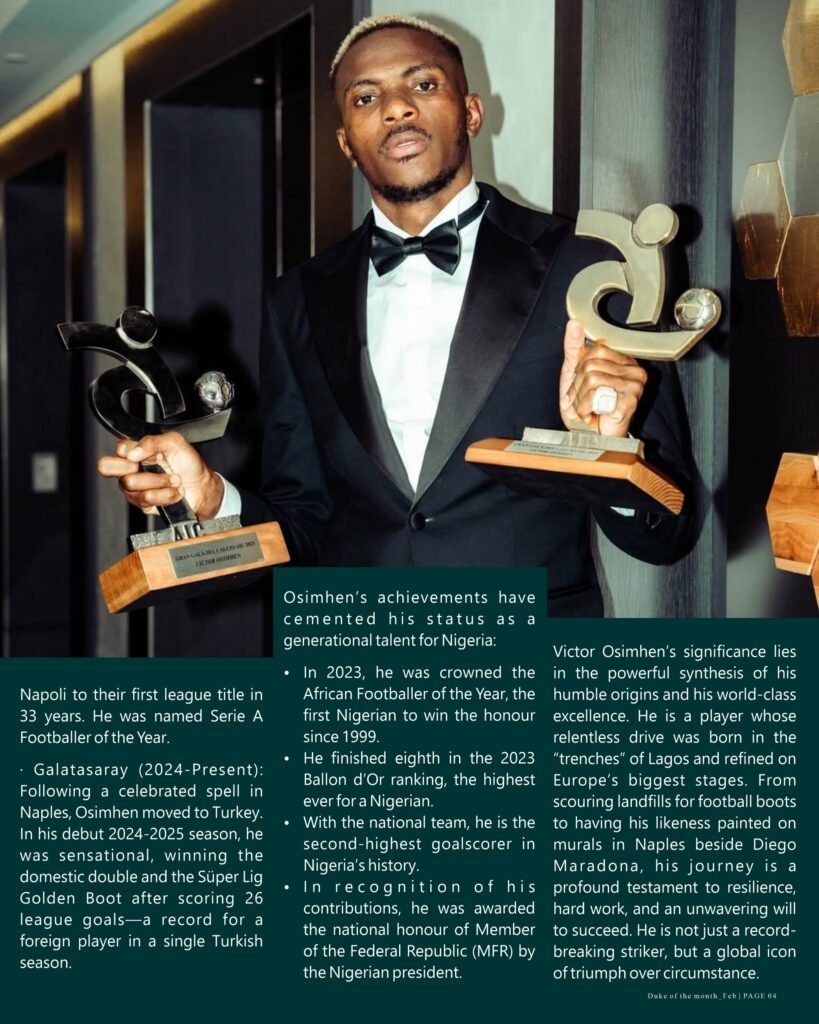
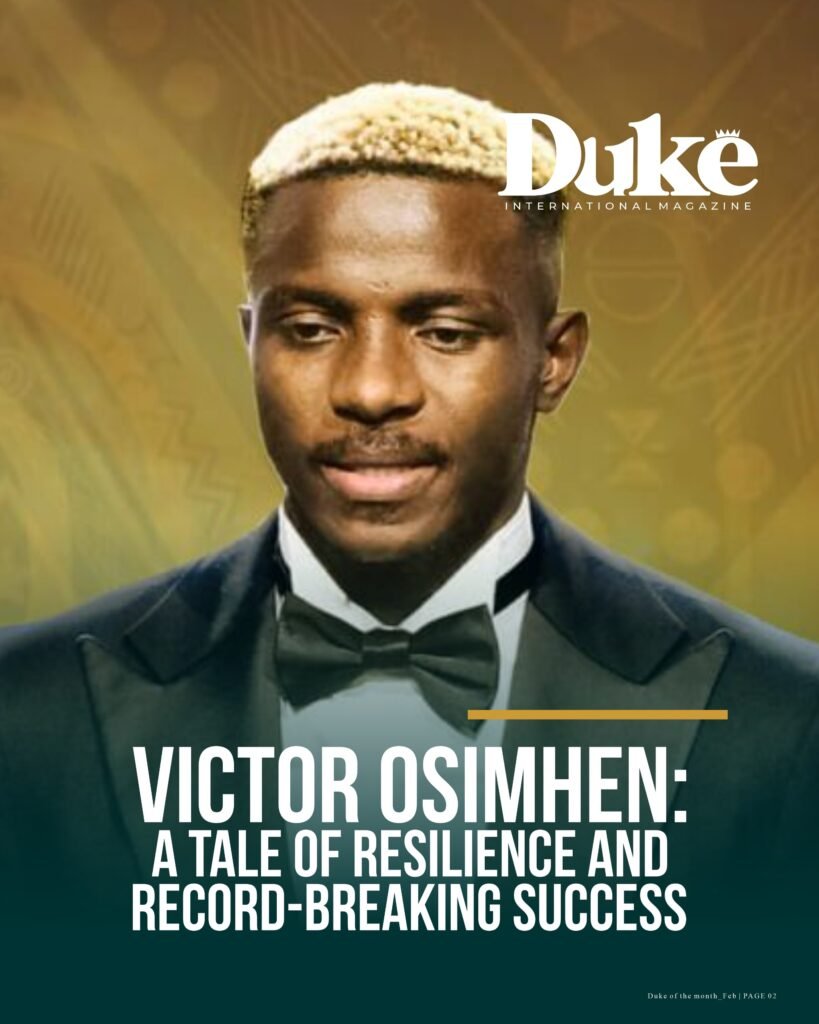
Victor Osimhen: A Tale of Resilience and Record-Breaking Success
Victor James Osimhen, a footballer for Galatasaray and the Nigerian national team, has forged a legacy as one of the most formidable strikers in the modern game. His journey, however, transcends the statistics and trophies, charting a path from profound hardship in Lagos to the summit of world football, defined by explosive pace, aerial prowess, and clinical finishing.
Osimhen’s story begins in the Olusosun community of Lagos, a district overshadowed by one of the city’s largest landfills. Born into poverty, his early life was marked by immense struggle.
After losing his mother at a young age, he helped support his family by selling sachets of water in traffic and labouring on construction sites. Football was his escape, often played barefoot with improvised balls. His first pair of boots were mismatched discards salvaged from the dump.
This adversity forged an unbreakable spirit. As Osimhen reflected, “The place where I came from, nothing is promised… I have shown the kids there that when you work hard and you’re focused, anything is possible”.
His prodigious talent offered a route out. A breakout performance at the 2015 FIFA Under-17 World Cup announced him to the world, where he scored ten goals to win the Golden Boot and lead Nigeria to the title.
Osimhen’s professional journey in Europe encountered early setbacks. A move to German club VfL Wolfsburg was hindered by injuries and illness. A transformative loan to Charleroi in Belgium restored his confidence and showcased his scoring touch. Subsequent moves followed a steep upward trajectory:
· Lille (2019-2020): He announced himself in France’s Ligue 1, scoring 13 league goals and being named the club’s Player of the Season.
· Napoli (2020-2024): A club-record transfer to Italy’s Serie A made him the most expensive African player at the time. After adapting to the league and overcoming a serious facial injury that now requires his signature protective mask, his 2022-2023 season became legendary. He scored 26 league goals, becoming the highest-scoring African in Serie A history, and propelled Napoli to their first league title in 33 years. He was named Serie A Footballer of the Year.
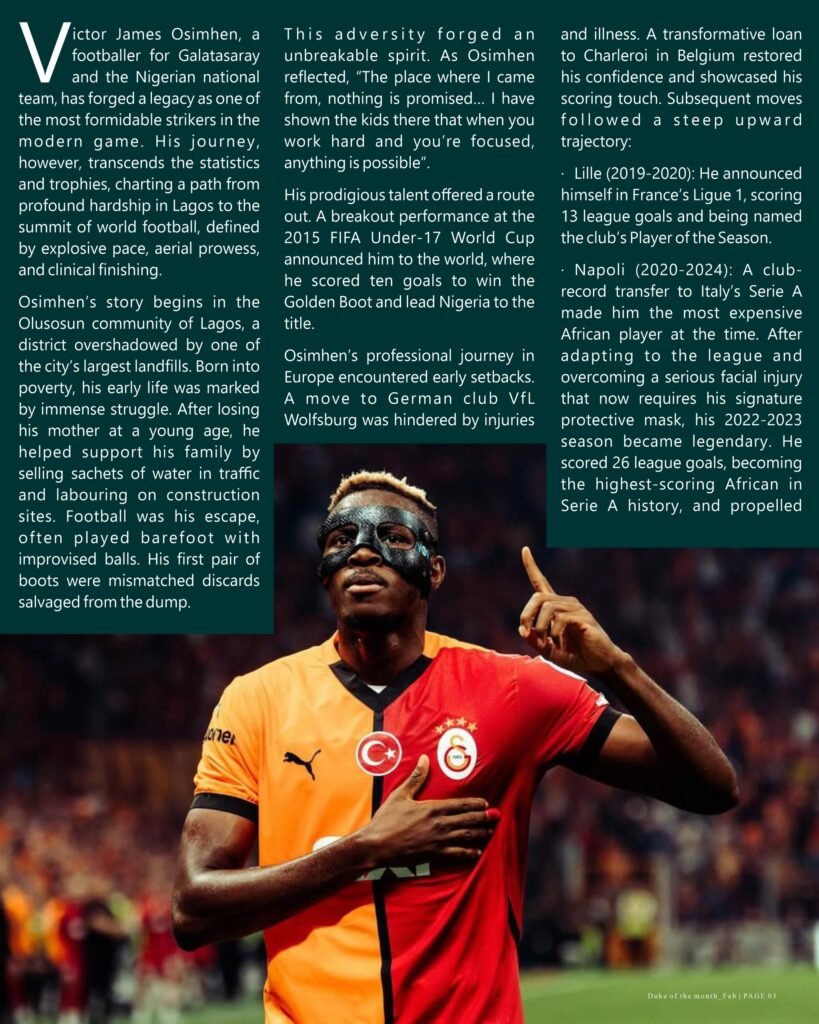
· Galatasaray (2024-Present): Following a celebrated spell in Naples, Osimhen moved to Turkey. In his debut 2024-2025 season, he was sensational, winning the domestic double and the Süper Lig Golden Boot after scoring 26 league goals—a record for a foreign player in a single Turkish season.
Osimhen’s achievements have cemented his status as a generational talent for Nigeria:
· In 2023, he was crowned the African Footballer of the Year, the first Nigerian to win the honour since 1999.
· He finished eighth in the 2023 Ballon d’Or ranking, the highest ever for a Nigerian.
· With the national team, he is the second-highest goalscorer in Nigeria’s history.
· In recognition of his contributions, he was awarded the national honour of Member of the Federal Republic (MFR) by the Nigerian president.
Victor Osimhen’s significance lies in the powerful synthesis of his humble origins and his world-class excellence. He is a player whose relentless drive was born in the “trenches” of Lagos and refined on Europe’s biggest stages.
From scouring landfills for football boots to having his likeness painted on murals in Naples beside Diego Maradona, his journey is a profound testament to resilience, hard work, and an unwavering will to succeed. He is not just a record-breaking striker, but a global icon of triumph over circumstance.