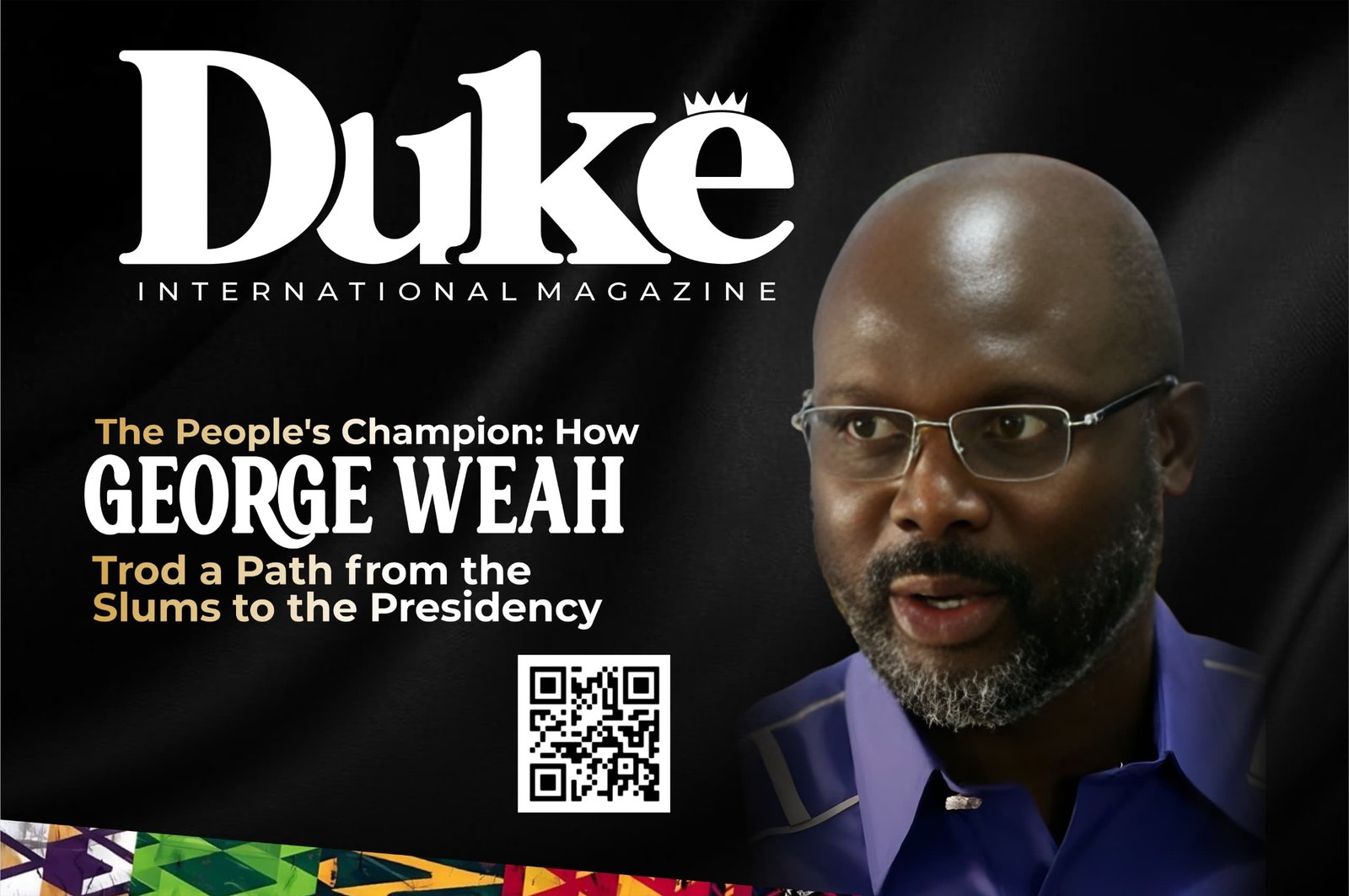
The journey of George Weah is one of the most extraordinary narratives of modern times, a life lived in three distinct acts that took him from the muddy fields of a Monrovia slum to the summit of world football and, finally, to the highest office in his native Liberia.
Born on the 1st of October 1966 in the Clara Town district of the capital, a area of reclaimed swamp beset by overcrowding and disease, Weah was sent to live with his grandmother after his parents separated. It was on these dusty streets that he first honed the skills that would one day captivate the globe, a raw talent that provided an escape route from a nation on the brink of decades of civil strife.
His professional career began in earnest with a move to Cameroon’s Tonnerre Yaoundé, but his life changed forever when he was spotted there by the great French manager Arsène Wenger. Wenger brought the 22-year-old striker to AS Monaco in 1988, launching him onto the European stage. A powerful and skilful forward with blistering pace, Weah’s reputation grew rapidly.
After winning the French Cup with Monaco in 1991, he transferred to Paris Saint-Germain, where he became one of the most feared attackers on the continent, leading his team to the league title and the semi-finals of the European Champions League.
Yet it was his move to the Italian giants AC Milan in 1995 that would cement his legendary status. In his first season at the San Siro, he helped the Rossoneri win the Italian scudetto and delivered a series of performances that would earn him an unprecedented personal treble: he was named African, European, and FIFA World Player of the Year, remaining the only player from the continent to have won the latter award.
One goal in particular, a majestic 80-yard solo run against Verona in 1996, became emblematic of his power and artistry. His later career included loan spells at Chelsea, where he won the FA Cup, and brief stints at Manchester City and Marseille before he retired in 2003.
Throughout his time abroad, Weah never forgot the country he had left behind. During Liberia’s ruinous civil wars, he often used his own money to fund the national team, the Lone Star, paying for kit and travel expenses to allow them to compete internationally. This deep and tangible connection to his people earned him the adoring nickname “King George” and cast him as a national hero.
Upon retiring, he turned his focus to politics, founding the Congress for Democratic Change and standing for president in 2005 . Despite winning the first round of voting, he was ultimately defeated by the Harvard-educated Ellen Johnson Sirleaf, a result his critics attributed to his lack of formal education and political experience.
Undeterred, Weah returned to the classroom, obtaining a high school diploma and later a university degree in business management from DeVry University in the United States. He ran unsuccessfully for the vice-presidency in 2011 before winning a Senate seat in 2014 with a resounding 78 per cent of the vote in Montserrado County.
The ultimate prize, however, came in 2017. On a platform promising jobs, education, and infrastructure, Weah defeated Vice President Joseph Boakai in a runoff election with more than 61 per cent of the vote, achieving the first democratic transfer of power from one elected leader to another in Liberia since 1944. His inauguration in January 2018 was a moment of profound significance for a nation still healing from years of conflict.
As president, his administration made some strides in constructing roads and healthcare facilities and introduced free tuition at public universities. Yet his tenure was also marked by persistent challenges.
Critics pointed to a perceived failure to deliver on his promises to the poorest, widespread corruption that appeared to worsen by some measures, and a struggling economy exacerbated by the Covid-19 pandemic. In 2023, he faced his old rival Boakai in a tightly contested election, ultimately losing by a narrow margin of approximately 49 to 51 per cent.
In his moment of defeat, however, George Weah secured perhaps his most important legacy. Rather than dispute the result, he made a gracious national broadcast, conceding the election and describing his opponent’s victory as a victory for all Liberians.
This act of statesmanship, placing the stability of his country above personal ambition, was hailed across the continent as a rare and powerful example of democratic maturity. From the slums of Clara Town to the presidency and beyond, George Weah’s life has been a testament to resilience. He may have fallen short of a second term, but by bowing out with dignity, he proved that the people’s champion could also be a statesman.