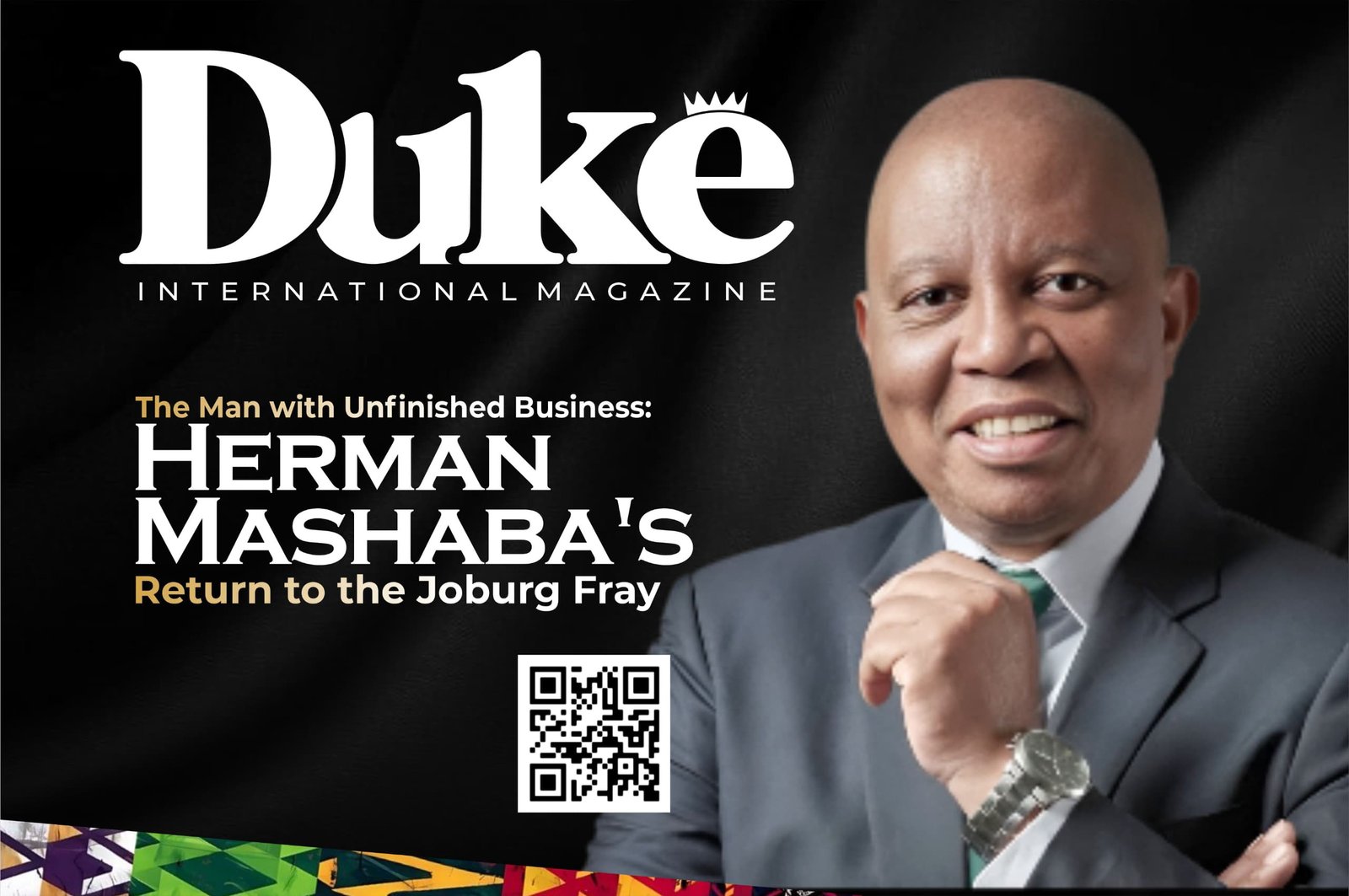
At 66 years of age, most successful business executives would be content to trade the cut and thrust of the office for a life of leisure. For Herman Mashaba, however, the opposite is true.
The self-made millionaire and current leader of the ActionSA party is once again throwing his hat into the political ring, aiming to reclaim the mayorship of Johannesburg in the upcoming local government elections. It is a move he frames not merely as an ambition, but as a duty—a chance to complete what he describes as his “unfinished business” with the city.
It is a far cry from the dusty streets of Ga-Ramotse in Hammanskraal where Mashaba was born in 1959. Losing his father at the age of two, he was raised in near-poverty by a mother who worked as a domestic worker in the distant city of Johannesburg. Education, he realised, was his only escape. After high school, a job as a clerk and later a salesman for SuperKurl hair products ignited his entrepreneurial spirit.
Recognising a gap in a segregated market, he partnered with a chemist and, with a 30,000 Rand loan from a friend, launched Black Like Me on Valentine’s Day in 1985. It was a risky venture during the height of apartheid, but it paid off spectacularly, turning him into one of South Africa’s most prominent black industrialists and earning him the nickname “Mr Black Like Me”.
Decades later, after building a multi-million-rand empire, Mashaba entered formal politics. His tenure as the Democratic Alliance (DA) mayor of Johannesburg from 2016 to 2019 was a period of relative stability often looked back upon with a sense of nostalgia by residents weary of the city’s current decline. His administration was credited with tackling corruption, reclaiming hijacked buildings, and driving investment.
However, his relationship with the DA leadership, particularly Helen Zille, soured dramatically. He resigned in 2019, blaming Zille for his removal and what he sees as a backroom deal that plunged the city into political chaos. “Zille is the only woman in the world who can pass a lie detector test,” he once quipped, “because she believes her lies”.
Today, the bad blood remains, but Mashaba insists his motivation runs deeper than personal scores. Now at the helm of ActionSA—the party he founded in 2020—he is painting a dire picture of a metropolis in crisis.
From his palatial home in an exclusive Sandton estate, the view is not one of comfort but of stark inequality. “How can I be comfortable knowing that down the road people are going hungry, people are going without water?” he asks, gesturing towards Alexandra, the sprawling township that stands as a symbol of South Africa’s economic divide.
Speaking to supporters in Soweto upon his nomination, Mashaba abandoned political pleasantries for pugilistic metaphors. “I stand before you today in a boxing ring,” he declared, “because this city needs a fighter who knows what it takes to win”. He describes a Johannesburg where potholes have become craters, sewage runs through the streets, and lawlessness has taken hold.
AaHis solution is a return to the disciplined, professional governance he believes he personifies. While acknowledging that South Africa has entered an era of coalition politics, he remains adamant that it is no excuse for failure. “It is up to me. I can control what I can control,” he stated recently.
Behind the fiery rhetoric, however, lies a man aware of the personal toll. His wife, Connie, with whom he shares a warm and supportive relationship, admits to a quiet resignation about his relentless drive.
“I’ve learned to accept it,” she confessed during a rare joint interview. “We live our lives—him in his political world and me in the business—and then we come together as a couple”. It is a dynamic that speaks to the consuming nature of his ambition.
Whether voters will welcome him back remains to be seen. His critics point to accusations of xenophobia over his tough stance on illegal immigration, a label his supporters reject.
Yet, as the 2026 local elections approach, Herman Mashaba is betting that his track record as a fixer, forged in the crucible of apartheid-era entrepreneurship and tested in the mayor’s office, is exactly what Johannesburg needs. For him, the fight is not just about winning a seat, but about proving that the city—and the man—can still be fixed.