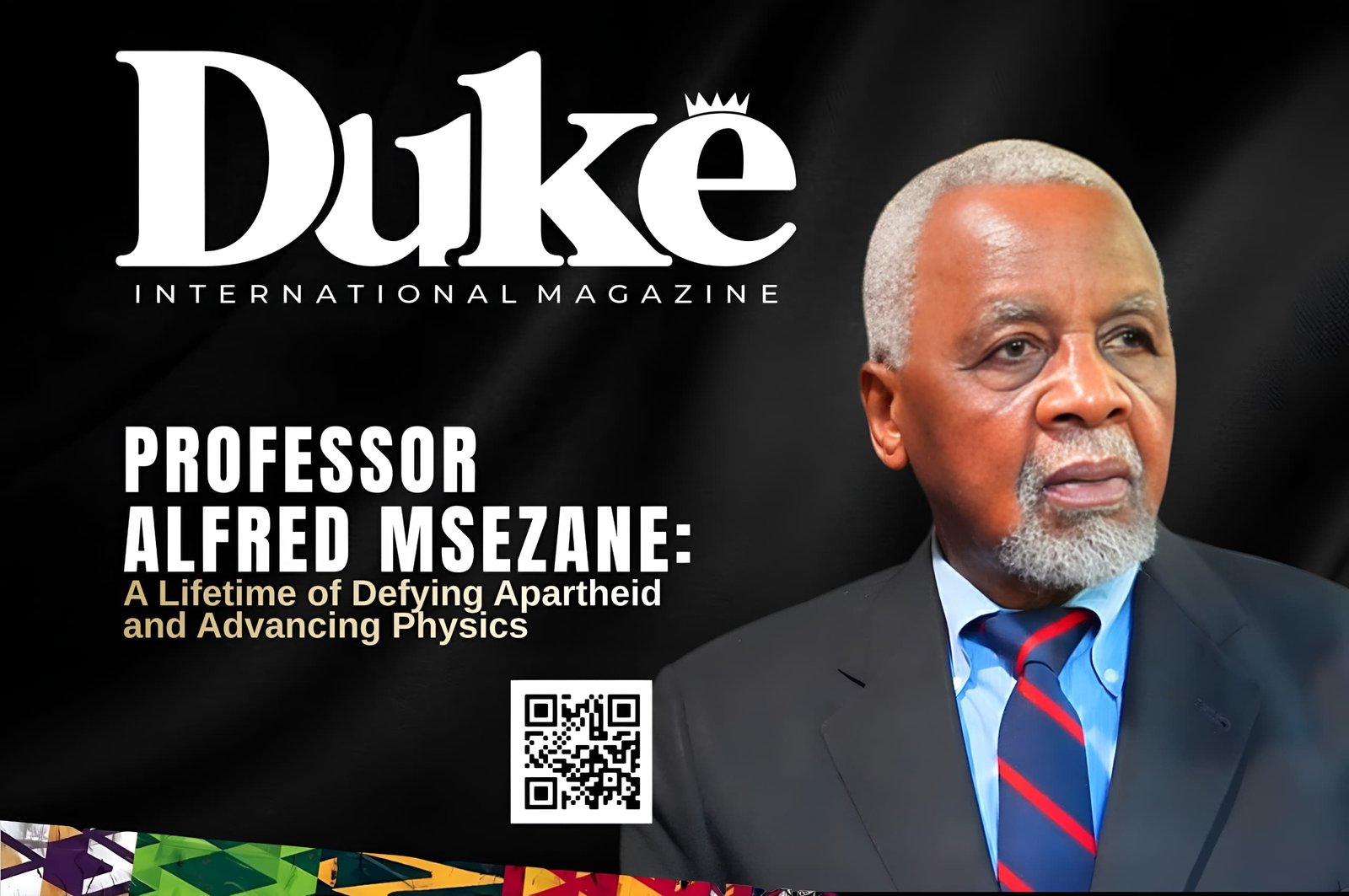
From herding sheep as a boy in rural South Africa to becoming a theoretical physicist of international renown, the life of Professor Alfred Zakhele Msezane is a testament to resilience, intellectual curiosity, and the transformative power of education.
Now in his late eighties, his recent recognition as a Black History Month Honoree in 2026 by the National Society of Black Physicists serves as the latest chapter in a story defined by triumph over adversity.
Born in Springs, South Africa, on 31 December 1938 into a Zulu family, Msezane’s early life was spent on a farm with his grandmother, where he worked as a shepherd. It was during his schooling that his aptitude for mathematics became clear, a path that was soon to be obstructed by the brutal strictures of the apartheid regime.
Barred from enrolling in white-only universities within his own country, he was driven to seek opportunity elsewhere. A Rotary International Scholarship enabled him to attend the University of Fort Hare, a historic institution for black African scholars, where he obtained his Bachelor of Science degree with honours in physics in 1965.
His academic journey then took him to Canada, where he earned a Master of Science from the University of Saskatchewan in 1968 and a Ph.D. in physics from the University of Western Ontario in 1973. His attempts to return home and complete his research were thwarted by the apartheid government’s policies, forcing him back to Canada and eventually leading him to the United States.
In the United States, Professor Msezane built a formidable career, holding positions at Georgia State University, the University of New Brunswick, and Louisiana State University before joining the faculty at Morehouse College in 1980. In 1983, he moved to Atlanta University, which later merged to become Clark Atlanta University.
There, he served as chair of the physics department and, in 1991, became the founding director of the Center for Theoretical Studies of Physical Systems, a hub for research established with significant funding from the National Science Foundation.
His research is remarkably broad and deeply influential, spanning theoretical atomic and molecular physics, condensed matter theory, and mathematical physics. He has published more than 480 scientific papers and delivered over 420 presentations at major conferences worldwide.
His pioneering work on electron-atom and electron-molecule scattering has significantly advanced the global understanding of fundamental atomic interactions. Notably, he has developed a fundamental theory to better understand the formation of negative ions in complex heavy systems, a process with applications in fields such as catalysis.
Over his long career, Professor Msezane’s contributions have been recognised with numerous prestigious honours. He was elected a Fellow of the American Physical Society and received its Edward A. Bouchet Award in 1999 for his contributions to physics and his work in advancing minority representation in science.
He is also a Fellow of the American Association for the Advancement of Science, the Royal Society of Chemistry, and the Institute of Physics in London. His alma mater, the University of Fort Hare, awarded him an honorary doctorate in 1998, and in March 2025, the University of Johannesburg conferred upon him another honorary doctorate, a poignant homecoming for a son of South Africa.
Reflecting on his life’s journey during that ceremony, Professor Msezane offered a metaphor drawn from his scientific work. “All of us exist in a deformable environment,” he explained. “When we move, the medium adjusts – sometimes resisting, sometimes opening new paths.
This environment can frustrate you, but it can also protect and guide you. Success comes from learning to navigate it”. It is a fitting description of a life navigated with exceptional skill, resilience, and purpose.