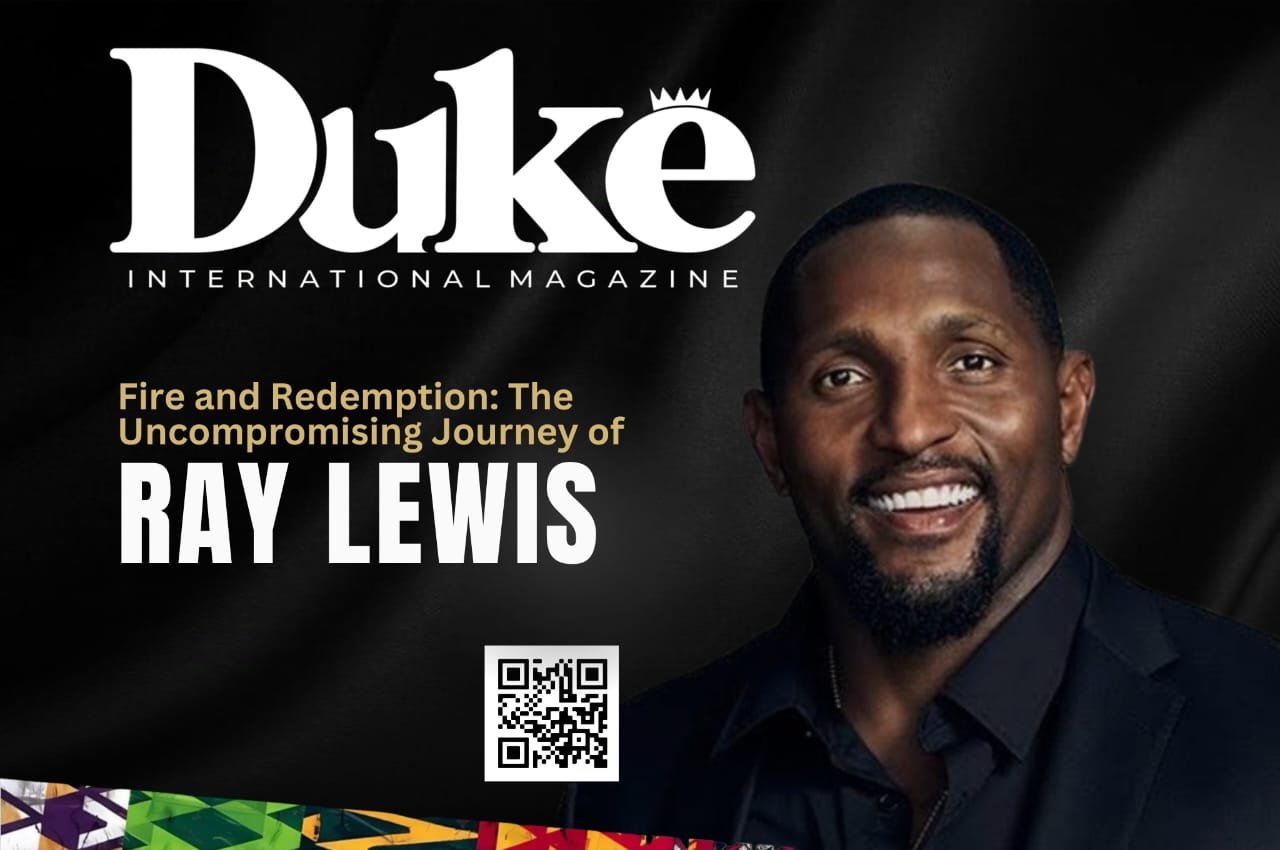
Ray Lewis did not merely play the position of middle linebacker; he redefined it with a ferocity and emotional intensity that transformed the Baltimore Ravens from an expansion team into a two-time Super Bowl champion.
His seventeen-year career, spent entirely in the purple and black of Baltimore, was a saga of profound adversity, athletic genius, and eventual redemption, culminating in a fairy-tale exit that cemented his legacy as one of the most formidable defensive players in the history of the National Football League.
Born on 15 May 1975 in Bartow, Florida, his entry into the world was marked by the very struggle that would forge his unbreakable will. His mother was just sixteen years old, and his father was largely absent, later incarcerated for drug-related offences.
As the eldest of five siblings raised by a single mother in Lakeland, Lewis was thrust into adulthood prematurely. The man his mother later married was, by Lewis’s account, abusive, fostering a deep resentment and a desperate need for protection within the young boy.
He later revealed that he began his rigorous regimen of push-ups using a deck of fifty-two playing cards, a daily ritual undertaken to build the strength necessary to defend his mother. This profound motivation would later explain his choice to wear the number fifty-two jersey throughout his professional career.
Football was not his first athletic love, nor his first path to discipline. At Kathleen High School, Lewis excelled as a wrestler, a sport that provided an unexpected and deeply personal connection. Upon discovering that his estranged biological father held several school wrestling records, Lewis channeled his anger into a focused mission.
He dedicated himself to the sport with such intensity that he not only broke every one of his father’s records, finishing with an impressive 89-10 record and winning a state championship, but he also forged a path to eventual reconciliation. On the football field, he was an All-American linebacker, his relatively modest stature overshadowed by his explosive instincts and relentless intensity.
His recruitment by the University of Miami was a harbinger of the confident, uncompromising leader he would become. During his visit to Florida State, a powerhouse program he had dreamed of joining, head coach Bobby Bowden was impressed. However, when defensive coordinator Chuck Amato suggested Lewis would need to learn behind future star Derrick Brooks, the young prospect responded without hesitation.
“No disrespect, sir,” he reportedly said, “but how do you know I’m not better than Derrick Brooks right now?” He then left the room. He chose Miami instead, where he became a two-time All-American, amassing 398 tackles over three dominant seasons and leaving coach Dennis Erickson to marvel at his singular impact.
Selected with the twenty-sixth overall pick in the 1996 draft by the newly-formed Ravens, Lewis was the franchise’s second-ever draft choice. He immediately became the emotional and statistical leader of the defence, leading the team in tackles as a rookie—a feat he would repeat an astonishing fourteen times over his career.
His playing style was a spectacle of controlled chaos; he was a missile wrapped in pads, capable of diagnosing a play in an instant and delivering hits that reverberated through the stadium. He led the league in tackles in 1997 and quickly became a perennial Pro Bowl selection.
Then, in the winter of 2000, his life and legacy were irrevocably shadowed. In the early morning hours following a post-Super Bowl party in an Atlanta nightclub, a fight erupted that left two men dead. Lewis and two companions were initially charged with murder.
In a deal with prosecutors, the murder charges against Lewis were dropped in exchange for his testimony against his co-defendants and a guilty plea to a single count of obstruction of justice, a misdemeanour for which he received one year of probation. The co-defendants were later acquitted on grounds of self-defence. Yet, for many, the stain of the accusation lingered, creating a cloud of controversy that would follow him for the rest of his career.
If the controversy threatened to define him, his response on the field in the ensuing season would redefine his legend. Upon returning to the Ravens for the 2000 season, Lewis delivered what many consider the greatest single-season performance by a linebacker. He was named the NFL Defensive Player of the Year, leading a defence that set a sixteen-game record for the fewest points allowed, a mark that stands as a testament to its sheer dominance.
The Ravens swept through the playoffs, and in Super Bowl XXXV, Lewis was the undeniable star. He recorded four passes defenced—an extraordinary number for a linebacker—and made numerous tackles in a 34-7 demolition of the New York Giants, earning him the Super Bowl Most Valuable Player award. He became the first linebacker to win the honour as a member of the winning team.
A second NFL Defensive Player of the Year award followed in 2003, a season in which he recorded six interceptions, further solidifying his reputation as a complete, three-down defender. As the years progressed, his body of work grew to monumental proportions.
He accumulated a staggering 2,059 combined tackles, including an NFL-record 1,568 solo stops, totals that many analysts believe may never be surpassed. He is the only player in league history to record at least forty sacks and thirty interceptions in a career, a testament to his rare versatility.
A torn triceps in 2012 threatened to end his career on a quiet, disappointing note. True to form, Lewis refused to let that happen. He announced that the upcoming playoffs would be his “last ride,” and his return galvanised the entire team.
The Ravens, underdogs on the road, defeated the Denver Broncos and the New England Patriots to reach the Super Bowl. In his final game, a narrow victory over the San Francisco 49ers in Super Bowl XLVII, Lewis walked off the field a two-time champion, having scripted one of the most dramatic conclusions in sports history.
Inducted into the Pro Football Hall of Fame in 2018, his first year of eligibility, Ray Lewis remains an iconic, if complex, figure. His post-playing career has been dedicated to philanthropy through the Ray Lewis 52 Foundation and to sports commentary, where his passionate oratory remains undiminished.
His former teammate, tight end Shannon Sharpe, perhaps best encapsulated his essence, declaring him the greatest leader in the history of team sports. Whether through the prism of his athletic brilliance or his tumultuous personal journey, Ray Lewis’s story is one of a man who rose from poverty and pain to achieve greatness, his path lit by an inextinguishable inner fire.