In this month’s edition of Duke International Magazine, we shine a spotlight on individuals who exemplify excellence within the Black community. Their dedication to uplifting others, fostering innovation, and making significant contributions across various fields serves as an inspiration to us all.
Join us as we celebrate their remarkable journeys and the lasting impact they continue to have in shaping a brighter future.
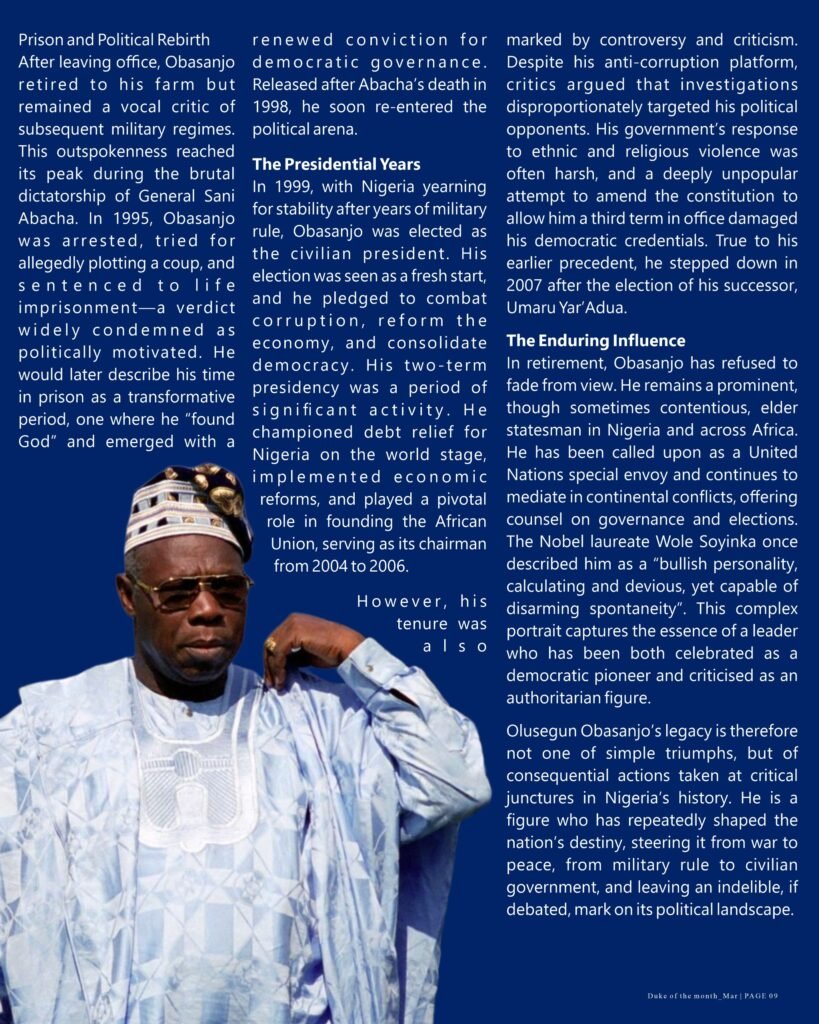
Olusegun Obasanjo: The Soldier Who Shaped Nigerian Democracy
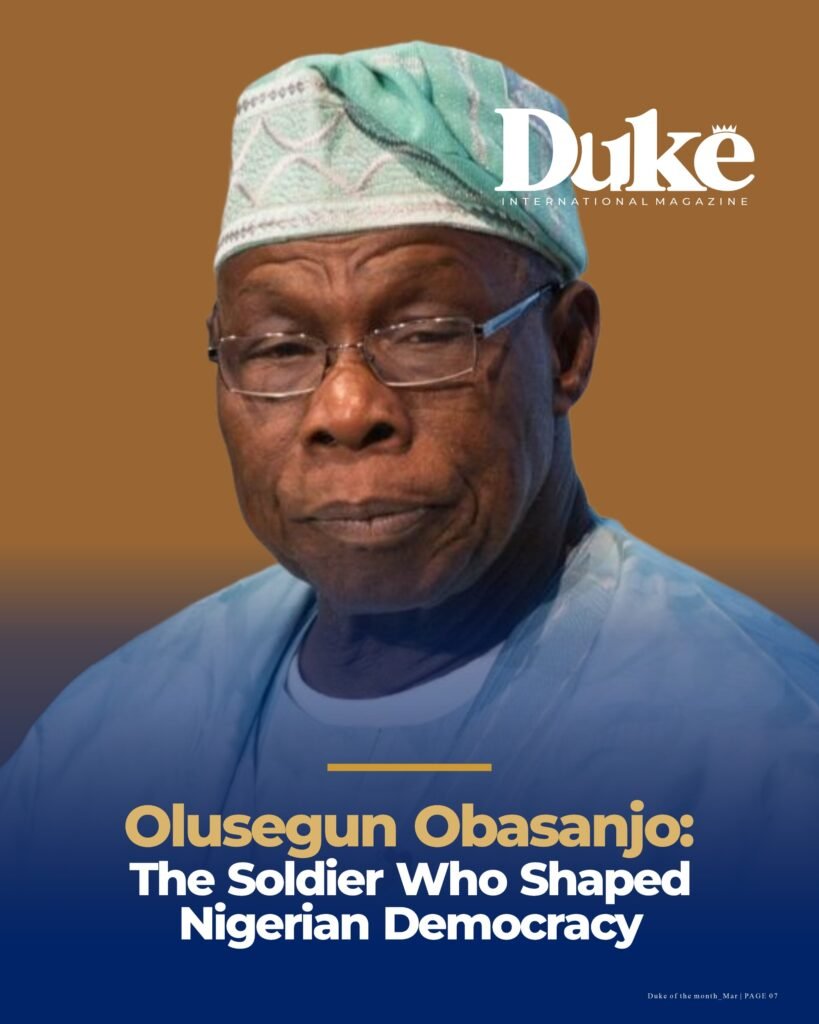
The story of modern Nigeria is, in many ways, reflected in the extraordinary life of Olusegun Obasanjo. A retired army general who became a civilian president, his career is marked by a profound contradiction: he is both a product of military rule and the architect of its most significant democratic transitions.
From reluctantly assuming power after an assassination to voluntarily surrendering it, and from a prison cell under a dictator to the presidential villa, his journey encapsulates the turbulent struggle for Nigeria’s democratic soul.
From Soldier to Statesman
Born in 1937 in south-western Nigeria, Obasanjo’s path to prominence began not through politics, but through the military. Unable to afford university, he joined the army in 1958, seeing it as an institution for advancement. His rise through the ranks was steady, and his defining military moment came during the Nigerian Civil War.
As the commander of the Third Marine Commando Division, he accepted the surrender of Biafran forces in January 1970, bringing the conflict to a close.His entry into governance was sudden and tragic.
Following the assassination of General Murtala Muhammed in 1976, Obasanjo, then his deputy, was thrust into the role of head of state. Despite leading a military government, he committed to a pre-existing pledge to restore civilian rule.
In 1979, he oversaw democratic elections and handed power to the newly elected President Shehu Shagari, becoming the first military head of state in Africa to voluntarily transfer authority to a civilian government. This act earned him immense international respect and established his reputation as a man of his word.

Prison and Political Rebirth
After leaving office, Obasanjo retired to his farm but remained a vocal critic of subsequent military regimes. This outspokenness reached its peak during the brutal dictatorship of General Sani Abacha.
In 1995, Obasanjo was arrested, tried for allegedly plotting a coup, and sentenced to life imprisonment—a verdict widely condemned as politically motivated. He would later describe his time in prison as a transformative period, one where he “found God” and emerged with a renewed conviction for democratic governance. Released after Abacha’s death in 1998, he soon re-entered the political arena.
The Presidential Years
In 1999, with Nigeria yearning for stability after years of military rule, Obasanjo was elected as the civilian president. His election was seen as a fresh start, and he pledged to combat corruption, reform the economy, and consolidate democracy. His two-term presidency was a period of significant activity.
He championed debt relief for Nigeria on the world stage, implemented economic reforms, and played a pivotal role in founding the African Union, serving as its chairman from 2004 to 2006.However, his tenure was also marked by controversy and criticism. Despite his anti-corruption platform, critics argued that investigations disproportionately targeted his political opponents.
His government’s response to ethnic and religious violence was often harsh, and a deeply unpopular attempt to amend the constitution to allow him a third term in office damaged his democratic credentials. True to his earlier precedent, he stepped down in 2007 after the election of his successor, Umaru Yar’Adua.
The Enduring Influence
In retirement, Obasanjo has refused to fade from view. He remains a prominent, though sometimes contentious, elder statesman in Nigeria and across Africa. He has been called upon as a United Nations special envoy and continues to mediate in continental conflicts, offering counsel on governance and elections.
The Nobel laureate Wole Soyinka once described him as a “bullish personality, calculating and devious, yet capable of disarming spontaneity”.
This complex portrait captures the essence of a leader who has been both celebrated as a democratic pioneer and criticised as an authoritarian figure.Olusegun Obasanjo’s legacy is therefore not one of simple triumphs, but of consequential actions taken at critical junctures in Nigeria’s history.
He is a figure who has repeatedly shaped the nation’s destiny, steering it from war to peace, from military rule to civilian government, and leaving an indelible, if debated, mark on its political landscape.
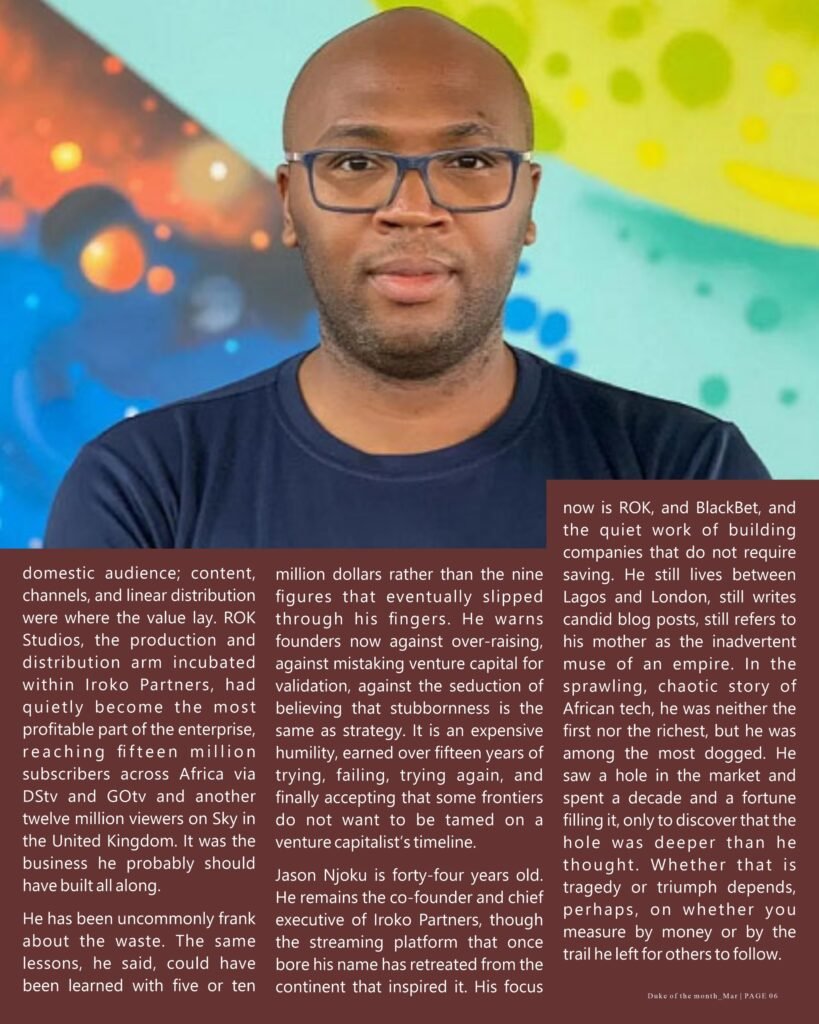
Jason Njoku’s Long Game: How One Man Put Nollywood On The World’s Screen
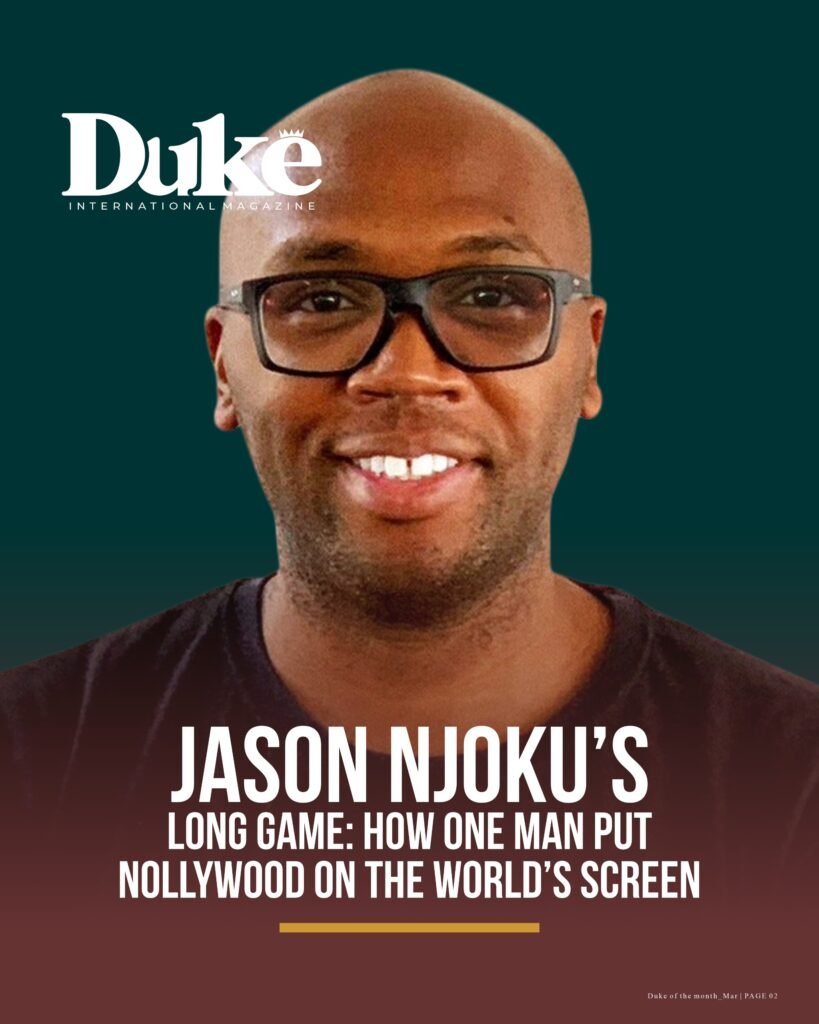
The morning light in a Deptford council flat does not, as a rule, herald the arrival of a millionaire. Yet it was there, in his mother’s house, that Jason Chukwuma Njoku sat at the age of thirty and watched the woman who had raised him alone switch channels from British soap operas to the vibrant, melodramatic world of Nollywood. He asked her where she found the new releases. She asked him to locate them online.
It was a simple request from a mother to a son, and it should have been simple to fulfil. Instead, Njoku found nothing. No streaming service, no digital library, no legal archive for the second-largest film industry on earth. For the internet geek who had spent five years failing upwards through ten collapsed businesses, it was not a problem. It was an invitation.
Born in London to Nigerian parents in December 1980, Njoku spent his early years in the working-class streets of Deptford under the watch of his mother, a National Health Service employee who raised four children alone. When he was twelve, she sent him to live in a Nigerian village to understand his roots; three years later he returned to the United Kingdom to complete his A-Levels and eventually read Chemistry at the University of Manchester.
He graduated in 2005 with a 2:1 and the distinct feeling that the laboratory was not for him. Brash Magazine, a student publication, consumed the next three years of his life before it folded. A blog network collapsed. A T‑shirt business went nowhere. A web design company joined the pile. By 2010, he had moved back into his childhood bedroom, humbled, penniless, and quietly certain that his instincts were not the problem—only his timing.
The discovery that Nollywood had no digital home became the eleventh attempt. With capital supplied by his university friend Bastian Gotter, Njoku flew to Lagos and set up base in a two-bedroom apartment in Festac Town. He began buying online licences for Nigerian films, an administrative slog that required persuading sceptical producers that digital rights held value.

He and Gotter launched NollywoodLove, a YouTube channel, and watched it turn profitable within two months. Then came the TechCrunch article, the attention of Tiger Global, and a Series A investment of three million dollars.
In December 2011, iROKOtv went live as a standalone platform, and suddenly a million visitors a month from 178 countries were streaming Nollywood from Lagos to Malaysia, from London to Hungary. Forbes Africa named him one of its ten young African millionaires to watch. The boy from Deptford had built the so-called Netflix of Africa.
Success, however, came with its own peculiar exhaustion. Broadband penetration across sub‑Saharan Africa remained stubbornly low, and the cost of data made continuous streaming a luxury for the few rather than a utility for the many. Njoku pivoted the company toward Android mobile applications in 2015, but the fundamental arithmetic of the Nigerian market would not balance. Global competitors arrived: Netflix, Amazon, Showmax.
They carried balance sheets that made his own venture capital hauls—eventually totalling forty million dollars—look like petty cash. Yet he kept investing, kept doubling down, kept believing that the market would catch up to his ambition. In retrospect, he would describe the decade that followed as neither winning nor losing, but operating in full survival mode under the toughest conditions possible.
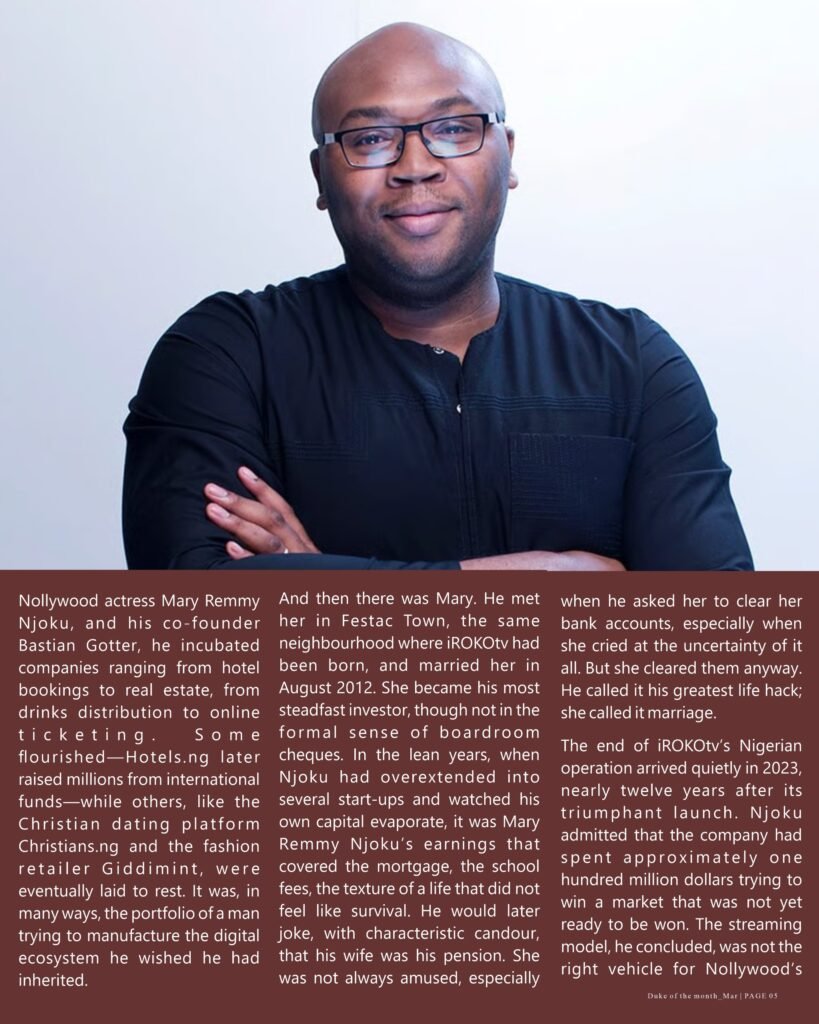
During those years, Njoku diversified. He launched Spark in 2013, a two-million-dollar investment vehicle designed to catalyse Lagos-based internet start-ups. With his wife, the Nollywood actress Mary Remmy Njoku, and his co-founder Bastian Gotter, he incubated companies ranging from hotel bookings to real estate, from drinks distribution to online ticketing.

Some flourished—Hotels.ng later raised millions from international funds—while others, like the Christian dating platform Christians.ng and the fashion retailer Giddimint, were eventually laid to rest. It was, in many ways, the portfolio of a man trying to manufacture the digital ecosystem he wished he had inherited.
And then there was Mary. He met her in Festac Town, the same neighbourhood where iROKOtv had been born, and married her in August 2012. She became his most steadfast investor, though not in the formal sense of boardroom cheques. In the lean years, when Njoku had overextended into several start-ups and watched his own capital evaporate, it was Mary Remmy Njoku’s earnings that covered the mortgage, the school fees, the texture of a life that did not feel like survival.
He would later joke, with characteristic candour, that his wife was his pension. She was not always amused, especially when he asked her to clear her bank accounts, especially when she cried at the uncertainty of it all. But she cleared them anyway. He called it his greatest life hack; she called it marriage.
The end of iROKOtv’s Nigerian operation arrived quietly in 2023, nearly twelve years after its triumphant launch. Njoku admitted that the company had spent approximately one hundred million dollars trying to win a market that was not yet ready to be won.
The streaming model, he concluded, was not the right vehicle for Nollywood’s domestic audience; content, channels, and linear distribution were where the value lay. ROK Studios, the production and distribution arm incubated within Iroko Partners, had quietly become the most profitable part of the enterprise, reaching fifteen million subscribers across Africa via DStv and GOtv and another twelve million viewers on Sky in the United Kingdom.
It was the business he probably should have built all along. He has been uncommonly frank about the waste. The same lessons, he said, could have been learned with five or ten million dollars rather than the nine figures that eventually slipped through his fingers.
He warns founders now against over-raising, against mistaking venture capital for validation, against the seduction of believing that stubbornness is the same as strategy. It is an expensive humility, earned over fifteen years of trying, failing, trying again, and finally accepting that some frontiers do not want to be tamed on a venture capitalist’s timeline.
Jason Njoku is forty-four years old. He remains the co-founder and chief executive of Iroko Partners, though the streaming platform that once bore his name has retreated from the continent that inspired it. His focus now is ROK, and BlackBet, and the quiet work of building companies that do not require saving. He still lives between Lagos and London, still writes candid blog posts, still refers to his mother as the inadvertent muse of an empire.
In the sprawling, chaotic story of African tech, he was neither the first nor the richest, but he was among the most dogged. He saw a hole in the market and spent a decade and a fortune filling it, only to discover that the hole was deeper than he thought. Whether that is tragedy or triumph depends, perhaps, on whether you measure by money or by the trail he left for others to follow.