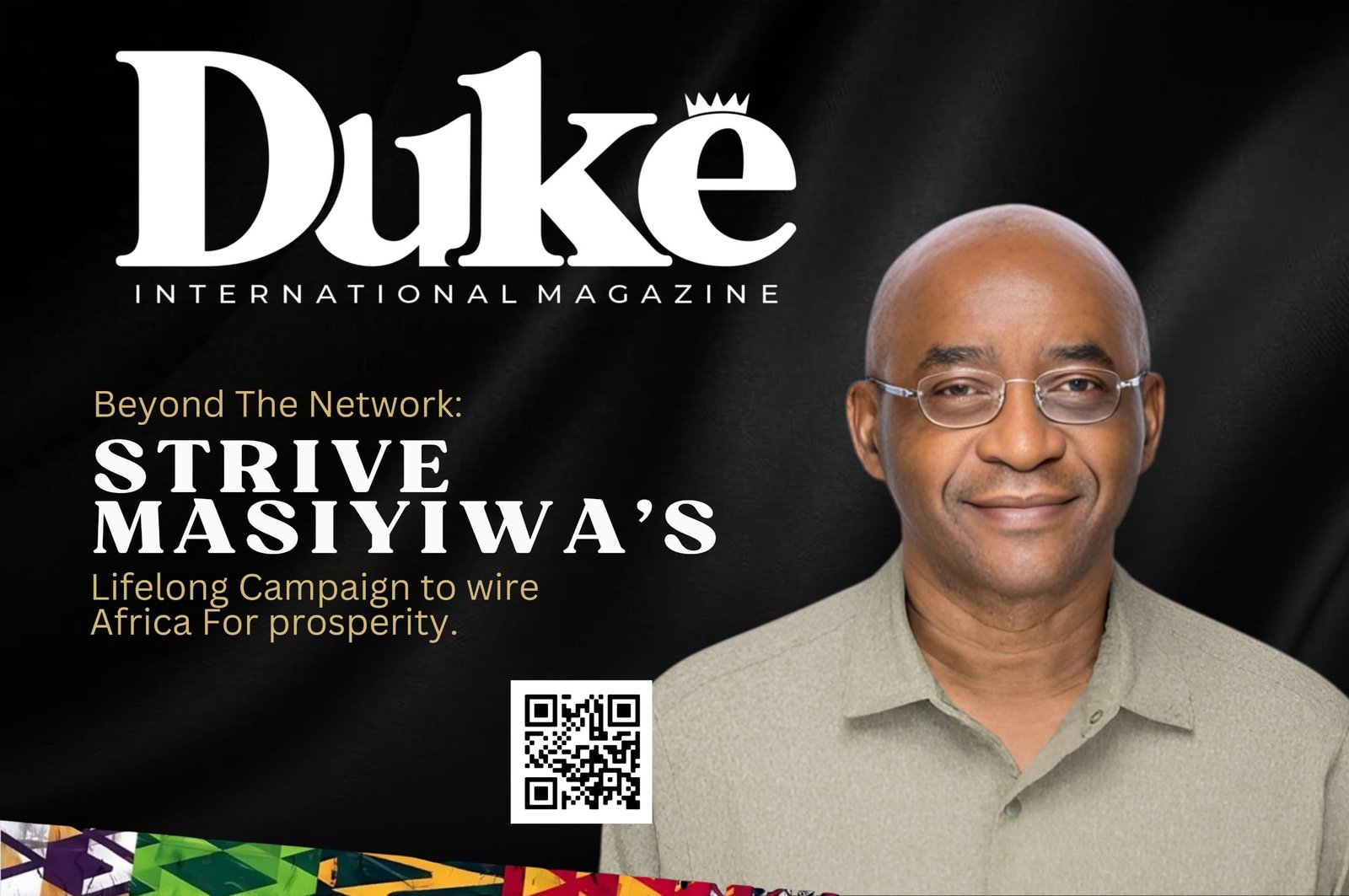
From a historic legal battle to birth a telecoms giant, to a new philanthropic war on poverty, the Zimbabwean billionaire remains fixed on a singular mission: connecting a continent to its own potential.
In the narrative of modern Africa’s economic awakening, certain names are synonymous with seminal change. Among them is Strive Masiyiwa, the Zimbabwean founder of the international telecommunications group Econet. Yet, to define Masiyiwa solely by the vast mobile networks he built would be to miss the profound depth of his ambition. His career reveals a consistent, evolving mission: to act as a master architect of connection, first through fibre and frequency, and now through finance and philanthropy, in a relentless campaign for African prosperity.
Masiyiwa’s origin story is etched into the lore of African business. In the early 1990s, his company, then called Econet Wireless, fought a five-year constitutional legal battle against the Zimbabwean government’s telecommunications monopoly. His eventual victory was more than a corporate milestone; it was a precedent, proving that a determined African entrepreneur could break state monopolies and catalyse an industry.
The company he built, now a diversified global group with operations and investments in telecommunications, technology, renewable energy, and fintech across Africa, Europe, and the Americas, stands as a testament to that tenacity.
“Infrastructure is the skeleton upon which the body economic grows,” Masiyiwa stated in a recent address to the African Development Bank. “We fought to prove that the digital artery was critical. But an artery is useless if the blood—the opportunity, the education, the capital—does not flow through it to every part of the body.”
This philosophy of holistic development drives his most consequential work beyond Econet. Through the Higherlife Foundation, established with his wife Tsitsi, Masiyiwa has funded the education of over 350,000 orphans and vulnerable children across Africa.
Furthermore, his Founder’s Pledge commits the majority of his wealth to philanthropic causes, placing him within the Giving Pledge league of global philanthropists.
However, his current focus represents a strategic escalation of his core mission. As the founder and chair of the African Prosperity Fund, Masiyiwa is targeting what he terms “the hardwiring of the African Continental Free Trade Area.” He argues that political agreements alone will not create a single continental market; it requires intentional, private sector-led investment in the cross-border roads, rail, digital infrastructure, and trade facilitation that make commerce possible.
“We must move from agreements on paper to trucks on the road, data across borders, and payments across currencies,” he explained at a recent summit in Kigali. “The African Prosperity Fund is about de-risking and catalysing the projects that physically and digitally connect our nations. True sovereignty will come from trade with one another.”
His stance during the coronavirus pandemic underscored this hands-on, continent-first approach. He led the African Union’s vaccine acquisition task team, negotiating directly with manufacturers and helping to secure over 400 million doses for the continent when richer nations were hoarding supply. It was a stark demonstration of pragmatic Pan-Africanism.
To his observers, Masiyiwa cuts a figure of disciplined conviction. A devout Christian who does not drink or smoke, his personal austerity contrasts with the scale of his ambition. He is a prolific user of social media, particularly WhatsApp, where he shares his thoughts on leadership, current affairs, and faith directly with a vast audience, bypassing traditional media to connect and mentor.
In a landscape often characterised by short-termism, Strive Masiyiwa’s vision is stubbornly long-term. He is building for a century, not a quarter. From the courtrooms of Harare to the boardrooms of the world, his narrative has evolved from that of a disruptive entrepreneur to a statecraft-influencing philanthropist and a passionate advocate for intra-African unity.
His legacy, still in active construction, is not merely in the millions of mobile phones connected to his networks, but in the enduring architecture of connection—of people, markets, and ideas—that he is determined to leave as the foundation for Africa’s transformed future.